334 posters, 125 sessions, 831 authors, 236 institutions
ePostersLive by SciGen Technologies S.A. All rights reserved.
78th Annual PostGraduate Assembly in Anesthesiology (PGA78) 2024
December 6 - 9, 2024 | New York City

3010
Our successful ECCO2R Applications in Patients with Hypercapnic Respiratory Failure
Poster Presenter
Part of Topic
Our Successful ECCO2R Applications in Patients with Hypercapnic Respiratory Failure
Introduction/Hypothesis: Extracorporeal carbon dioxide removal (ECCO2R) is a form of extracorporeal life support (ECLS) largely aimed at removing carbon dioxide in patients with acute respiratory failure.. One of the most important advantages of using ECCO2R is that it allows the application of Lung protective ventilation support. The ECCO2R is used with its own device. ECCO2R can be integrated into standard continuous renal replacement therapy (CRRT) circuits (ECCO2R-CRRT). Discussions on the concepts of ECCO2R and blood flow rates continue. However, it may not be appropriate to place a catheter suitable for this flow rate for all patients. ECCO2R technology is now available and used in Turkey In this presentation, we aimed to present the use of ECCO2R in the treatment of hypercapnic respiratory failure with acute renal failure in two of our patients.
Extracorporeal carbon dioxide removal (ECCO2R) is a form of extracorporeal life support (ECLS) largely aimed at Removing Carbon Dioxide in patients with acute respiratory failure.One of the most important advantages of using ECCO2R is that it allows the application of Lung protective ventilation support. A male patient developed acute hypercapnic acidosis due to high CO2 values that could not be reduced with mechanical ventilation due to ARDS. ECCO2R was started due to high CO2 values that could not be controlled with MV. CO2 decreased to acceptable levels with ECCO22. In this case, we were able to manage very high CO2 values that could not be controlled with ECCO2R. We think that ECCO22 is useful in treatment in such cases. Our other patient was male and similarly, ECCO2R was started
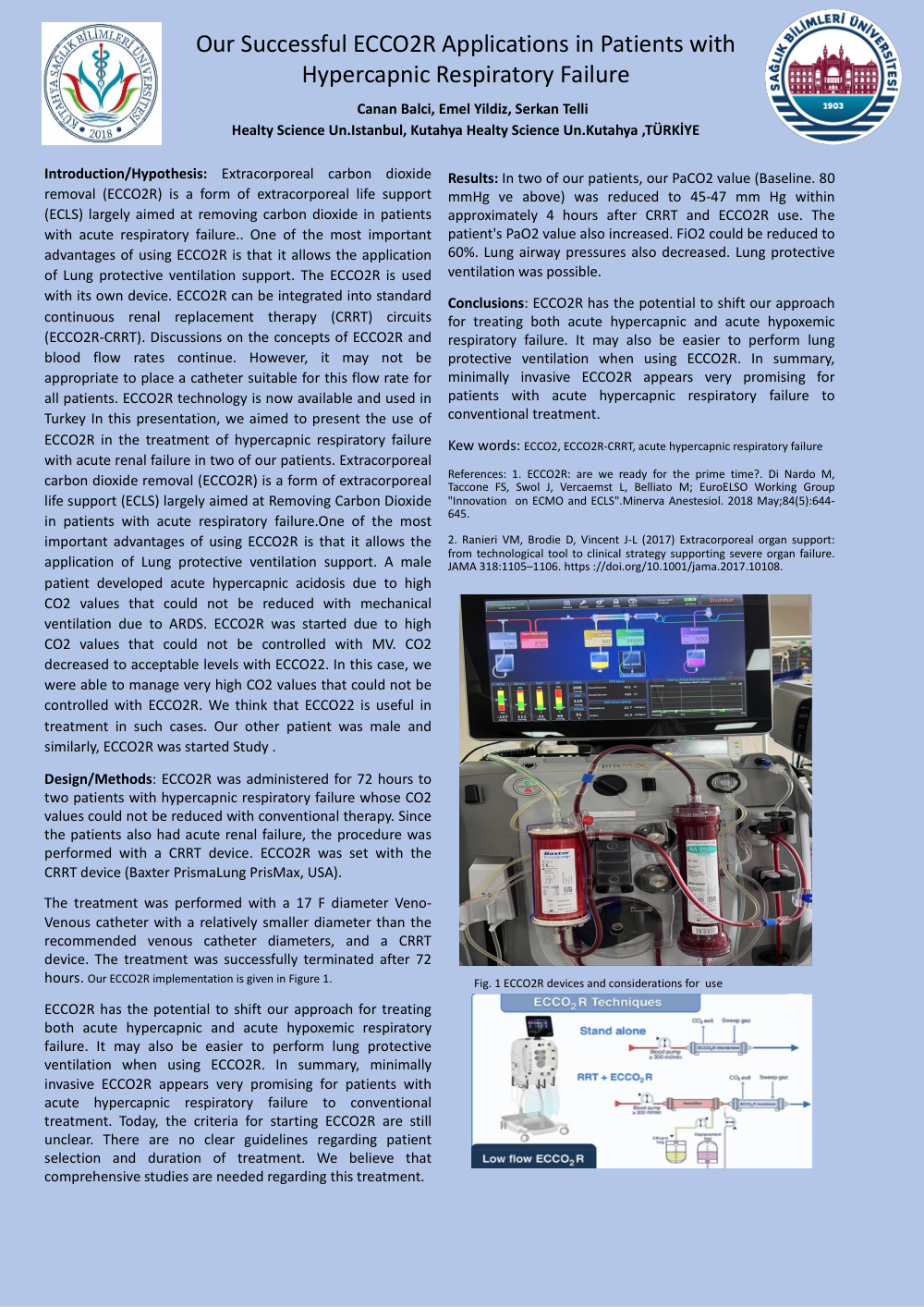
Study Design/Methods: ECCO2R was administered for 72 hours to two patients with hypercapnic respiratory failure whose CO2 values could not be reduced with conventional therapy. Since the patients also had acute renal failure, the procedure was performed with a CRRT device. ECCO2R was set with the CRRT device (Baxter PrismaLung PrisMax, USA). The treatment was performed with a 17 F diameter Veno-Venous catheter with a relatively smaller diameter than the recommended venous catheter diameters, and a CRRT device. The treatment was successfully terminated after 72 hours.
ECCO2R has the potential to shift our approach for treating both acute hypercapnic and acute hypoxemic respiratory failure. It may also be easier to perform lung protective ventilation when using ECCO2R. In summary, minimally invasive ECCO2R appears very promising for patients with acute hypercapnic respiratory failure to conventional treatment.
Today, the criteria for starting ECCO2R are still unclear. There are no clear guidelines regarding patient selection and duration of treatment. We believe that comprehensive studies are needed regarding this treatment.
Results In two of our patients, our PaCO2 value (Baseline. 80 mmHg ve above) was reduced to 45-47 mm Hg within approximately 4 hours after CRRT and ECCO2R use. The patient's PaO2 value also increased. FiO2 could be reduced to 60%. Lung airway pressures also decreased. Lung protective ventilation was possible. Discussions/Conclusions: ECCO2R has the potential to shift our approach for treating both acute hypercapnic and acute hypoxemic respiratory failure. It may also be easier to perform lung protective ventilation when using ECCO2R.
In summary, minimally invasive ECCO2R appears very promising for patients with acute hypercapnic respiratory failure to conventional treatment.
References 1. 1. ECCO2R: are we ready for the prime time?. Di Nardo M, Taccone FS, Swol J, Vercaemst L, Belliato M; EuroELSO Working Group "Innovation on ECMO and ECLS".Minerva Anestesiol. 2018 May;84(5):644-645.