334 posters, 125 sessions, 831 authors, 236 institutions
ePostersLive by SciGen Technologies S.A. All rights reserved.
78th Annual PostGraduate Assembly in Anesthesiology (PGA78) 2024
December 6 - 9, 2024 | New York City

3009
The use of propofol and ketamine (PK) for office-based IV sedation of a pediatric dental patient with methylenetetrahydrofolate reductase (MTHFR) deficiency.
Poster Presenter
Authors
Affiliations
Part of Topic
Case Report: The use of propofol and ketamine for intravenous sedation
of a pediatric dental patient with MTHFR deficiency
Abstract
•Review of the anesthetic management of a pediatric dental patient with methylenetetrahydrofolate reductase (MTHFR) deficiency
•MTHFR deficiency is a contraindication for the use of nitrous oxide (N2O)
•In this case, propofol and ketamine were utilized together to safely deliver intravenous (IV) sedation
Introduction
•Methylenetetrahydrofolate reductase (MTHFR): an enzyme that breaks down the amino acid homocysteine (HCY)
•Patients with MTHFR deficiency are unable to metabolize HCY and subsequently develop elevated blood levels of HCY
•Complications include seizures, intellectual disability, and venous thrombosis
•Labs reveal homocystinuria, hyperhomocysteinemia, low serum methionine level, and normal vitamin B12 level
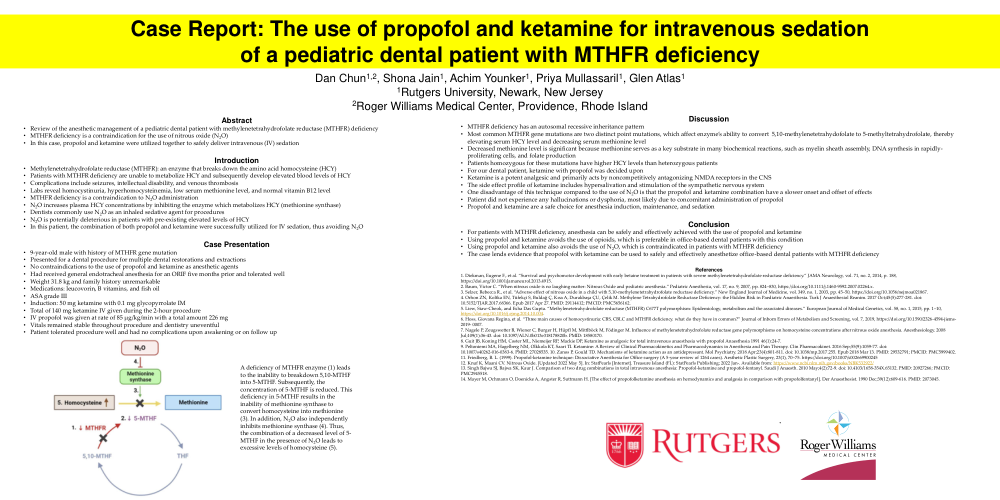
•MTHFR deficiency is a contraindication to N2O administration
•N2O increases plasma HCY concentrations by inhibiting the enzyme which metabolizes HCY (methionine synthase)
•Dentists commonly use N2O as an inhaled sedative agent for procedures
•N2O is potentially deleterious in patients with pre-existing elevated levels of HCY
•In this patient, the combination of both propofol and ketamine were successfully utilized for IV sedation, thus avoiding N2O
Case Presentation
•9-year-old male with history of MTHFR gene mutation
•Presented for a dental procedure for multiple dental restorations and extractions
•No contraindications to the use of propofol and ketamine as anesthetic agents
•Had received general endotracheal anesthesia for an ORIF five months prior and tolerated well
•Weight 31.8 kg and family history unremarkable
•Medications: leucovorin, B vitamins, and fish oil
•ASA grade III
•Induction: 50 mg ketamine with 0.1 mg glycopyrrolate IM
•Total of 140 mg ketamine IV given during the 2-hour procedure
•IV propofol was given at rate of 85 μg/kg/min with a total amount 226 mg
•Vitals remained stable throughout procedure and dentistry uneventful
•Patient tolerated procedure well and had no complications upon awakening or on follow up
Discussion
•MTHFR deficiency has an autosomal recessive inheritance pattern
•Most common MTHFR gene mutations are two distinct point mutations, which affect enzyme’s ability to convert 5,10-methylenetetrahydofolate to 5-methyltetrahydrofolate, thereby elevating serum HCY level and decreasing serum methionine level
•Decreased methionine level is significant because methionine serves as a key substrate in many biochemical reactions, such as myelin sheath assembly, DNA synthesis in rapidly-proliferating cells, and folate production
•Patients homozygous for these mutations have higher HCY levels than heterozygous patients
•For our dental patient, ketamine with propofol was decided upon
•Ketamine is a potent analgesic and primarily acts by noncompetitively antagonizing NMDA receptors in the CNS
•The side effect profile of ketamine includes hypersalivation and stimulation of the sympathetic nervous system
•One disadvantage of this technique compared to the use of N2O is that the propofol and ketamine combination have a slower onset and offset of effects
•Patient did not experience any hallucinations or dysphoria, most likely due to concomitant administration of propofol
•Propofol and ketamine are a safe choice for anesthesia induction, maintenance, and sedation
Conclusion
•For patients with MTHFR deficiency, anesthesia can be safely and effectively achieved with the use of propofol and ketamine
•Using propofol and ketamine avoids the use of opioids, which is preferable in office-based dental patients with this condition
•Using propofol and ketamine also avoids the use of N2O, which is contraindicated in patients with MTHFR deficiency
•The case lends evidence that propofol with ketamine can be used to safely and effectively anesthetize office-based dental patients with MTHFR deficiency