334 posters, 125 sessions, 831 authors, 236 institutions
ePostersLive by SciGen Technologies S.A. All rights reserved.
78th Annual PostGraduate Assembly in Anesthesiology (PGA78) 2024
December 6 - 9, 2024 | New York City

3126
ACEi-ng Difficult Airway Management in Patients Afflicted with Bradykinin Mediated Angioedema
Poster Presenter
Authors
Affiliations
Part of Topic
ACEi-ng Difficult Airway Management in Patients Afflicted with Bradykinin Mediated Angioedema
Edward Chen, MS4 | David Livingstone MD.
Bronxcare Health System Department of Anesthesiology
Introduction
Angioedema: Swelling of soft tissue due to loss of vascular integrity, leading to fluid leakage into interstitial spaces.
Histamine vs. Bradykinin mediated: Two main types; histamine-mediated (hypersensitivity-like) responds to antihistamines/epinephrine, while bradykinin-mediated is resistant to such treatments.
Bradykinin-mediated angioedema: Caused by either hereditary loss of C1 esterase inhibitor or drug-induced inhibition of bradykinin metabolism.
ACE inhibitors (ACEis): Common drug cause of bradykinin-mediated angioedema, responsible for 30% of cases, with incidence of 0.1-0.7%, often within first few months of use.
Airway compromise: Bradykinin-induced angioedema with airway involvement is a medical emergency, requiring urgent airway management, intubation, and treatments like fresh frozen plasma or icatibant.
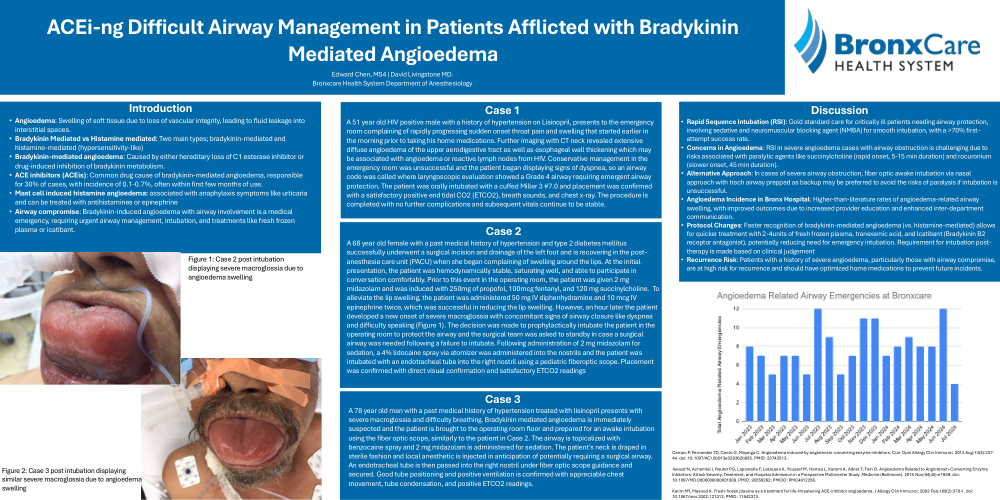
3 Cases: 3 similarly presenting cases at Bronxcare hospital are displayed here with Case 1 demonstrating improper high-risk management and Cases 2 and 3 demonstrating proper and safe practices
Figure 1: Case 2 post intubation displaying severe macroglossia due to angioedema swelling
Figure 2: Case 3 post intubation displaying similar severe macroglossia due to angioedema swelling
Case 1
A 51 year old male with a history of hypertension on Lisinopril, presents to the emergency room complaining of rapidly progressing sudden onset throat pain and swelling that started earlier in the morning prior to taking his home medications. Conservative management in the emergency room was unsuccessful and the patient began displaying signs of dyspnea, so an airway code was called where laryngoscopic evaluation showed a Cormack-Lehane Grade 4 airway as well as a Mallampati score of 3. Further imaging with CT neck revealed extensive diffuse angioedema of the upper aerodigestive tract as well as esophageal wall thickening which may be associated with angioedema or reactive lymph nodes from HIV. The patient was orally intubated with a cuffed Miller 3 #7.0 and placement was confirmed with EtCO2 breath sounds and chest x-ray. The procedure is completed with no further complications and subsequent vitals continue to be stable.
Case 2
A 68 year old female with a past medical history of hypertension and type 2 diabetes mellitus successfully underwent a surgical incision and drainage of the left foot and is recovering in the post-anesthesia care unit (PACU) when she began complaining of swelling around the lips. At the initial presentation, the patient was hemodynamically stable, saturating well, and able to participate in conversation comfortably. Prior to this event in the operating room, the patient was given 2 mg midazolam and was induced with 250mg of propofol, 100mcg fentanyl, and 120 mg succinylcholine. To alleviate the lip swelling, the patient was administered 50 mg IV diphenhydramine and 10 mcg IV epinephrine twice, which was successful in reducing the lip swelling. However, an hour later the patient developed a new onset of severe macroglossia with concomitant signs of airway closure like dyspnea and difficulty speaking (Figure 2). The decision was made to prophylactically intubate the patient in the operating room to protect the airway and the surgical team was asked to standby in case a surgical airway was needed following a failure to intubate. Following administration of 2 mg midazolam for sedation, a 4% lidocaine swish and swallow and benzocaine spray were administered and the patient was intubated with an endotracheal tube into the right nostril using a pediatric fiberoptic scope. Placement was confirmed with visual signs and a satisfactory positive end tidal CO2 (ETCO2) reading
Case 3
A 78 year old man with a past medical history of hypertension treated with lisinopril presents with severe macroglossia and difficulty breathing. Bradykinin mediated angioedema is immediately suspected and the patient is brought to the operating room floor and prepared for an awake intubation using the fiber optic scope, similarly to the patient in Case 2. The airway is topicalized with benzocaine spray and 2 mg midazolam is administered for sedation. The patient is draped in sterile fashion and local anesthetic is injected at the surgical site, with the surgical team standing by ready to establish a tracheal airway in the event of intubation failure. An endotracheal tube is then passed into the right nostril under fiber optic scope guidance and secured. Good tube positioning and positive ventilation is confirmed with appreciable chest movement, tube condensation, and positive ETCO2 readings.
Discussion
Rapid Sequence Intubation (RSI): Standard care for critically ill patients needing airway protection, involving sedative and neuromuscular blocking agent (NMBA) for smooth intubation, with a >70% first-attempt success rate.
Concerns in Angioedema: RSI in severe angioedema cases with airway obstruction is challenging due to risks associated with paralytic agents like succinylcholine (rapid onset, 5-15 min duration) and rocuronium (slower onset, 45 min duration).
Alternative Approach: In cases of severe airway obstruction, fiber optic awake intubation may be preferred to avoid the risks of paralysis if intubation is unsuccessful.
Angioedema Incidence in Bronx Hospital: Higher-than-expected rates of angioedema-related airway swelling, with improved outcomes due to increased provider education and enhanced inter-department communication.
Protocol Changes: Faster recognition of bradykinin-mediated angioedema (vs. histamine-mediated) allows for quicker treatment with fresh frozen plasma and tranexamic acid, reducing need for emergency intubation.
Bradykinin-mediated Angioedema Treatment: Fresh frozen plasma and tranexamic acid help break down bradykinin, rapidly reducing airway swelling. Icatibant (bradykinin B2 receptor antagonist) is another treatment option.
Recurrence Risk: Patients with a history of severe angioedema, particularly those with airway compromise, are at high risk for recurrence and should have optimized home medications to prevent future incidents.
Campo P, Fernandez TD, Canto G, Mayorga C. Angioedema induced by angiotensin-converting enzyme inhibitors. Curr Opin Allergy Clin Immunol. 2013 Aug;13(4):337-44. doi: 10.1097/ACI.0b013e328362b835. PMID: 23743513.
Javaud N, Achamlal J, Reuter PG, Lapostolle F, Lekouara A, Youssef M, Hamza L, Karami A, Adnet F, Fain O. Angioedema Related to Angiotensin-Converting Enzyme Inhibitors: Attack Severity, Treatment, and Hospital Admission in a Prospective Multicenter Study. Medicine (Baltimore). 2015 Nov;94(45):e1939. doi: 10.1097/MD.0000000000001939. PMID: 26559262; PMCID: PMC4912256.
Karim MY, Masood A. Fresh-frozen plasma as a treatment for life-threatening ACE-inhibitor angioedema. J Allergy Clin Immunol. 2002 Feb;109(2):370-1. doi: 10.1067/mai.2002.121313. PMID: 11842313.