334 posters, 125 sessions, 831 authors, 236 institutions
ePostersLive by SciGen Technologies S.A. All rights reserved.
78th Annual PostGraduate Assembly in Anesthesiology (PGA78) 2024
December 6 - 9, 2024 | New York City

3123
Sustained ventricular tachycardia during cesarean section in a patient with surgically repaired structural heart disease
Poster Presenter
Part of Topic
|
Sustained Ventricular Tachycardia in Cesarean Section Abanoub Wanees, DO, Maritza Luna Marin, MD, Priya Shenwai, MD, Manjusha Kuraganti, MD, Joel Yarmush, MD Department of Anesthesiology, NewYork Presbyterian Brooklyn Methodist Hospital, Brooklyn, NY, USA |
|
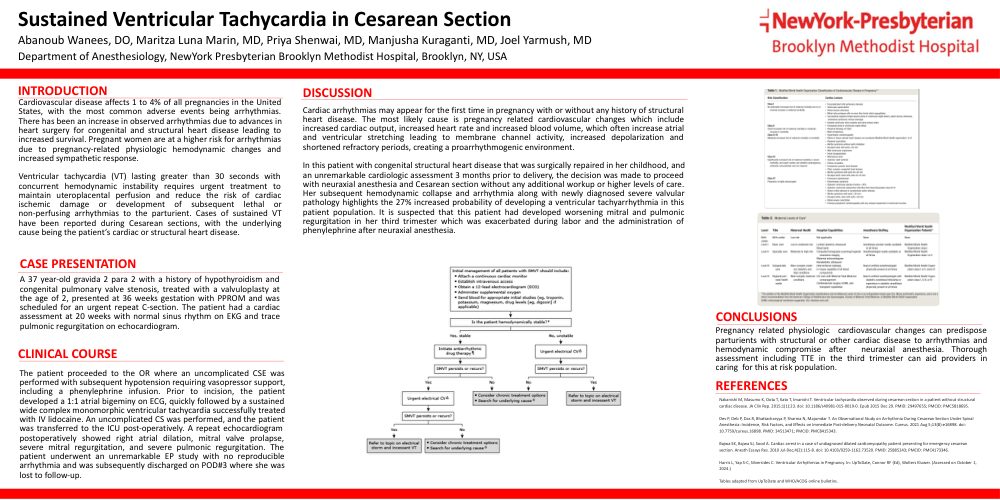
INTRODUCTION Cardiovascular disease affects 1 to 4% of all pregnancies in the United States, with the most common adverse events being arrhythmias. There has been an increase in observed arrhythmias due to advances in heart surgery for congenital and structural heart disease leading to increased survival. Pregnant women are at a higher risk for arrhythmias due to pregnancy-related physiologic hemodynamic changes and increased sympathetic response. Ventricular tachycardia (VT) lasting greater than 30 seconds with concurrent hemodynamic instability requires urgent treatment to maintain uteroplacental perfusion and reduce the risk of cardiac ischemic damage or development of subsequent lethal or non-perfusing arrhythmias to the parturient. Cases of sustained VT have been reported during Cesarean sections, with the underlying cause being the patient’s cardiac or structural heart disease. CASE PRESENTATION A 37 year-old gravida 2 para 2 with a history of hypothyroidism and congenital pulmonary valve stenosis, treated with a valvuloplasty at the age of 2, presented at 36 weeks gestation with PPROM and was scheduled for an urgent repeat C-section. The patient had a cardiac assessment at 20 weeks with normal sinus rhythm on EKG and trace pulmonic regurgitation on echocardiogram. CLINICAL COURSE The patient proceeded to the OR where an uncomplicated CSE was performed with subsequent hypotension requiring vasopressor support, including a phenylephrine infusion. Prior to incision, the patient developed a 1:1 atrial bigeminy on ECG, quickly followed by a sustained wide complex monomorphic ventricular tachycardia successfully treated with IV lidocaine. An uncomplicated CS was performed, and the patient was transferred to the ICU post-operatively. A repeat echocardiogram postoperatively showed right atrial dilation, mitral valve prolapse, severe mitral regurgitation, and severe pulmonic regurgitation. The patient underwent an unremarkable EP study with no reproducible arrhythmia and was subsequently discharged on POD#3 where she was lost to follow-up. DISCUSSION Cardiac arrhythmias may appear for the first time in pregnancy with or without any history of structural heart disease. The most likely cause is pregnancy related cardiovascular changes which include increased cardiac output, increased heart rate and increased blood volume, which often increase atrial and ventricular stretching leading to membrane channel activity, increased depolarization and shortened refractory periods, creating a proarrhythmogenic environment. In this patient with congenital structural heart disease that was surgically repaired in her childhood, and an unremarkable cardiologic assessment 3 months prior to delivery, the decision was made to proceed with neuraxial anesthesia and Cesarean section without any additional workup or higher levels of care. Her subsequent hemodynamic collapse and arrhythmia along with newly diagnosed severe valvular pathology highlights the 27% increased probability of developing a ventricular tachyarrhythmia in this patient population. It is suspected that this patient had developed worsening mitral and pulmonic regurgitation in her third trimester which was exacerbated during labor and the administration of phenylephrine after neuraxial anesthesia. CONCLUSIONS Pregnancy related physiologic cardiovascular changes can predispose parturients with structural or other cardiac disease to arrhythmias and hemodynamic compromise after neuraxial anesthesia. Thorough assessment including TTE in the third trimester can aid providers in caring for this at risk population. REFERENCES Nakanishi M, Masumo K, Oota T, Kato T, Imanishi T. Ventricular tachycardia observed during cesarean section in a patient without structural cardiac disease. JA Clin Rep. 2015;1(1):23. doi: 10.1186/s40981-015-0019-0. Epub 2015 Dec 29. PMID: 29497655; PMCID: PMC5818695. Dev P, Deb P, Das R, Bhattacharyya P, Sharma N, Majumdar T. An Observational Study on Arrhythmia During Cesarean Section Under Spinal Anesthesia: Incidence, Risk Factors, and Effects on Immediate Post-delivery Neonatal Outcome. Cureus. 2021 Aug 5;13(8):e16898. doi: 10.7759/cureus.16898. PMID: 34513471; PMCID: PMC8415343. Bajwa SK, Bajwa SJ, Sood A. Cardiac arrest in a case of undiagnosed dilated cardiomyopathy patient presenting for emergency cesarean section. Anesth Essays Res. 2010 Jul-Dec;4(2):115-8. doi: 10.4103/0259-1162.73520. PMID: 25885243; PMCID: PMC4173346. Harris L, Yap S-C, Silversides C. Ventricular Arrhythmias in Pregnancy. In: UpToDate, Connor RF (Ed), Wolters Kluwer. (Accessed on October 1, 2024.) Tables adapted from UpToDate and WHO/ACOG online bulletins. |