334 posters, 125 sessions, 831 authors, 236 institutions
ePostersLive by SciGen Technologies S.A. All rights reserved.
78th Annual PostGraduate Assembly in Anesthesiology (PGA78) 2024
December 6 - 9, 2024 | New York City

3118
Subdural Hemorrhage Complication Following Neuraxial Anesthesia
Poster Presenter
Part of Topic
Subdural Hemorrhage Complication Following Neuraxial Anesthesia
Introduction
Epidural analgesia/anesthesia is commonly used for labor analgesia, some surgical procedures, post-operative analgesia and therapy for some spinal conditions. This technique involves the injection of anesthetic agents, and sometimes narcotics and/or steroids, into the epidural space of the cervical, thoracic and lumbar spine.
Accidental dural puncture is a known complication of neuraxial analgesia/anesthesia. While a postdural puncture headache (PDPH) is the most common sequelae, this case demonstrates a rare and severe complication that might have resulted from an unrecognized dural puncture. The complication is that of a subdural hematoma (SDH), with an uncommon presentation involving a seizure instead of a PDPH.
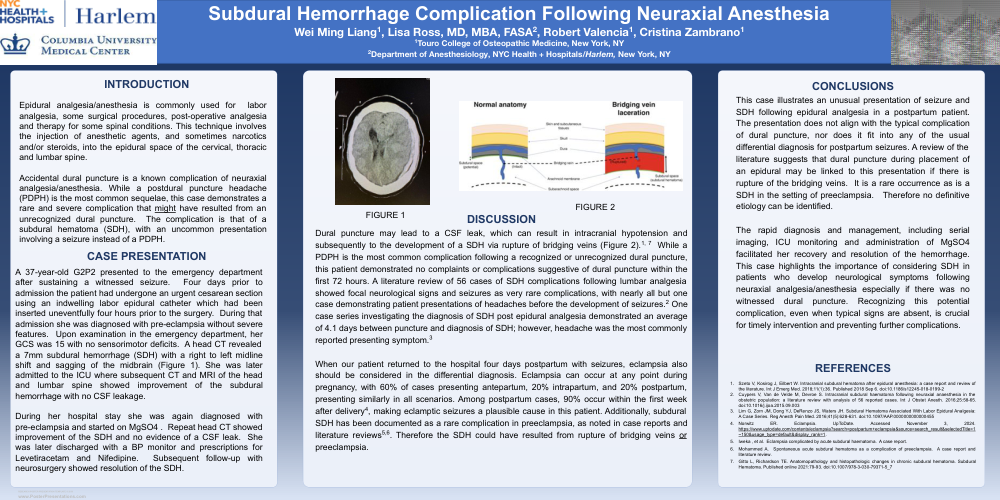
A 37-year-old G2P2 presented to the emergency department after sustaining a witnessed seizure. Four days prior to admission the patient had undergone an urgent cesarean section using an indwelling labor epidural catheter which had been inserted uneventfully four hours prior to the surgery. During that admission she was diagnosed with pre-eclampsia without severe features. Upon examination in the emergency department, her GCS was 15 with no sensorimotor deficits. A head CT revealed a 7mm subdural hemorrhage (SDH) with a right to left midline shift and sagging of the midbrain (Figure 1). She was later admitted to the ICU where subsequent CT and MRI of the head and lumbar spine showed improvement of the subdural hemorrhage with no CSF leakage.
During her hospital stay she was again diagnosed with pre-eclampsia and started on MgSO4 . Repeat head CT showed improvement of the SDH and no evidence of a CSF leak. She was later discharged with a BP monitor and prescriptions for Levetiracetam and Nifedipine. Subsequent follow-up with neurosurgery showed resolution of the SDH.
Dural puncture may lead to a CSF leak, which can result in intracranial hypotension and subsequently to the development of a SDH via rupture of bridging veins (Figure 2).1, 7 While a PDPH is the most common complication following a recognized or unrecognized dural puncture, this patient demonstrated no complaints or complications suggestive of dural puncture within the first 72 hours. A literature review of 56 cases of SDH complications following lumbar analgesia showed focal neurological signs and seizures as very rare complications, with nearly all but one case demonstrating patient presentations of headaches before the development of seizures.2 One case series investigating the diagnosis of SDH post epidural analgesia demonstrated an average of 4.1 days between puncture and diagnosis of SDH; however, headache was the most commonly reported presenting symptom.3
When our patient returned to the hospital four days postpartum with seizures, eclampsia also should be considered in the differential diagnosis. Eclampsia can occur at any point during pregnancy, with 60% of cases presenting antepartum, 20% intrapartum, and 20% postpartum, presenting similarly in all scenarios. Among postpartum cases, 90% occur within the first week after delivery4, making eclamptic seizures a plausible cause in this patient. Additionally, subdural SDH has been documented as a rare complication in preeclampsia, as noted in case reports and literature reviews5,6. Therefore the SDH could have resulted from rupture of bridging veins or preeclampsia.
Conclusion
This case illustrates an unusual presentation of seizure and SDH following epidural analgesia in a postpartum patient. The presentation does not align with the typical complication of dural puncture, nor does it fit into any of the usual differential diagnosis for postpartum seizures. A review of the literature suggests that dural puncture during placement of an epidural may be linked to this presentation if there is rupture of the bridging veins. It is a rare occurrence as is a SDH in the setting of preeclampsia. Therefore no definitive etiology can be identified.
The rapid diagnosis and management, including serial imaging, ICU monitoring and administration of MgSO4 facilitated her recovery and resolution of the hemorrhage. This case highlights the importance of considering SDH in patients who develop neurological symptoms following neuraxial analgesia/anesthesia especially if there was no witnessed dural puncture. Recognizing this potential complication, even when typical signs are absent, is crucial for timely intervention and preventing further complications.