334 posters, 125 sessions, 831 authors, 236 institutions
ePostersLive by SciGen Technologies S.A. All rights reserved.
78th Annual PostGraduate Assembly in Anesthesiology (PGA78) 2024
December 6 - 9, 2024 | New York City

3115
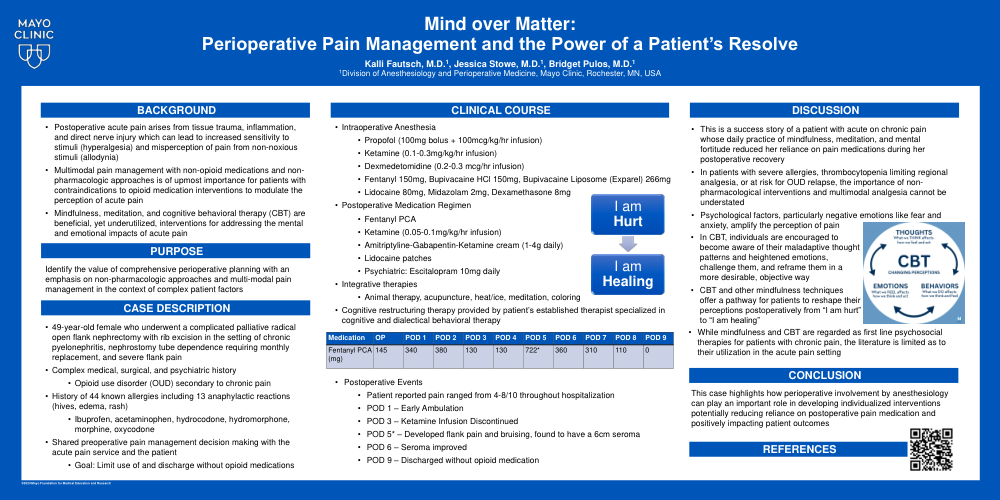
Mind over Matter: Perioperative Pain Management and the Power of a Patient’s Resolve
Poster Presenter
Authors
Affiliations
Part of Topic
BACKGROUND
- Postoperative acute pain arises from tissue trauma, inflammation, and direct nerve injury which can lead to increased sensitivity to stimuli (hyperalgesia) and misperception of pain from non-noxious stimuli (allodynia)
- Multimodal pain management with non-opioid medications and non-pharmacologic approaches is of upmost importance for patients with contraindications to opioid medication interventions to modulate the perception of acute pain
- Mindfulness, meditation, and cognitive behavioral therapy (CBT) are beneficial, yet underutilized, interventions for addressing the mental and emotional impacts of acute pain
PURPOSE
Identify the value of comprehensive perioperative planning with an emphasis on non-pharmacologic approaches and multi-modal pain management in the context of complex patient factors
CASE DESCRIPTION
- 49-year-old female who underwent a complicated palliative radical open flank nephrectomy with rib excision in the setting of chronic pyelonephritis, nephrostomy tube dependence requiring monthly replacement, and severe flank pain
- Complex medical, surgical, and psychiatric history
- Opioid use disorder (OUD) secondary to chronic pain
- History of 44 known allergies including 13 anaphylactic reactions (hives, edema, rash)
- Ibuprofen, acetaminophen, hydrocodone, hydromorphone, morphine, oxycodone
- Shared preoperative pain management decision making with the acute pain service and the patient
- Goal: Limit use of and discharge without opioid medications
CLINICAL COURSE
- Intraoperative Anesthesia
- Propofol (100mg bolus + 100mcg/kg/hr infusion)
- Ketamine (0.1-0.3mg/kg/hr infusion)
- Dexmedetomidine (0.2-0.3 mcg/hr infusion)
- Fentanyl 150mg, Bupivacaine HCl 150mg, Bupivacaine Liposome (Exparel) 266mg
- Lidocaine 80mg, Midazolam 2mg, Dexamethasone 8mg
- Postoperative Medication Regimen
- Fentanyl PCA
- Ketamine (0.05-0.1mg/kg/hr infusion)
- Amitriptyline-Gabapentin-Ketamine cream (1-4g daily)
- Lidocaine patches
- Psychiatric: Escitalopram 10mg daily
- Integrative therapies
- Animal therapy, acupuncture, heat/ice, meditation, coloring
- Cognitive restructuring therapy provided by patient’s established therapist specialized in cognitive and dialectical behavioral therapy
- Postoperative Events
- Patient reported pain ranged from 4-8/10 throughout hospitalization
- POD 1 – Early Ambulation
- POD 3 – Ketamine Infusion Discontinued
- POD 5* – Developed flank pain and bruising, found to have a 6cm seroma
- POD 6 – Seroma improved
- POD 9 – Discharged without opioid medication
DISCUSSION
- This is a success story of a patient with acute on chronic pain whose daily practice of mindfulness, meditation, and mental fortitude reduced her reliance on pain medications during her postoperative recovery
- In patients with severe allergies, thrombocytopenia limiting regional analgesia, or at risk for OUD relapse, the importance of non-pharmacological interventions and multimodal analgesia cannot be understated
- Psychological factors, particularly negative emotions like fear and anxiety, amplify the perception of pain
- In CBT, individuals are encouraged to become aware of their maladaptive thought patterns and heightened emotions, challenge them, and reframe them in a more desirable, objective way
- CBT and other mindfulness techniques offer a pathway for patients to reshape their perceptions postoperatively from “I am hurt” to “I am healing”
- While mindfulness and CBT are regarded as first line psychosocial therapies for patients with chronic pain, the literature is limited as to their utilization in the acute pain setting
CONCLUSION
This case highlights how perioperative involvement by anesthesiology can play an important role in developing individualized interventions potentially reducing reliance on postoperative pain medication and positively impacting patient outcomes