334 posters, 125 sessions, 831 authors, 236 institutions
ePostersLive by SciGen Technologies S.A. All rights reserved.
78th Annual PostGraduate Assembly in Anesthesiology (PGA78) 2024
December 6 - 9, 2024 | New York City

3114
Positioning is Key
Poster Presenter
Authors
Affiliations
Part of Topic
Title: Positioning is Key: Risk of aortocaval compression in patient with massive bilateral polycystic kidneys
Authors: Gurbis, J., MD; Seid, K., MD; Vogt, M., MD
Affiliations: Department of Anesthesiology and perioperative Medicine, Mayo Clinic, Rochester, Minnesota, USA
Learning objective:
•Identify and manage aortocaval compression syndrome in non-obstetric patients with large intra-abdominal masses, emphasizing the importance of positioning.
Case Description:
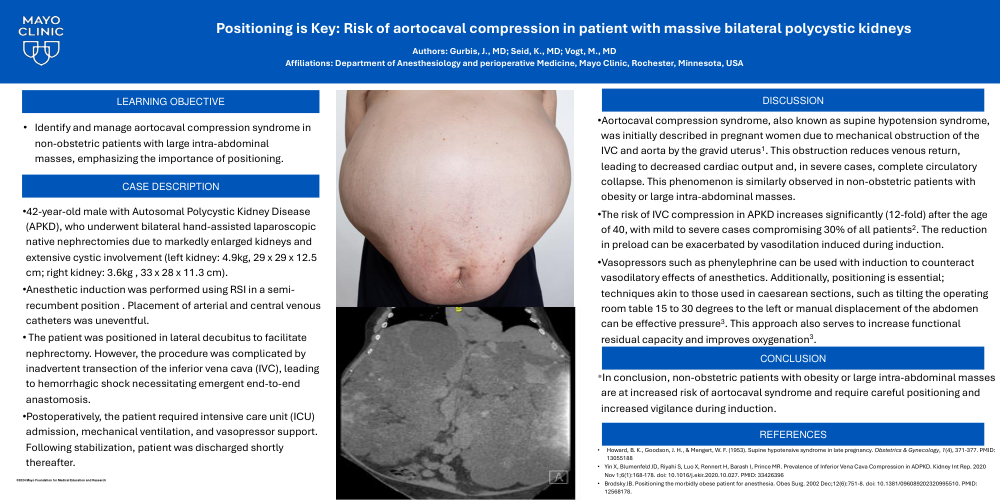
•42-year-old male with Autosomal Polycystic Kidney Disease (APKD), who underwent bilateral hand-assisted laparoscopic native nephrectomies due to markedly enlarged kidneys and extensive cystic involvement (left kidney: 4.9kg, 29 x 29 x 12.5 cm; right kidney: 3.6kg , 33 x 28 x 11.3 cm).
•Anesthetic induction was performed using RSI in a semi-recumbent position . Placement of arterial and central venous catheters was uneventful.
• The patient was positioned in lateral decubitus to facilitate nephrectomy. However, the procedure was complicated by inadvertent transection of the inferior vena cava (IVC), leading to hemorrhagic shock necessitating emergent end-to-end anastomosis.
•Postoperatively, the patient required intensive care unit (ICU) admission, mechanical ventilation, and vasopressor support. Following stabilization, patient was discharged shortly thereafter.
Discussion:
•Aortocaval compression syndrome, also known as supine hypotension syndrome, was initially described in pregnant women due to mechanical obstruction of the IVC and aorta by the gravid uterus1. This obstruction reduces venous return, leading to decreased cardiac output and, in severe cases, complete circulatory collapse. This phenomenon is similarly observed in non-obstetric patients with obesity or large intra-abdominal masses.
•The risk of IVC compression in APKD increases significantly (12-fold) after the age of 40, with mild to severe cases compromising 30% of all patients2. The reduction in preload can be exacerbated by vasodilation induced during induction.
•Vasopressors such as phenylephrine can be used with induction to counteract vasodilatory effects of anesthetics. Additionally, positioning is essential; techniques akin to those used in caesarean sections, such as tilting the operating room table 15 to 30 degrees to the left or manual displacement of the abdomen can be effective pressure3. This approach also serves to increase functional residual capacity and improves oxygenation3.
Conclusion:
•In conclusion, non-obstetric patients with obesity or large intra-abdominal masses are at increased risk of aortocaval syndrome and require careful positioning and increased vigilance during induction.
References:
•Howard, B. K., Goodson, J. H., & Mengert, W. F. (1953). Supine hypotensive syndrome in late pregnancy. Obstetrics & Gynecology, 1(4), 371-377. PMID: 13055188
•Yin X, Blumenfeld JD, Riyahi S, Luo X, Rennert H, Barash I, Prince MR. Prevalence of Inferior Vena Cava Compression in ADPKD. Kidney Int Rep. 2020 Nov 1;6(1):168-178. doi: 10.1016/j.ekir.2020.10.027. PMID: 33426396
•Brodsky JB. Positioning the morbidly obese patient for anesthesia. Obes Surg. 2002 Dec;12(6):751-8. doi: 10.1381/096089202320995510. PMID: 12568178.