334 posters, 125 sessions, 831 authors, 236 institutions
ePostersLive by SciGen Technologies S.A. All rights reserved.
78th Annual PostGraduate Assembly in Anesthesiology (PGA78) 2024
December 6 - 9, 2024 | New York City

3112
Tough Decisions: Managing Multiple Simultaneous Life-Threatening Conditions
Poster Presenter
Authors
Affiliations
Part of Topic
Introduction:
More than 2.8 million individuals are hospitalized annually due to injuries, with a rising trend in polytrauma incidents, among which motor vehicle collisions reign as the top contributor to injury-related fatalities. Polytrauma, which affects multiple organ systems, complicates triage and clinical decision-making. As anesthesiologists, it is vital we understand the importance of triaging and managing simultaneous life-threatening conditions.
Case Report:
We present a 73-year-old male who was a restrained driver in an MVC, presenting with an acute anterior STEMI, right rib fracture, sternal facture, small right pneumothorax, retrosternal hematoma, liver laceration, and hemoperitoneum. After a comprehensive discussion with cardiology, emergency medicine, and trauma surgery, it was decided that the patient would first undergo bleeding management followed by cardiac catheterization.
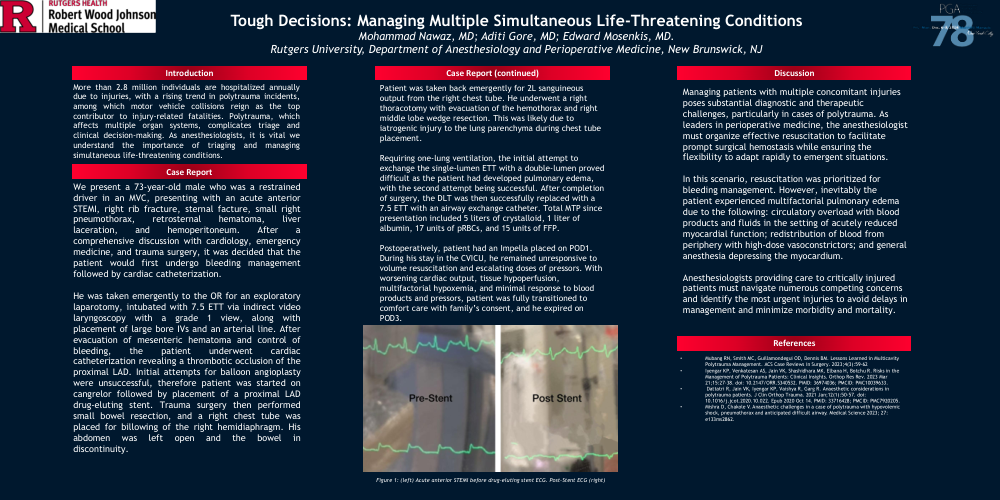
He was taken emergently to the OR for an exploratory laparotomy, intubated with 7.5 ETT via indirect video laryngoscopy with a grade 1 view, along with placement of large bore IVs and an arterial line. After evacuation of mesenteric hematoma and control of bleeding, the patient underwent cardiac catheterization revealing a thrombotic occlusion of the proximal LAD. Initial attempts for balloon angioplasty were unsuccessful, therefore patient was started on cangrelor followed by placement of a proximal LAD drug-eluting stent. Trauma surgery then performed small bowel resection, and a right chest tube was placed for billowing of the right hemidiaphragm. His abdomen was left open and the bowel in discontinuity.
Patient was taken back emergently for 2L sanguineous output from the right chest tube. He underwent a right thoracotomy with evacuation of the hemothorax and right middle lobe wedge resection. This was likely due to iatrogenic injury to the lung parenchyma during chest tube placement.
Requiring one-lung ventilation, the initial attempt to exchange the single-lumen ETT with a double-lumen proved difficult as the patient had developed pulmonary edema, with the second attempt being successful. After completion of surgery, the DLT was then successfully replaced with a 7.5 ETT with an airway exchange catheter. Total MTP since presentation included 5 liters of crystalloid, 1 liter of albumin, 17 units of pRBCs, and 15 units of FFP.
Postoperatively, patient had an Impella placed on POD1. During his stay in the CVICU, he remained unresponsive to volume resuscitation and escalating doses of pressors. With worsening cardiac output, tissue hypoperfusion, multifactorial hypoxemia, and minimal response to blood products and pressors, patient was fully transitioned to comfort care with family’s consent, and he expired on POD3.
Discussion:
Managing patients with multiple concomitant injuries poses substantial diagnostic and therapeutic challenges, particularly in cases of polytrauma. As leaders in perioperative medicine, the anesthesiologist must organize effective resuscitation to facilitate prompt surgical hemostasis while ensuring the flexibility to adapt rapidly to emergent situations.
In this scenario, resuscitation was prioritized for bleeding management. However, inevitably the patient experienced multifactorial pulmonary edema due to the following: circulatory overload with blood products and fluids in the setting of acutely reduced myocardial function; redistribution of blood from periphery with high-dose vasoconstrictors; and general anesthesia depressing the myocardium.
Anesthesiologists providing care to critically injured patients must navigate numerous competing concerns and identify the most urgent injuries to avoid delays in management and minimize morbidity and mortality.
References: