334 posters, 125 sessions, 831 authors, 236 institutions
ePostersLive by SciGen Technologies S.A. All rights reserved.
78th Annual PostGraduate Assembly in Anesthesiology (PGA78) 2024
December 6 - 9, 2024 | New York City

3102
A Case Study of Congenital Ciliary Dyskinesia: Navigating Difficult Ethical Considerations for Pediatric Anesthesia in an Amish, Rural Community
Poster Presenter
Part of Topic
Title:
A Case Study of Congenital Ciliary Dyskinesia: Navigating Difficult Ethical Considerations
for Pediatric Anesthesia in an Amish, Rural Community
Authors:
James Kim BA[1]; Anjana Kundu, MD[2] ; Alexander Mandych, MD[3]; Robert Williams, MSNA, Ph.D, MD[4]
[1] = University of Rochester School of Medicine and Dentistry ; [2] = University of Rochester Medical Center, Golisano Children’s Hospital;
[3] = University of Rochester Medical Center, Department of Otolaryngology ; [4] = University of Rochester Medical Center, Department of Anesthesiology
Introduction
Pediatric anesthesia in rural settings presents unique challenges, often
requiring a balance between limited resources and the complex health needs
of vulnerable populations. Social determinants of health, such as access to
specialized facilities, can create ethical dilemmas when families face barriers
to optimal care. In such cases, healthcare providers must navigate parental
preferences, cultural considerations, and safety risks, making difficult
decisions about when and where to proceed with care. This case highlights
the ethical complexities of providing anesthesia to a young child with
congenital ciliary dyskinesia in a rural, Amish community, where both
medical risk and healthcare access play pivotal roles.
Case Report
A two-year-old Amish patient presented to a rural outpatient surgery center
for a scheduled bilateral tympanostomy tube insertion for chronic otitis.
Owing to lack of phone access and automobile transportation, routine
screening had not occurred, and no known prior medical history was
available for comparison. Day-of-surgery preoperative interview revealed
that the patient had chronic cough secondary to a suspected case of
congenital ciliary dyskinesia, a rare disorder associated with impaired
mucociliary clearance and higher incidence of respiratory complications
under general anesthesia, due to the presenting symptoms and a family
history of the condition. However, this was neither confirmed nor ruled out
owing to a lack of confirmatory ciliary biopsy needed for diagnosis.
The surgery center was staffed by a single Board-Certified anesthesiologist
working alone without ay pediatric specialists on site. The consent
discussion considered whether to proceed, or to reschedule at the
university’s pediatric hospital. Given the demographics, there was risk of
losing the patient to follow-up or, at best, delaying care with potential
worsening of hearing loss. While the patient did not have any significant
history for developmental delay, prolonged hearing deficient has been
shown to lead to speech delay, and this patients was noted to speak only a
few words by their parents.
Ultimately, the parents were well informed about the diagnosis and wished
to proceed with general anesthesia using inhalational anesthetics. The
surgery was uneventful, and the patient recovered without complication.
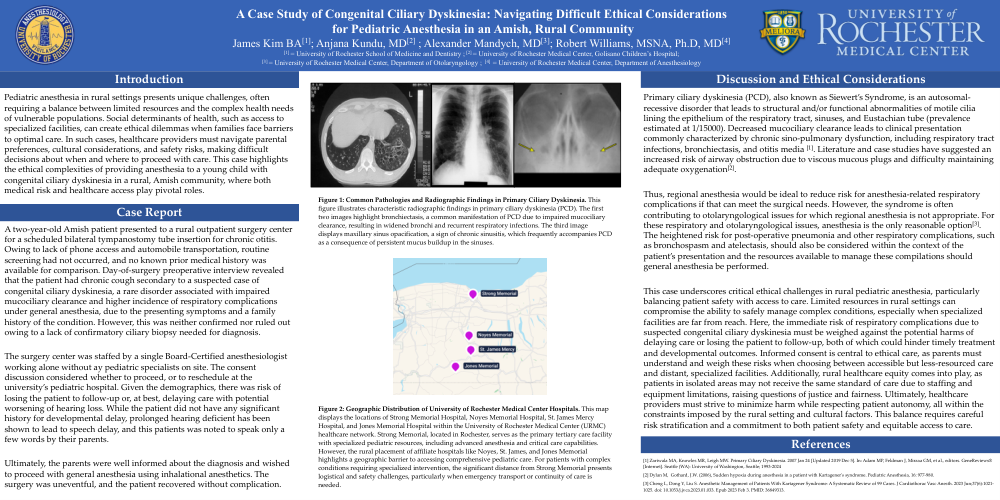
Figure 1
Common Pathologies and Radiographic Findings in Primary Ciliary Dyskinesia. This
figure illustrates characteristic radiographic findings in primary ciliary dyskinesia (PCD). The first
two images highlight bronchiectasis, a common manifestation of PCD due to impaired mucociliary
clearance, resulting in widened bronchi and recurrent respiratory infections. The third image
displays maxillary sinus opacification, a sign of chronic sinusitis, which frequently accompanies PCD
as a consequence of persistent mucus buildup in the sinuses.
Figure 2
Geographic Distribution of University of Rochester Medical Center Hospitals. This map
displays the locations of Strong Memorial Hospital, Noyes Memorial Hospital, St. James Mercy
Hospital, and Jones Memorial Hospital within the University of Rochester Medical Center (URMC)
healthcare network. Strong Memorial, located in Rochester, serves as the primary tertiary care facility
with specialized pediatric resources, including advanced anesthesia and critical care capabilities.
However, the rural placement of affiliate hospitals like Noyes, St. James, and Jones Memorial
highlights a geographic barrier to accessing comprehensive pediatric care. For patients with complex
conditions requiring specialized intervention, the significant distance from Strong Memorial presents
logistical and safety challenges, particularly when emergency transport or continuity of care is
needed.
Discussion and Ethical Considerations
Primary ciliary dyskinesia (PCD), also known as Siewert’s Syndrome, is an autosomal-
recessive disorder that leads to structural and/or functional abnormalities of motile cilia
lining the epithelium of the respiratory tract, sinuses, and Eustachian tube (prevalence
estimated at 1/15000). Decreased mucociliary clearance leads to clinical presentation
commonly characterized by chronic sino-pulmonary dysfunction, including respiratory tract
infections, bronchiectasis, and otitis media [1]. Literature and case studies have suggested an
increased risk of airway obstruction due to viscous mucous plugs and difficulty maintaining
adequate oxygenation[2]
.
Thus, regional anesthesia would be ideal to reduce risk for anesthesia-related respiratory
complications if that can meet the surgical needs. However, the syndrome is often
contributing to otolaryngological issues for which regional anesthesia is not appropriate. For
these respiratory and otolaryngological issues, anesthesia is the only reasonable option[3]
.
The heightened risk for post-operative pneumonia and other respiratory complications, such
as bronchospasm and atelectasis, should also be considered within the context of the
patient’s presentation and the resources available to manage these compilations should
general anesthesia be performed.
This case underscores critical ethical challenges in rural pediatric anesthesia, particularly
balancing patient safety with access to care. Limited resources in rural settings can
compromise the ability to safely manage complex conditions, especially when specialized
facilities are far from reach. Here, the immediate risk of respiratory complications due to
suspected congenital ciliary dyskinesia must be weighed against the potential harms of
delaying care or losing the patient to follow-up, both of which could hinder timely treatment
and developmental outcomes. Informed consent is central to ethical care, as parents must
understand and weigh these risks when choosing between accessible but less-resourced care
and distant, specialized facilities. Additionally, rural healthcare equity comes into play, as
patients in isolated areas may not receive the same standard of care due to staffing and
equipment limitations, raising questions of justice and fairness. Ultimately, healthcare
providers must strive to minimize harm while respecting patient autonomy, all within the
constraints imposed by the rural setting and cultural factors. This balance requires careful
risk stratification and a commitment to both patient safety and equitable access to care.
References
[1] Zariwala MA, Knowles MR, Leigh MW. Primary Ciliary Dyskinesia. 2007 Jan 24 [Updated 2019 Dec 5]. In: Adam MP, Feldman J, Mirzaa GM, et al., editors. GeneReviews®
[Internet]. Seattle (WA): University of Washington, Seattle; 1993-2024
[2] Dylan M, Gothard, J.W. (2006), Sudden hypoxia during anesthesia in a patient with Kartagener's syndrome. Pediatric Anesthesia, 16: 977-980.
[3] Cheng L, Dong Y, Liu S. Anesthetic Management of Patients With Kartagener Syndrome: A Systematic Review of 99 Cases. J Cardiothorac Vasc Anesth. 2023 Jun;37(6):1021-
1025. doi: 10.1053/j.jvca.2023.01.033. Epub 2023 Feb 3. PMID: 36849313.