334 posters, 125 sessions, 831 authors, 236 institutions
ePostersLive by SciGen Technologies S.A. All rights reserved.
78th Annual PostGraduate Assembly in Anesthesiology (PGA78) 2024
December 6 - 9, 2024 | New York City

3101
Complications of Long Term Tracheostomy and Management Strategies
Poster Presenter
Authors
Affiliations
Part of Topic
Complications of Long-Term Tracheostomy and Management Strategies
Introduction
•Long term trach complications include: airway obstruction (mucus plugging); accidental decannulation; stomal problems (granuloma, tracheocutaneous fistula); tracheal lesions (subglottic stenosis, suprastomal collapse, granuloma); hemorrhage (stomal, tracheal mucosa, tracheoinnominate fistula); tracheoesophageal fistula; swallowing problems1
•Tracheal stenosis: 50% occlusion- stridor, tachypnea; 75% occlusion- extreme respiratory insufficiency2
•Risk factors for tracheal stenosis with tracheostomy include: cuff trach; trach tube too high in the airway; trauma; previous endotracheal intubation; low-grade inflammation, as seen in uncontrolled reflux1
Perioperative management
•2-year-old male with history of extreme prematurity (22 weeks), Dandy Walker Syndrome and tracheomalacia requiring tracheostomy since infancy presented for increased work of breathing
•Initial evaluation:
•Physical exam: Inadequate chest rise; 3.5 mm custom trach in situ; manually ventilated
•SpO2: 70s
•VBG: 6.97/>128/102 pH/pCO2/pO2
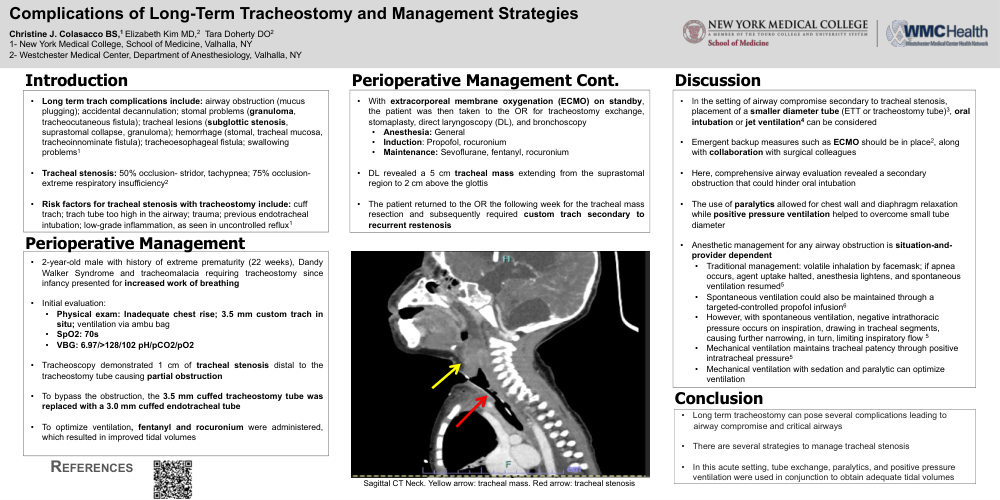
•Tracheoscopy demonstrated 1 cm of tracheal stenosis distal to the tracheostomy tube causing partial obstruction
•To bypass the obstruction, the 3.5 mm cuffed tracheostomy tube was replaced with a 3.0 mm cuffed endotracheal tube
•To optimize ventilation, fentanyl and rocuronium were administered, which resulted in improved tidal volumes
•With extracorporeal membrane oxygenation (ECMO) on standby, the patient was then taken to the OR for tracheostomy exchange, stomaplasty, direct laryngoscopy (DL), and bronchoscopy
•Anesthesia: General
•Induction: Propofol, rocuronium
•Maintenance: Sevoflurane, fentanyl, rocuronium
•DL revealed a 5 cm tracheal mass extending from the suprastomal region to 2 cm above the glottis
•The patient returned to the OR the following week for the tracheal mass resection and subsequently required custom trach secondary to recurrent restenosis
Discussion
•In the setting of airway compromise secondary to tracheal stenosis, placement of a smaller diameter tube (ETT or tracheostomy tube)3, oral intubation or jet ventilation4 can be considered
•Emergent backup measures such as ECMO should be in place2, along with collaboration with surgical colleagues
•Here, comprehensive airway evaluation revealed a secondary obstruction that could hinder oral intubation
•The use of paralytics allowed for chest wall and diaphragm relaxation while positive pressure ventilation helped to overcome small tube diameter
•Anesthetic management for any airway obstruction is situation-and-provider dependent
•Traditional management: volatile inhalation by facemask; if apnea occurs, agent uptake halted, anesthesia lightens, and spontaneous ventilation resumed5
•Spontaneous ventilation could also be maintained through a targeted-controlled propofol infusion6
•However, with spontaneous ventilation, negative intrathoracic pressure occurs on inspiration, drawing in tracheal segments, causing further narrowing, in turn, limiting inspiratory flow 5
•Mechanical ventilation maintains tracheal patency through positive intratracheal pressure5
•Mechanical ventilation with sedation and paralytic can optimize ventilation
Conclusion
•Long term tracheostomy can pose several complications leading to airway compromise and critical airways
•There are several strategies to manage tracheal stenosis
•In this acute setting, tube exchange, paralytics, and positive pressure ventilation were used in conjunction to obtain adequate tidal volumes