334 posters, 125 sessions, 831 authors, 236 institutions
ePostersLive by SciGen Technologies S.A. All rights reserved.
78th Annual PostGraduate Assembly in Anesthesiology (PGA78) 2024
December 6 - 9, 2024 | New York City

3096
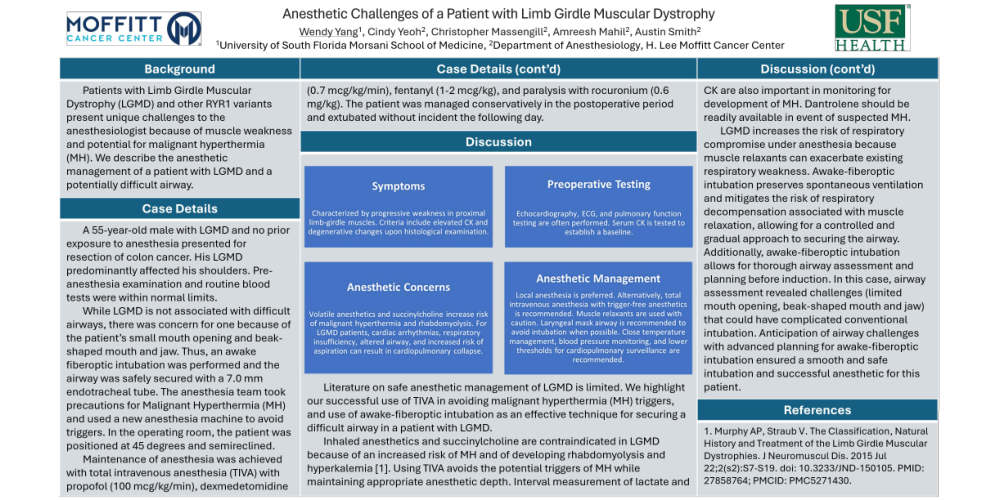
Anesthetic challenges of a patient with limb girdle muscular dystrophy
Part of Topic
Anesthetic Challenges of a Patient with Limb Girdle Muscular Dystrophy
Wendy Yang1, Cindy Yeoh2, Christopher Massengill2, Amreesh Mahil2, Austin Smith2
1University of South Florida Morsani School of Medicine, 2Department of Anesthesiology, H. Lee Moffitt Cancer Center
Background
Patients with Limb Girdle Muscular Dystrophy (LGMD) and other RYR1 variants present unique challenges to the anesthesiologist because of muscle weakness and potential for malignant hyperthermia (MH). We describe the anesthetic management of a patient with LGMD and a potentially difficult airway.
Case Details
A 55-year-old male with LGMD and no prior exposure to anesthesia presented for resection of colon cancer. His LGMD predominantly affected his shoulders. Pre-anesthesia examination and routine blood tests were within normal limits.
While LGMD is not associated with difficult airways, there was concern for one because of the patient’s small mouth opening and beak-shaped mouth and jaw. Thus, an awake fiberoptic intubation was performed and the airway was safely secured with a 7.0 mm endotracheal tube. The anesthesia team took precautions for Malignant Hyperthermia (MH) and used a new anesthesia machine to avoid triggers. In the operating room, the patient was positioned at 45 degrees and semireclined.
Maintenance of anesthesia was achieved with total intravenous anesthesia (TIVA) with propofol (100 mcg/kg/min), dexmedetomidine (0.7 mcg/kg/min), fentanyl (1-2 mcg/kg), and paralysis with rocuronium (0.6 mg/kg). The patient was managed conservatively in the postoperative period and extubated without incident the following day.
Discussion
Literature on safe anesthetic management of LGMD is limited. We highlight our successful use of TIVA in avoiding malignant hyperthermia (MH) triggers, and use of awake-fiberoptic intubation as an effective technique for securing a difficult airway in a patient with LGMD.
Inhaled anesthetics and succinylcholine are contraindicated in LGMD because of an increased risk of MH and of developing rhabdomyolysis and hyperkalemia [1]. Using TIVA avoids the potential triggers of MH while maintaining appropriate anesthetic depth. Interval measurement of lactate and CK are also important in monitoring for development of MH. Dantrolene should be readily available in event of suspected MH.
LGMD increases the risk of respiratory compromise under anesthesia because muscle relaxants can exacerbate existing respiratory weakness. Awake-fiberoptic intubation preserves spontaneous ventilation and mitigates the risk of respiratory decompensation associated with muscle relaxation, allowing for a controlled and gradual approach to securing the airway. Additionally, awake-fiberoptic intubation allows for thorough airway assessment and planning before induction. In this case, airway assessment revealed challenges (limited mouth opening, beak-shaped mouth and jaw) that could have complicated conventional intubation. Anticipation of airway challenges with advanced planning for awake-fiberoptic intubation ensured a smooth and safe intubation and successful anesthetic for this patient.
References
1. Murphy AP, Straub V. The Classification, Natural History and Treatment of the Limb Girdle Muscular Dystrophies. J Neuromuscul Dis. 2015 Jul 22;2(s2):S7-S19. doi: 10.3233/JND-150105. PMID: 27858764; PMCID: PMC5271430.