334 posters, 125 sessions, 831 authors, 236 institutions
ePostersLive by SciGen Technologies S.A. All rights reserved.
78th Annual PostGraduate Assembly in Anesthesiology (PGA78) 2024
December 6 - 9, 2024 | New York City

3084
A Brush with Danger: Navigating an Awake Fiberoptic Intubation
Poster Presenter
Part of Topic
Introduction
Awake Fiberoptic Intubation (AFOI) offers real-time visualization and maintenance of spontaneous ventilation prior to airway securement
•Essential for avoiding airway collapse during management of difficult airways, with the goal of avoiding a cannot intubate/cannot ventilate situation
•AFOI is employed in 1-2% of general anesthesia cases but is crucial in preventing aspiration and airway obstruction in high-risk patients.
•AFOI success rate exceeds 90%, and topical anesthesia with 4% lidocaine is effective in 90-95% of AFOI [1]
•Adequate nasal dilation and airway topicalization minimizes complications such as laryngospasm or gag reflex activation, with a reported 95% success rate [2]
Case
64-year-old female presents to the emergency department two days after a ground level fall while brushing her teeth.
•Electric toothbrush head lodged into right submandibular space
•Maintaining intact airway and tolerating oral secretions without signs of respiratory distress
•Initial fiberoptic laryngoscopy
•Revealed large, edematous hematoma obstructing glottic opening
•Airway topicalization
•4% lidocaine nebulization along with direct lidocaine application to the vocal folds using an orotracheal injector
•Oxymetazoline nasal spray and additional 4% lidocaine were applied throughout dilation with nasopharyngeal airway
•Patient premedicated with IV midazolam followed by induction dose of propofol and fentanyl after nasal RAE endotracheal tube was secured
•Ten hours after AFOI, patient was taken to the operating room for deep neck space dissection to retrieve the foreign body, as well as temporary tracheostomy to maintain airway protection
Imaging Findings
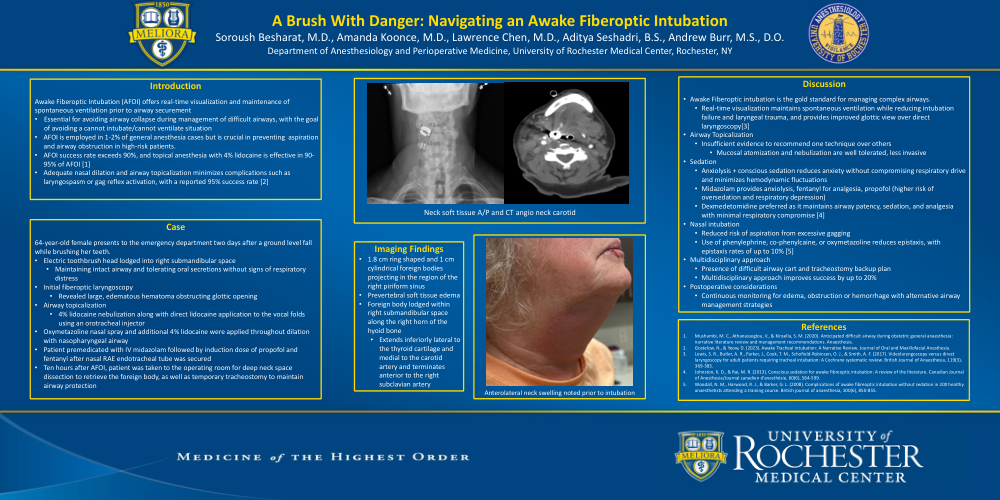
•1.8 cm ring shaped and 1 cm cylindrical foreign bodies projecting in the region of the right piriform sinus
•Prevertebral soft tissue edema
•Foreign body lodged within right submandibular space along the right horn of the hyoid bone
•Extends inferiorly lateral to the thyroid cartilage and medial to the carotid artery and terminates anterior to the right subclavian artery
Discussion
•Awake Fiberoptic intubation is the gold standard for managing complex airways.
•Real-time visualization maintains spontaneous ventilation while reducing intubation failure and laryngeal trauma, and provides improved glottic view over direct laryngoscopy[3]
•Airway Topicalization
•Insufficient evidence to recommend one technique over others
•Mucosal atomization and nebulization are well tolerated, less invasive
•Sedation
•Anxiolysis + conscious sedation reduces anxiety without compromising respiratory drive and minimizes hemodynamic fluctuations
•Midazolam provides anxiolysis, fentanyl for analgesia, propofol (higher risk of oversedation and respiratory depression)
•Dexmedetomidine preferred as it maintains airway patency, sedation, and analgesia with minimal respiratory compromise [4]
•Nasal intubation
•Reduced risk of aspiration from excessive gagging
•Use of phenylephrine, co-phenylcaine, or oxymetazoline reduces epistaxis, with epistaxis rates of up to 10% [5]
•Multidisciplinary approach
•Presence of difficult airway cart and tracheostomy backup plan
•Multidisciplinary approach improves success by up to 20%
•Postoperative considerations
•Continuous monitoring for edema, obstruction or hemorrhage with alternative airway management strategies