334 posters, 125 sessions, 831 authors, 236 institutions
ePostersLive by SciGen Technologies S.A. All rights reserved.
78th Annual PostGraduate Assembly in Anesthesiology (PGA78) 2024
December 6 - 9, 2024 | New York City

3083
Low Dose Naltrexone to Treat Chronic Pain from Oral Submucous Fibrosis Secondary to Betel Nut Use
Poster Presenter
Authors
Affiliations
Part of Topic
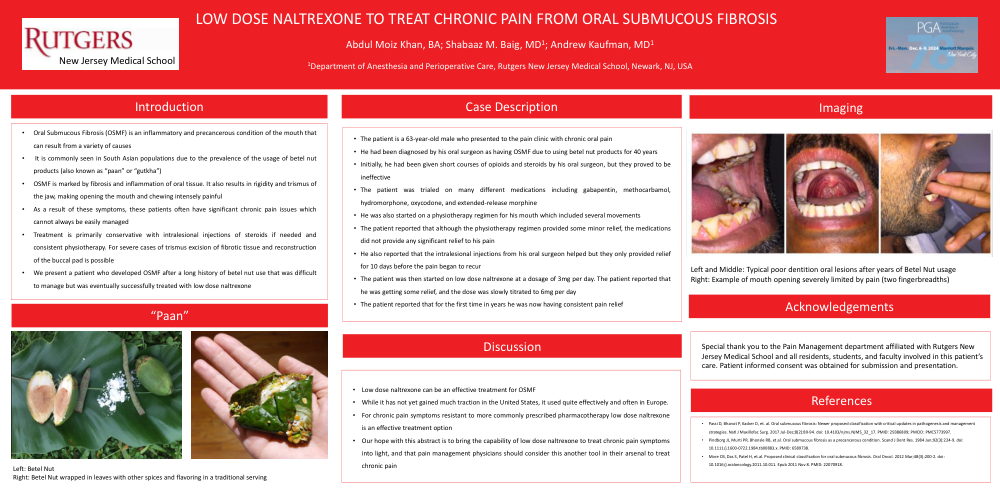
LOW DOSE NALTREXONE TO TREAT CHRONIC PAIN FROM ORAL SUBMUCOUS FIBROSIS
•Oral Submucous Fibrosis (OSMF) is an inflammatory and precancerous condition of the mouth that can result from a variety of causes
• It is commonly seen in South Asian populations due to the prevalence of the usage of betel nut products (also known as “paan” or “gutkha”)
•OSMF is marked by fibrosis and inflammation of oral tissue. It also results in rigidity and trismus of the jaw, making opening the mouth and chewing intensely painful
•As a result of these symptoms, these patients often have significant chronic pain issues which cannot always be easily managed
•Treatment is primarily conservative with intralesional injections of steroids if needed and consistent physiotherapy. For severe cases of trismus excision of fibrotic tissue and reconstruction of the buccal pad is possible
•We present a patient who developed OSMF after a long history of betel nut use that was difficult to manage but was eventually successfully treated with low dose naltrexone
•The patient is a 63-year-old male who presented to the pain clinic with chronic oral pain
•He had been diagnosed by his oral surgeon as having OSMF due to using betel nut products for 40 years
•Initially, he had been given short courses of opioids and steroids by his oral surgeon, but they proved to be ineffective
•The patient was trialed on many different medications including gabapentin, methocarbamol, hydromorphone, oxycodone, and extended-release morphine
•He was also started on a physiotherapy regimen for his mouth which included several movements
•The patient reported that although the physiotherapy regimen provided some minor relief, the medications did not provide any significant relief to his pain
•He also reported that the intralesional injections from his oral surgeon helped but they only provided relief for 10 days before the pain began to recur
•The patient was then started on low dose naltrexone at a dosage of 3mg per day. The patient reported that he was getting some relief, and the dose was slowly titrated to 6mg per day
•The patient reported that for the first time in years he was now having consistent pain relief
•Low dose naltrexone can be an effective treatment for OSMF
•While it has not yet gained much traction in the United States, it used quite effectively and often in Europe.
•For chronic pain symptoms resistant to more commonly prescribed pharmacotherapy low dose naltrexone is an effective treatment option
•Our hope with this abstract is to bring the capability of low dose naltrexone to treat chronic pain symptoms into light, and that pain management physicians should consider this another tool in their arsenal to treat chronic pain