334 posters, 125 sessions, 831 authors, 236 institutions
ePostersLive by SciGen Technologies S.A. All rights reserved.
78th Annual PostGraduate Assembly in Anesthesiology (PGA78) 2024
December 6 - 9, 2024 | New York City

3077
Approach to the Perioperative Management of Alpha-Gal Syndrome in a Parturient
Poster Presenter
Part of Topic
Approach to the Perioperative Management of Alpha-Gal Syndrome in a Parturient
Lauren Marzolini, B.S., Bahaa Daoud, M.D., Tiffany Angelo, D.O., Morgane Factor, M.D.
Department of Anesthesiology, Renaissance School of Medicine at Stony Brook University, Stony Brook, NY, 11794
Introduction
•Galactose-α-1,3-galactose, also known as alpha-gal, is an oligosaccharide commonly found in mammalian products and pharmaceutical ingredients
•Alpha-Gal Syndrome (AGS) is an IgE-mediated immune response to products containing alpha-gal
•AGS is believed to be triggered by a tick bite
•Patients with AGS can experience a range of symptoms, including pruritus, abdominal pain, diarrhea, emesis, angioedema, and/or hypotensive anaphylaxis
•Reactions in AGS can occur immediately or be delayed, can vary from person to person, and with each exposure
•Given the variety of timing and clinical presentation of reactions, AGS is challenging to identify
•AGS has recently increased in prevalence and recognition
•Many medications used in general and obstetric anesthesia can cause a reaction
•Anesthesiologists must understand the diverse triggers and reactions of AGS to identify and manage patients
Case Description
•33-year-old G1P0 female with AGS presented at 35 weeks gestation for high-risk obstetric anesthesiology consultation
•AGS was diagnosed after a tick bite, and the patient was found to have elevated IgE antibodies to alpha-gal
•When consuming products with gelatin or food prepared near red meat, the patient reported abdominal pain, diarrhea, and urticaria
•For delivery planning, a multidisciplinary conference was held with anesthesiology, obstetrics and gynecology, pharmacy, and nursing
•All possible obstetric and anesthetic medications were reviewed
•At 37 weeks gestation, the patient presented for induction of labor due to gestational hypertension
•When the patient was admitted, all possible medications were again reviewed in collaboration with pharmacy
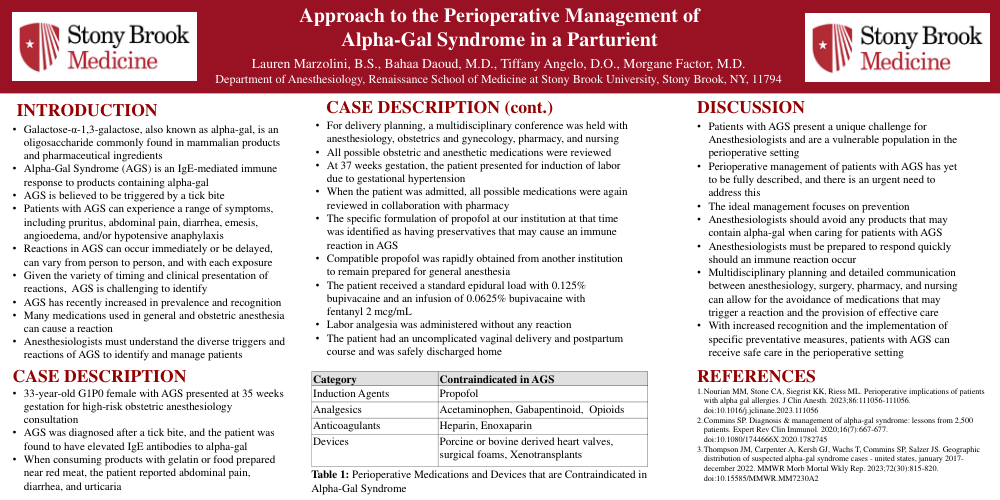
•The specific formulation of propofol at our institution at that time was identified as having preservatives that may cause an immune reaction in AGS
•Compatible propofol was rapidly obtained from another institution to remain prepared for general anesthesia
•The patient received a standard epidural load with 0.125% bupivacaine and an infusion of 0.0625% bupivacaine with fentanyl 2 mcg/mL
•Labor analgesia was administered without any reaction
•The patient had an uncomplicated vaginal delivery and postpartum course and was safely discharged home
Discussion
•Patients with AGS present a unique challenge for Anesthesiologists and are a vulnerable population in the perioperative setting
•Perioperative management of patients with AGS has yet to be fully described, and there is an urgent need to address this
•The ideal management focuses on prevention
•Anesthesiologists should avoid any products that may contain alpha-gal when caring for patients with AGS
•Anesthesiologists must be prepared to respond quickly should an immune reaction occur
•Multidisciplinary planning and detailed communication between anesthesiology, surgery, pharmacy, and nursing can allow for the avoidance of medications that may trigger a reaction and the provision of effective care
•With increased recognition and the implementation of specific preventative measures, patients with AGS can receive safe care in the perioperative setting
References
1.Nourian MM, Stone CA, Siegrist KK, Riess ML. Perioperative implications of patients with alpha gal allergies. J Clin Anesth. 2023;86:111056-111056. doi:10.1016/j.jclinane.2023.111056
2.Commins SP. Diagnosis & management of alpha-gal syndrome: lessons from 2,500 patients. Expert Rev Clin Immunol. 2020;16(7):667-677. doi:10.1080/1744666X.2020.1782745
3.Thompson JM, Carpenter A, Kersh GJ, Wachs T, Commins SP, Salzer JS. Geographic distribution of suspected alpha-gal syndrome cases - united states, january 2017-december 2022. MMWR Morb Mortal Wkly Rep. 2023;72(30):815-820. doi:10.15585/MMWR.MM7230A2