334 posters, 125 sessions, 831 authors, 236 institutions
ePostersLive by SciGen Technologies S.A. All rights reserved.
78th Annual PostGraduate Assembly in Anesthesiology (PGA78) 2024
December 6 - 9, 2024 | New York City

3074
Perioperative Anaphylaxis: A Rare but Severe Reaction to Sugammadex in a High-Risk Patient
Poster Presenter
Authors
Affiliations
Part of Topic
Perioperative Anaphylaxis: A Rare but Severe Reaction to Sugammadex in a High-Risk Patient
Sheetal Bapu, B.S.1, Jonathan McKinley, M.D.2, Divya Cherukupalli, M.D.2
1Albany Medical College
2Albany Medical Center, Department of Anesthesiology, Albany, NY
Main Points
- Perioperative Anaphylaxis from Sugammadex:
- Sugammadex, a drug used to reverse the neuromuscular blockade, has been associated with rare but life-threatening anaphylactic reactions, which have been increasing with its widespread use.
- Case Report Summary:
- This is a case of a 63-year-old female with an extensive allergy history who experienced anaphylaxis after being administered sugammadex during surgery. The reaction included severe bronchospasm, hypotension, and required emergency interventions, including epinephrine and a tracheostomy.
- Mechanism and Risks:
- The exact mechanism of sugammadex-induced anaphylaxis is unclear, but it may involve both allergic and non-allergic pathways. There is speculation that environmental exposure to cyclodextrins, which are structurally like sugammadex, might contribute to hypersensitivity.
- Clinical Presentation and Management:
- Anaphylactic reactions to sugammadex typically manifest within minutes of administration, with symptoms like hypotension, wheezing, and swelling. Immediate treatment is critical, with epinephrine being the first-line therapy.
- Implications for Practice:
- Given the risk of anaphylaxis, especially in patients with a history of allergies, preoperative allergy testing for the sugammadex-rocuronium compound might be warranted. Awareness of the potential for severe reactions is essential for anesthesiologists to ensure patient safety.
Case Report
- 1) Patient Information:
- 63-year-old female with cervical disc disease and myelopathy at C6-7.
- Scheduled for anterior cervical diskectomy and fusion.
- 2) Medical History:
- Delayed emergence from anesthesia.
- BMI of 34.32 kg/m².
- Dysphagia and history of difficult intubation.
- Conditions: sleep apnea, asthma, hypertension, coronary artery disease, hyperlipidemia, hypothyroidism, peripheral vascular disease, Type 1 diabetes.
- Allergies: cephalosporins (anaphylactic reactions), hydrocodone (nausea), and penicillin (rash).
- 3) Anesthesia and Intubation:
- Induced with propofol, fentanyl, and rocuronium.
- Intubated with a GlideScope due to difficult airway history.
- Maintained on remifentanil drip.
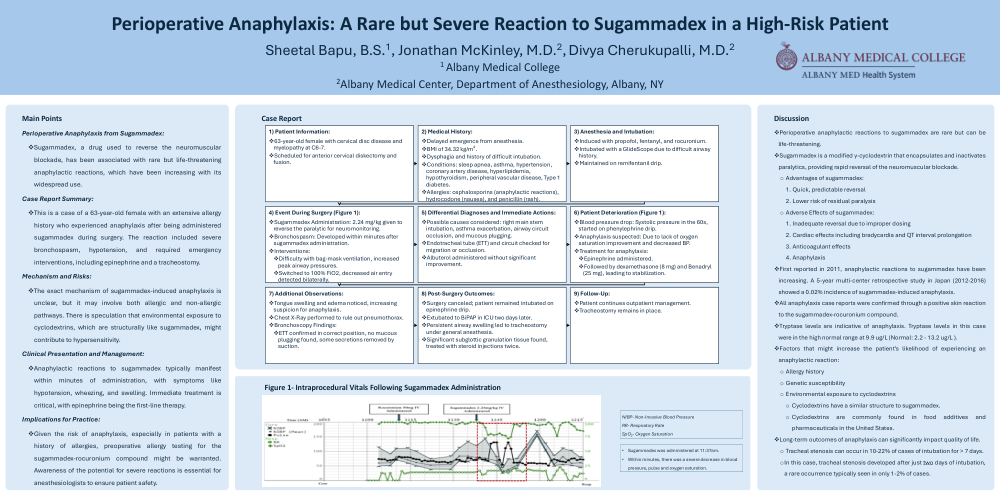
- 4) Event During Surgery (Figure 1):
- Sugammadex administration: 2.24 mg/kg given to reverse the paralytic for neuromonitoring.
- Bronchospasm: Developed within minutes after sugammadex administration.
- Interventions:
- Difficulty with bag-mask ventilation, increased peak airway pressures.
- Switched to 100% FiO2, decreased air entry detected bilaterally.
- 5) Differential Diagnoses and Immediate Actions:
- Possible causes considered: right main stem intubation, asthma exacerbation, airway circuit occlusion, and mucous plugging.
- Endotracheal tube (ETT) and circuit checked for migration or occlusion.
- Albuterol administered without significant improvement.
- 6) Patient Deterioration (Figure 1):
- Blood pressure drop: Systolic pressure in the 60s, started on phenylephrine drip.
- Anaphylaxis suspected: Due to lack of oxygen saturation improvement and decreased BP.
- Treatment for anaphylaxis:
- Epinephrine administered.
- Followed by dexamethasone (8 mg) and Benadryl (25 mg), leading to stabilization.
- 7) Additional Observations:
- Tongue swelling and edema noticed, increasing suspicion for anaphylaxis.
- Chest X-Ray performed to rule out pneumothorax.
- Bronchoscopy findings: ETT confirmed in correct position, no mucous plugging found, some secretions removed by suction.
- 8) Post-Surgery Outcomes:
- Surgery canceled; patient remained intubated on epinephrine drip.
- Extubated to BiPAP in ICU two days later.
- Persistent airway swelling led to tracheostomy under general anesthesia.
- Significant subglottic granulation tissue found, treated with steroid injections twice.
- 9) Follow-Up:
- Patient continues outpatient management.
- Tracheostomy remains in place.
Figure 1- Intraprocedural Vitals Following Sugammadex Administration
- Sugammadex was administered at 11:37am.
- Within minutes, there was a severe decrease in blood pressure, pulse and oxygen saturation.
Discussion
- Perioperative anaphylactic reactions to sugammadex are rare but can be life-threatening.
- Sugammadex is a modified γ-cyclodextrin that encapsulates and inactivates paralytics, providing rapid reversal of the neuromuscular blockade.
- Advantages of Sugammadex:
- 1.Quick, predictable reversal
- 2.Lower risk of residual paralysis
- Adverse effects of sugammadex:
- 1.Inadequate reversal due to improper dosing
- 2.Cardiac effects including bradycardia and QT interval prolongation
- 3.Anticoagulant effects
- 4.Anaphylaxis
- First reported in 2011, anaphylactic reactions to sugammadex have been increasing. A 5-year multi-center retrospective study in Japan (2012-2016) showed a 0.02% incidence of sugammadex-induced anaphylaxis.
- All anaphylaxis case reports were confirmed through a positive skin reaction to the sugammadex-rocuronium compound.
- Tryptase levels are indicative of anaphylaxis. Tryptase levels in this case were in the high normal range at 9.9 ug/L (Normal: 2.2 - 13.2 ug/L ).
- Factors that might increase the patient’s likelihood of experiencing an anaphylactic reaction:
- Allergy history
- Genetic susceptibility
- Environmental exposure to cyclodextrins
- Cyclodextrins have a similar structure to sugammadex.
- Cyclodextrins are commonly found in food additives and pharmaceuticals in the United States.
- Long-term outcomes of anaphylaxis can significantly impact quality of life.
- Tracheal stenosis can occur in 10-22% of cases of intubation for > 7 days.
- In this case, tracheal stenosis developed after just two days of intubation, a rare occurrence typically seen in only 1-2% of cases.