334 posters, 125 sessions, 831 authors, 236 institutions
ePostersLive by SciGen Technologies S.A. All rights reserved.
78th Annual PostGraduate Assembly in Anesthesiology (PGA78) 2024
December 6 - 9, 2024 | New York City

3065
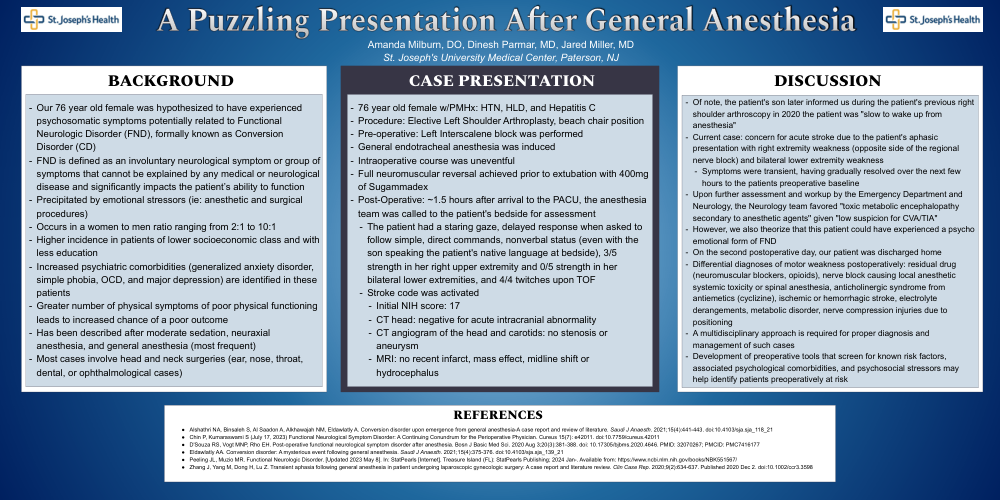
A Puzzling Presentation After General Anesthesia
Poster Presenter
Part of Topic
A Puzzling Presentation After General Anesthesia
Background:
-
Our 76 year old female was hypothesized to have experienced psychosomatic symptoms potentially related to Functional Neurologic Disorder (FND), formally known as Conversion Disorder (CD)
-
FND is defined as an involuntary neurological symptom or group of symptoms that cannot be explained by any medical or neurological disease and significantly impacts the patient’s ability to function
-
Precipitated by emotional stressors (ie: anesthetic and surgical procedures)
-
Occurs in a women to men ratio ranging from 2:1 to 10:1
-
Higher incidence in patients of lower socioeconomic class and with less education
-
Increased psychiatric comorbidities (generalized anxiety disorder, simple phobia, OCD, and major depression) are identified in these patients
-
Greater number of physical symptoms of poor physical functioning leads to increased chance of a poor outcome
-
Has been described after moderate sedation, neuraxial anesthesia, and general anesthesia (most frequent)
-
Most cases involve head and neck surgeries (ear, nose, throat, dental, or ophthalmological cases)
-
76 year old female w/PMHx: HTN, HLD, and Hepatitis C
-
Procedure: Elective Left Shoulder Arthroplasty, beach chair position
-
Pre-operative: Left Interscalene block was performed
-
General endotracheal anesthesia was induced
-
Intraoperative course was uneventful
-
Full neuromuscular reversal achieved prior to extubation with 400mg of Sugammadex
-
Post-Operative: ~1.5 hours after arrival to the PACU, the anesthesia team was called to the patient's bedside for assessment
-
The patient had a staring gaze, delayed response when asked to follow simple, direct commands, nonverbal status (even with the son speaking the patient's native language at bedside), 3/5 strength in her right upper extremity and 0/5 strength in her bilateral lower extremities, and 4/4 twitches upon TOF
-
Stroke code was activated
-
Initial NIH score: 17
-
CT head: negative for acute intracranial abnormality
-
CT angiogram of the head and carotids: no stenosis or aneurysm
-
MRI: no recent infarct, mass effect, midline shift or hydrocephalus
-
Of note, the patient's son later informed us during the patient's previous right shoulder arthroscopy in 2020 the patient was "slow to wake up from anesthesia"
-
Current case: concern for acute stroke due to the patient's aphasic presentation with right extremity weakness (opposite side of the regional nerve block) and bilateral lower extremity weakness
-
Symptoms were transient, having gradually resolved over the next few hours to the patients preoperative baseline
-
Upon further assessment and workup by the Emergency Department and Neurology, the Neurology team favored "toxic metabolic encephalopathy secondary to anesthetic agents'' given "low suspicion for CVA/TIA"
-
However, we also theorize that this patient could have experienced a psycho emotional form of FND
-
On the second postoperative day, our patient was discharged home
-
Differential diagnoses of motor weakness postoperatively: residual drug (neuromuscular blockers, opioids), nerve block causing local anesthetic systemic toxicity or spinal anesthesia, anticholinergic syndrome from antiemetics (cyclizine), ischemic or hemorrhagic stroke, electrolyte derangements, metabolic disorder, nerve compression injuries due to positioning
-
A multidisciplinary approach is required for proper diagnosis and management of such cases
-
Development of preoperative tools that screen for known risk factors, associated psychological comorbidities, and psychosocial stressors may help identify patients preoperatively at risk
-
Alshathri NA, Binsaleh S, Al Saadon A, Alkhawajah NM, Eldawlatly A. Conversion disorder upon emergence from general anesthesia-A case report and review of literature. Saudi J Anaesth. 2021;15(4):441-443. doi:10.4103/sja.sja_118_21
-
Chin P, Kumaraswami S (July 17, 2023) Functional Neurological Symptom Disorder: A Continuing Conundrum for the Perioperative Physician. Cureus 15(7): e42011. doi:10.7759/cureus.42011
-
D'Souza RS, Vogt MNP, Rho EH. Post-operative functional neurological symptom disorder after anesthesia. Bosn J Basic Med Sci. 2020 Aug 3;20(3):381-388. doi: 10.17305/bjbms.2020.4646. PMID: 32070267; PMCID: PMC7416177.
-
Eldawlatly AA. Conversion disorder: A mysterious event following general anesthesia. Saudi J Anaesth. 2021;15(4):375-376. doi:10.4103/sja.sja_139_21
-
Peeling JL, Muzio MR. Functional Neurologic Disorder. [Updated 2023 May 8]. In: StatPearls [Internet]. Treasure Island (FL): StatPearls Publishing; 2024 Jan-. Available from: https://www.ncbi.nlm.nih.gov/books/NBK551567/
-
Zhang J, Yang M, Dong H, Lu Z. Transient aphasia following general anesthesia in patient undergoing laparoscopic gynecologic surgery: A case report and literature review. Clin Case Rep. 2020;9(2):634-637. Published 2020 Dec 2. doi:10.1002/ccr3.3598