334 posters, 125 sessions, 831 authors, 236 institutions
ePostersLive by SciGen Technologies S.A. All rights reserved.
78th Annual PostGraduate Assembly in Anesthesiology (PGA78) 2024
December 6 - 9, 2024 | New York City

3064
Perioperative management of a patient with Stiff Person Syndrome undergoing Anterior Cervical Discectomy and Fusion
Poster Presenter
Part of Topic
Perioperative Management of a Patient with Stiff Person Syndrome Undergoing Anterior Cervical Discectomy and Fusion
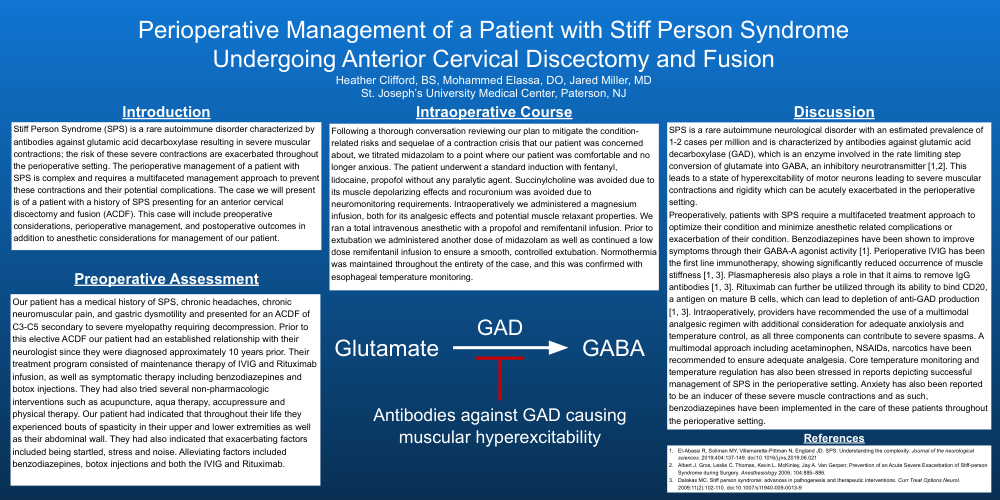
Stiff Person Syndrome (SPS) is a rare autoimmune disorder characterized by antibodies against glutamic acid decarboxylase resulting in severe muscular contractions; the risk of these severe contractions are exacerbated throughout the perioperative setting. The perioperative management of a patient with SPS is complex and requires a multifaceted management approach to prevent these contractions and their potential complications. The case we will present is of a patient with a history of SPS presenting for an anterior cervical discectomy and fusion (ACDF). This case will include preoperative considerations, perioperative management, and postoperative outcomes in addition to anesthetic considerations for management of our patient.
Our patient has a medical history of SPS, chronic headaches, chronic neuromuscular pain, and gastric dysmotility and presented for an ACDF of C3-C5 secondary to severe myelopathy requiring decompression. Prior to this elective ACDF our patient had an established relationship with their neurologist since they were diagnosed approximately 10 years prior. Their treatment program consisted of maintenance therapy of IVIG and Rituximab infusion, as well as symptomatic therapy including benzodiazepines and botox injections. They had also tried several non-pharmacologic interventions such as acupuncture, aqua therapy, accupressure and physical therapy. Our patient had indicated that throughout their life they experienced bouts of spasticity in their upper and lower extremities as well as their abdominal wall. They had also indicated that exacerbating factors included being startled, stress and noise. Alleviating factors included benzodiazepines, botox injections and both the IVIG and Rituximab.
Following a thorough conversation reviewing our plan to mitigate the condition-related risks and sequelae of a contraction crisis that our patient was concerned about, we titrated midazolam to a point where our patient was comfortable and no longer anxious. The patient underwent a standard induction with fentanyl, lidocaine, propofol without any paralytic agent. Succinylcholine was avoided due to its muscle depolarizing effects and rocuronium was avoided due to neuromonitoring requirements. Intraoperatively we administered a magnesium infusion, both for its analgesic effects and potential muscle relaxant properties. We ran a total intravenous anesthetic with a propofol and remifentanil infusion. Prior to extubation we administered another dose of midazolam as well as continued a low dose remifentanil infusion to ensure a smooth, controlled extubation. Normothermia was maintained throughout the entirety of the case, and this was confirmed with esophageal temperature monitoring.
SPS is a rare autoimmune neurological disorder with an estimated prevalence of 1-2 cases per million and is characterized by antibodies against glutamic acid decarboxylase (GAD), which is an enzyme involved in the rate limiting step conversion of glutamate into GABA, an inhibitory neurotransmitter [1,2]. This leads to a state of hyperexcitability of motor neurons leading to severe muscular contractions and rigidity which can be acutely exacerbated in the perioperative setting.
Preoperatively, patients with SPS require a multifaceted treatment approach to optimize their condition and minimize anesthetic related complications or exacerbation of their condition. Benzodiazepines have been shown to improve symptoms through their GABA-A agonist activity [1]. Perioperative IVIG has been the first line immunotherapy, showing significantly reduced occurrence of muscle stiffness [1, 3]. Plasmapheresis also plays a role in that it aims to remove IgG antibodies [1, 3]. Rituximab can further be utilized through its ability to bind CD20, a antigen on mature B cells, which can lead to depletion of anti-GAD production [1, 3]. Intraoperatively, providers have recommended the use of a multimodal analgesic regimen with additional consideration for adequate anxiolysis and temperature control, as all three components can contribute to severe spasms. A multimodal approach including acetaminophen, NSAIDs, narcotics have been recommended to ensure adequate analgesia. Core temperature monitoring and temperature regulation has also been stressed in reports depicting successful management of SPS in the perioperative setting. Anxiety has also been reported to be an inducer of these severe muscle contractions and as such, benzodiazepines have been implemented in the care of these patients throughout the perioperative setting.
-
El-Abassi R, Soliman MY, Villemarette-Pittman N, England JD. SPS: Understanding the complexity. Journal of the neurological sciences. 2019;404:137-149. doi:10.1016/j.jns.2019.06.021
-
Albert J. Gros, Leslie C. Thomas, Kevin L. McKinley, Jay A. Van Gerpen; Prevention of an Acute Severe Exacerbation of Stiff-person Syndrome during Surgery. Anesthesiology 2006; 104:885–886.
-
Dalakas MC. Stiff person syndrome: advances in pathogenesis and therapeutic interventions. Curr Treat Options Neurol. 2009;11(2):102-110. doi:10.1007/s11940-009-0013-9