334 posters, 125 sessions, 831 authors, 236 institutions
ePostersLive by SciGen Technologies S.A. All rights reserved.
78th Annual PostGraduate Assembly in Anesthesiology (PGA78) 2024
December 6 - 9, 2024 | New York City

3057
Posterior Femoral Cutaneous Neuropathy Treatment Following A Piriformis Release Surgery
Poster Presenter
Authors
Affiliations
Part of Topic
Posterior Femoral Cutaneous Neuropathy Following A Piriformis Release Surgery
Case History
-
A 48-year-old female with a past medical history of cervical myelopathy, migraines, axial low back pain, and fibromyalgia presented with right sided Piriformis syndrome. She experienced moderate, short-term improvement in symptoms following Right Superior Cluneal Nerve and Piriformis blocks by our pain management team
Patient Course
-
The patient elected to have surgical decompression of the right piriformis muscle and sciatic nerve by a neurosurgeon at our hospital. The surgery was well tolerated, and patient was discharged home on post op day 1.
-
Two weeks after the procedure, the patient returned to the emergency department. She was reporting severe right hip, gluteal, and lateral thigh pain around the area of incision. Pt described a burning and tenderness to light touch over the area around the incision site. The incision was examined by the neurosurgery team and noted to be healing well with no redness, swelling, drainage or other signs of infection.
-
Despite reassuring exam and imaging,, the patient continued to express uncontrolled pain in the right lateral thigh and we decided to proceed with a an ultrasound guided right posterior femoral cutaneous nerve block.
-
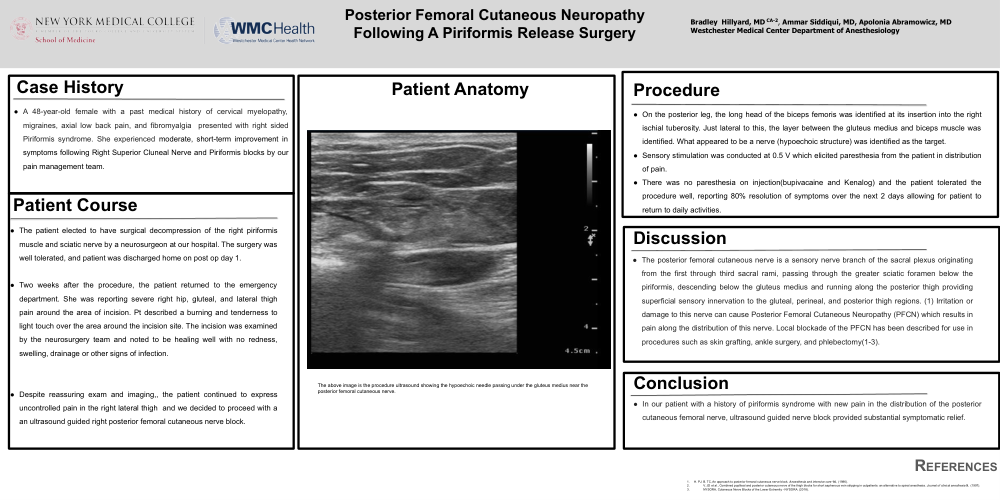
On the posterior leg, the long head of the biceps femoris was identified at its insertion into the right ischial tuberosity. Just lateral to this, the layer between the gluteus medius and biceps muscle was identified. What appeared to be a nerve (hypoechoic structure) was identified as the target.
-
Sensory stimulation was conducted at 0.5 V which elicited paresthesia from the patient in distribution of pain.
-
There was no paresthesia on injection(bupivacaine and Kenalog) and the patient tolerated the procedure well, reporting 80% resolution of symptoms over the next 2 days allowing for patient to return to daily activities.
Discussion
-
The posterior femoral cutaneous nerve is a sensory nerve branch of the sacral plexus originating from the first through third sacral rami, passing through the greater sciatic foramen below the piriformis, descending below the gluteus medius and running along the posterior thigh providing superficial sensory innervation to the gluteal, perineal, and posterior thigh regions. (1) Irritation or damage to this nerve can cause Posterior Femoral Cutaneous Neuropathy (PFCN) which results in pain along the distribution of this nerve. Local blockade of the PFCN has been described for use in procedures such as skin grafting, ankle surgery, and phlebectomy(1-3).
-
In our patient with a history of piriformis syndrome with new pain in the distribution of the posterior cutaneous femoral nerve, ultrasound guided nerve block provided substantial symptomatic relief.
REFERENCES
-
H. PJ, B. TC, An approach to posterior femoral cutaneous nerve block. Anaesthesia and intensive care14, (1986).
-
V. JD et al., Combined popliteal and posterior cutaneous nerve of the thigh blocks for short saphenous vein stripping in outpatients: an alternative to spinal anesthesia. Journal of clinical anesthesia9, (1997).
-
NYSORA, Cutaneous Nerve Blocks of the Lower Extremity - NYSORA. (2018).