334 posters, 125 sessions, 831 authors, 236 institutions
ePostersLive by SciGen Technologies S.A. All rights reserved.
78th Annual PostGraduate Assembly in Anesthesiology (PGA78) 2024
December 6 - 9, 2024 | New York City

3055
Severe hypotension and bradycardia after a routine interscalene block for shoulder surgery - Cancel or Proceed, a Clinical Dilemma.
Poster Presenter
Authors
Affiliations
Part of Topic
Severe hypotension and bradycardia after routine interscalene block for shoulder surgery: Cancel or Proceed, a Clinical Dilemma Dennis Howard BS, Sridhar Musuku MD, Divya Cherukupalli MD
Decision making on whether to proceed with surgery after hypotension and bradycardia after interscalene block
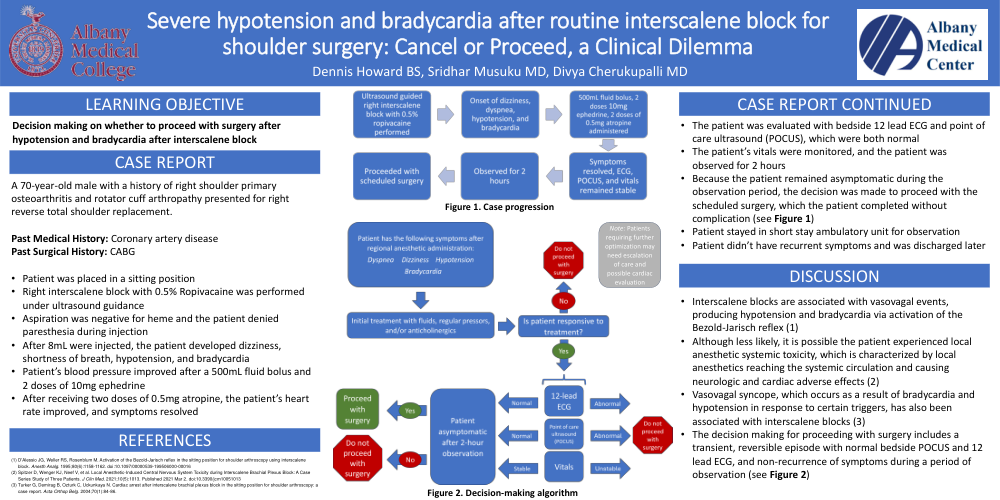
A 70-year-old male with a history of right shoulder primary osteoarthritis and rotator cuff arthropathy presented for right reverse total shoulder replacement. Past Medical History: Coronary artery disease Past Surgical History: CABG • Patient was placed in a sitting position • Right interscalene block with 0.5% Ropivacaine was performed under ultrasound guidance • Aspiration was negative for heme and the patient denied paresthesia during injection • After 8mL were injected, the patient developed dizziness, shortness of breath, hypotension, and bradycardia • Patient’s blood pressure improved after a 500mL fluid bolus and 2 doses of 10mg ephedrine • After receiving two doses of 0.5mg atropine, the patient’s heart rate improved, and symptoms resolved
The patient was evaluated with bedside 12 lead ECG and point of care ultrasound (POCUS), which were both normal • The patient’s vitals were monitored, and the patient was observed for 2 hours • Because the patient remained asymptomatic during the observation period, the decision was made to proceed with the scheduled surgery, which the patient completed without complication (see Figure 1) • Patient stayed in short stay ambulatory unit for observation • Patient didn’t have recurrent symptoms and was discharged later
Interscalene blocks are associated with vasovagal events, producing hypotension and bradycardia via activation of the Bezold-Jarisch reflex (1) • Although less likely, it is possible the patient experienced local anesthetic systemic toxicity, which is characterized by local anesthetics reaching the systemic circulation and causing neurologic and cardiac adverse effects (2) • Vasovagal syncope, which occurs as a result of bradycardia and hypotension in response to certain triggers, has also been associated with interscalene blocks (3) • The decision making for proceeding with surgery includes a transient, reversible episode with normal bedside POCUS and 12 lead ECG, and non-recurrence of symptoms during a period of observation (see Figure 2)