334 posters, 125 sessions, 831 authors, 236 institutions
ePostersLive by SciGen Technologies S.A. All rights reserved.
78th Annual PostGraduate Assembly in Anesthesiology (PGA78) 2024
December 6 - 9, 2024 | New York City

4153
Gaps in Enhanced Recovery After Liver Surgery Literature: Consideration of Social Determinants of Health
Poster Presenter
Part of Topic
Title: Gaps in Enhanced Recovery After Liver Surgery Literature: Considerations of Social Determinants of Health
Introduction
Disparities in race/ethnicity, socioeconomic status (SES), and other social determinants of health (SDOH) exist in surgical treatments and outcomes across various specialties, including liver surgery [1]. Research indicates that disadvantaged groups experience worse outcomes in liver surgery due to factors such as greater disease severity at presentation and implicit bias from providers [2].
Enhanced Recovery After Surgery (ERAS) protocols, which standardize perioperative care, have shown promise in improving surgical outcomes and reducing costs. ERAS has been shown to reduce racial differences in postoperative length of stay (LOS) in fields like colorectal surgery [3].
However, the impact of SDOH in ERAS protocols for liver surgery remains underexplored. We hypothesize that SDOH variables are underrepresented in ERAS liver surgery meta-analyses, creating a gap in understanding their influence on surgical outcomes. Our study aims to address this gap by reviewing existing literature and assessing the inclusion of SDOH in ERAS liver surgery studies.
Methods
We conducted a comprehensive review of four of the most recent and clinically relevant systematic reviews on ERAS protocols for liver surgery: Zhou et al. (2022), Delabays et al. (2024), Hughes et al. (2014), and Noba et al. (2020).
These reviews included a total of 46 studies, with 33 unique studies after excluding duplicates. We examined these studies for the inclusion of patient-level SDOH variables (race, ethnicity, income, insurance, education, geography) and hospital-level variables (safety-net burden status, hospital surgical volume, core-based statistical area, hospital type).
Additionally, 407 papers citing these systematic reviews were screened to identify any further mentions or analyses of SDOH in ERAS liver surgery outcomes.
Results
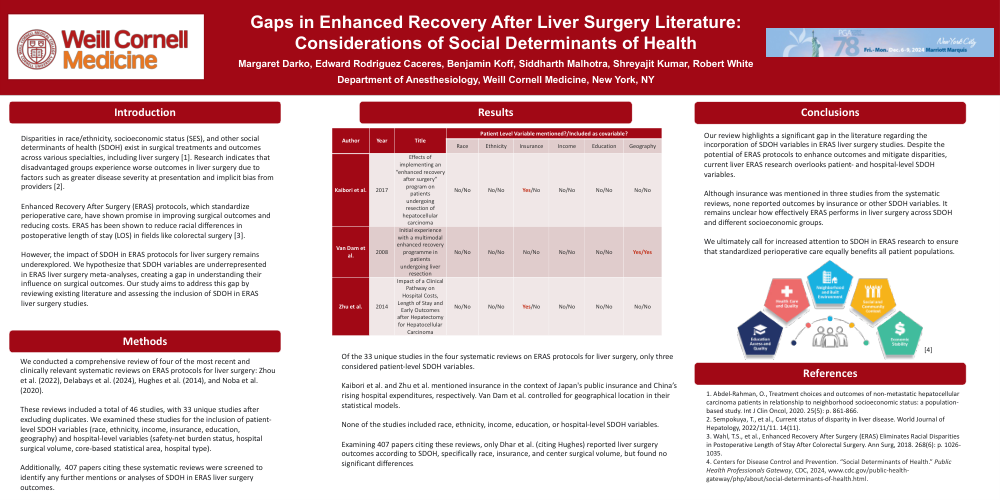
Of the 33 unique studies in the four systematic reviews on ERAS protocols for liver surgery, only three considered patient-level SDOH variables.
Kaibori et al. and Zhu et al. mentioned insurance in the context of Japan's public insurance and China’s rising hospital expenditures, respectively. Van Dam et al. controlled for geographical location in their statistical models.
None of the studies included race, ethnicity, income, education, or hospital-level SDOH variables.
Examining 407 papers citing these reviews, only Dhar et al. (citing Hughes) reported liver surgery outcomes according to SDOH, specifically race, insurance, and center surgical volume, but found no significant differences.
Conclusions
Our review highlights a significant gap in the literature regarding the incorporation of SDOH variables in ERAS liver surgery studies. Despite the potential of ERAS protocols to enhance outcomes and mitigate disparities, current liver ERAS research overlooks patient- and hospital-level SDOH variables.
Although insurance was mentioned in three studies from the systematic reviews, none reported outcomes by insurance or other SDOH variables. It remains unclear how effectively ERAS performs in liver surgery across SDOH and different socioeconomic groups. We ultimately call for increased attention to SDOH in ERAS research to ensure that standardized perioperative care equally benefits all patient populations.