Loading...

334 posters, 125 sessions, 831 authors, 236 institutions

ePostersLive by SciGen Technologies S.A. All rights reserved.

4112

Hospital Safety Net Burden is Associated with Perioperative Outcomes in Primary Total Hip Arthroplasty: A Multistate Retrospective Analysis, 2015-2020
Part of Topic

Title: Hospital Safety Net Burden is Associated with Perioperative Outcomes in Primary Total Hip Arthroplasty: A Multistate Retrospective Analysis, 2015-2020

Introduction
Total Hip Arthroplasty (THA) is one of the most commonly performed surgical procedures annually in the United States. While disparities in THA outcomes have been extensively studied in terms of patient-level factors, there is limited research on the association between hospital-level factors such as hospital safety net burden (SNB) and THA outcomes on a large scale.

The sole previous multicenter analysis on disparities in THA outcomes included data only until 2014[1]. This study aims to augment previous work on the relationship between hospital safety net burden and THA outcomes by analyzing multicenter, multistate, multilevel data from 2015- 2020.

Methods
•A retrospective study analyzing admission records for inpatient primary THA using data from the Healthcare Cost and Utilization Project’s State Inpatient Databases[2] for Florida, Kentucky, Maryland, New York, Washington, New Jersey, and North Carolina from 2015 to 2020.
•Independent Variable: Hospital safety net burden (defined as proportion of services billed to Medicaid and uninsured patients in an individual hospital; divided into tertiles).
•We used descriptive statistics to assess demographic data, present-on-admission comorbidities and hospital characteristics across hospital safety net burden categories (low, medium, and high).
•Generalized linear mixed models (GLMMs) and multilevel negative binomial regression were estimated to assess the association between safety net burden status and the following THA outcomes: in-hospital mortality and postoperative complications, length of stay.
•Adjusted odds ratios (aOR) and adjusted incidence rate ratios (aIRR) along with 95% confidence intervals (95% CI) are reported.
 
Results
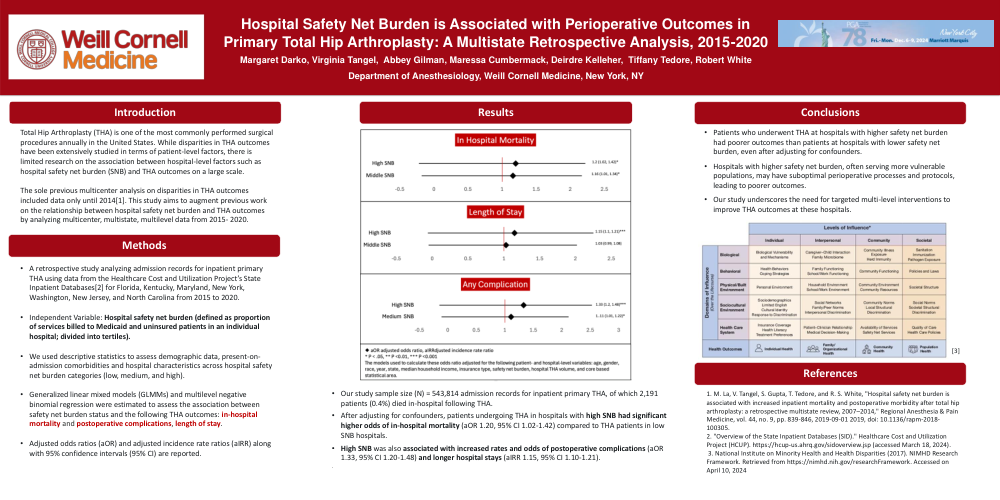
•Our study sample size (N) = 543,814 admission records for inpatient primary THA, of which 2,191 patients (0.4%) died in-hospital following THA.
•After adjusting for confounders, patients undergoing THA in hospitals with high SNB had significant higher odds of in-hospital mortality (aOR 1.20, 95% CI 1.02-1.42) compared to THA patients in low SNB hospitals.
•High SNB was also associated with increased rates and odds of postoperative complications (aOR 1.33, 95% CI 1.20-1.48) and longer hospital stays (aIRR 1.15, 95% CI 1.10-1.21).

Conclusions
•Patients who underwent THA at hospitals with higher safety net burden had poorer outcomes than patients at hospitals with lower safety net burden, even after adjusting for confounders.
•Hospitals with higher safety net burden, often serving more vulnerable populations, may have suboptimal perioperative processes and protocols, leading to poorer outcomes.
•Our study underscores the need for targeted multi-level interventions to improve THA outcomes at these hospitals.

78th Annual PostGraduate Assembly in Anesthesiology (PGA78) 2024 » banner
Copyright © 2015-2026, ePostersLive® SciGen is a registered trademark of SciGen Technologies S.A. Patent pending.

This website and third-party tools we use rely on cookies for the best user experience. By selecting "I agree", you agree to cookie usage as described in our Privacy Policy.
