Loading...

334 posters, 125 sessions, 831 authors, 236 institutions

ePostersLive by SciGen Technologies S.A. All rights reserved.

4104

Sarcoidosis and 30-Day Perioperative Pulmonary Complications: A retrospective analysis.
Part of Topic

Sarcoidosis and Postoperative Pulmonary Complications: Clinical insights from a retrospective propensity overlap weighted analysis.

Jonah Freund, Claudia Clarke Gosalvez, Zyad J. Carr, M.D., FASA


Background: 

•Sarcoidosis is a rare systemic granulomatous disorder characterized by lung involvement but frequently involves the heart, gastrointestinal system and lymphatic organs.
•Typically presents in young and middle-aged adults.
•Significant geographic and racial variation (Black Americans: 2.4% cumulative lifetime risk vs. 0.85% in White Americans).
•Most common variant of pulmonary fibrosis.
•Studies suggest that cardiac causes (25%; congestive heart failure, myocardial infarction, arrhythmias) followed by pulmonary fibrosis (9%) constitute the primary causes of mortality.


Objective: 

•Few studies have investigated sarcoidosis-related postoperative cardiopulmonary complications.


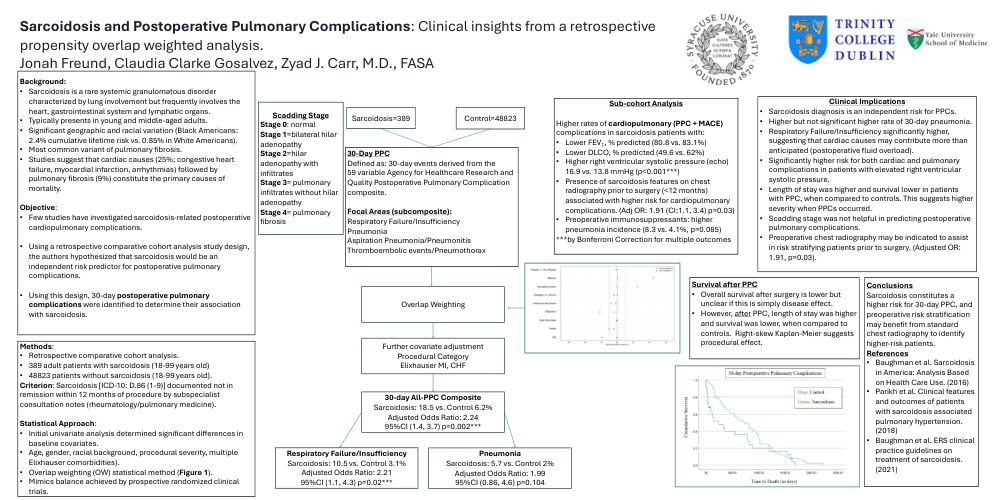
•Using a retrospective comparative cohort analysis study design, the authors hypothesized that sarcoidosis would be an independent risk predictor for postoperative pulmonary complications. 


•Using this design, 30-day postoperative pulmonary complications were identified to determine their association with sarcoidosis. 

Methods: 

•Retrospective comparative cohort analysis.
•389 adult patients with sarcoidosis (18-99 years old)
•48823 patients without sarcoidosis (18-99 years old).

Criterion: Sarcoidosis [ICD-10: D.86 (1-9)] documented not in remission within 12 months of procedure by subspecialist consultation notes (rheumatology/pulmonary medicine).


Statistical Approach: 

•Initial univariate analysis determined significant differences in baseline covariates.
•Age, gender, racial background, procedural severity, multiple Elixhauser comorbidities).
•Overlap weighting (OW) statistical method (Figure 1).
•Mimics balance achieved by prospective randomized clinical trials.

Scadding Stage

Stage 0: normal

Stage 1=bilateral hilar adenopathy

Stage 2=hilar adenopathy with infiltrates

Stage 3= pulmonary infiltrates without hilar adenopathy

Stage 4= pulmonary fibrosis


30-Day PPC

Defined as: 30-day events derived from the

59 variable Agency for Healthcare Research and Quality Postoperative Pulmonary Complication composite.


Focal Areas (subcomposite):

Respiratory Failure/Insufficiency

Pneumonia

Aspiration Pneumonia/Pneumonitis

Thromboembolic events/Pneumothorax


30-day All-PPC Composite

Sarcoidosis: 18.5 vs. Control 6.2%

Adjusted Odds Ratio: 2.24

95%CI (1.4, 3.7) p=0.002***


Respiratory Failure/Insufficiency

Sarcoidosis: 10.5 vs. Control 3.1%

Adjusted Odds Ratio: 2.21

95%CI (1.1, 4.3) p=0.02***


Pneumonia

Sarcoidosis: 5.7 vs. Control 2%

Adjusted Odds Ratio: 1.99

95%CI (0.86, 4.6) p=0.104


Sub-cohort Analysis


Higher rates of cardiopulmonary (PPC + MACE) complications in sarcoidosis patients with:

•Lower FEV1, % predicted (80.8 vs. 83.1%)
•Lower DLCO, % predicted (49.6 vs. 62%)
•Higher right ventricular systolic pressure (echo) 16.9 vs. 13.8 mmHg (p<0.001***)
•Presence of sarcoidosis features on chest radiography prior to surgery (<12 months) associated with higher risk for cardiopulmonary complications. (Adj OR: 1.91 (CI:1.1, 3.4) p=0.03)
•Preoperative immunosuppressants: higher pneumonia incidence (8.3 vs. 4.1%, p=0.085)

***by Bonferroni Correction for multiple outcomes


Survival after PPC

•Overall survival after surgery is lower but unclear if this is simply disease effect.
•However, after PPC, length of stay was higher and survival was lower, when compared to controls.  Right-skew Kaplan-Meier suggests procedural effect.


Clinical Implications

•Sarcoidosis diagnosis is an independent risk for PPCs.
•Higher but not significant higher rate of 30-day pneumonia.
•Respiratory Failure/Insufficiency significantly higher, suggesting that cardiac causes may contribute more than anticipated (postoperative fluid overload).
•Significantly higher risk for both cardiac and pulmonary complications in patients with elevated right ventricular systolic pressure.
•Length of stay was higher and survival lower in patients with PPC, when compared to controls. This suggests higher severity when PPCs occurred.
•Scadding stage was not helpful in predicting postoperative pulmonary complications.
•Preoperative chest radiography may be indicated to assist in risk stratifying patients prior to surgery. (Adjusted OR: 1.91, p=0.03).

Conclusions

Sarcoidosis constitutes a higher risk for 30-day PPC, and preoperative risk stratification may benefit from standard chest radiography to identify higher-risk patients.

References

•Baughman et al. Sarcoidosis in America: Analysis Based on Health Care Use. (2016)
•Parikh et al. Clinical features and outcomes of patients with sarcoidosis associated pulmonary hypertension. (2018)
•Baughman et al. ERS clinical practice guidelines on treatment of sarcoidosis. (2021)


78th Annual PostGraduate Assembly in Anesthesiology (PGA78) 2024 » banner
Copyright © 2015-2026, ePostersLive® SciGen is a registered trademark of SciGen Technologies S.A. Patent pending.

This website and third-party tools we use rely on cookies for the best user experience. By selecting "I agree", you agree to cookie usage as described in our Privacy Policy.
