334 posters, 125 sessions, 831 authors, 236 institutions
ePostersLive by SciGen Technologies S.A. All rights reserved.
78th Annual PostGraduate Assembly in Anesthesiology (PGA78) 2024
December 6 - 9, 2024 | New York City

4030
Low Gamma-Range Auditory Response: A Reliable Marker for Loss of Consciousness During General Anesthesia
Poster Presenter
Part of Topic
Low Gamma-Range Auditory Response: A Reliable Marker for Loss of Consciousness During General Anesthesia
BACKGROUND
Objective: To assess the attenuation of gamma-range responses to auditory stimulation during loss of consciousness under general anesthesia.
Prior Research: Studies have demonstrated1,2 that 40 Hz constant frequency stimulation— a measure sensitive to alterations in the thalamocortical loops essential for consciousness— is significantly attenuated during anesthesia.
Innovation: Building on these findings, our study explores Envelope Following Responses (EFR) to wide-band chirp-modulated stimulation, examining both low and high gamma frequencies to identify potential new markers for unconsciousness during anesthesia.
METHODS
Participants: 26 patients undergoing propofol-remifentanil total intravenous anesthesia (TIVA TCI)3,4.
Stimulation Protocols:
• Constant frequency 40-Hz stimulation, click-based
• Wide-band chirp-modulated stimulation in the range 30-100 Hz, click-based
Data Recording: EEG data were collected using a 64-channel amplifier system before anesthesia, during maintenance, and approximately 30 minutes post-awakening.
Monitoring: Standard monitoring, predicted effect-site concentrations of anesthetic agents (target-controlled infusion systems) and depth of anesthesia (bispectral index - BIS).
Analysis: EEG analysis focused on inter-trial phase clustering (ITPC) from 7 fronto-central channels employing a non-parametric cluster-based permutation procedure5
RESULTS
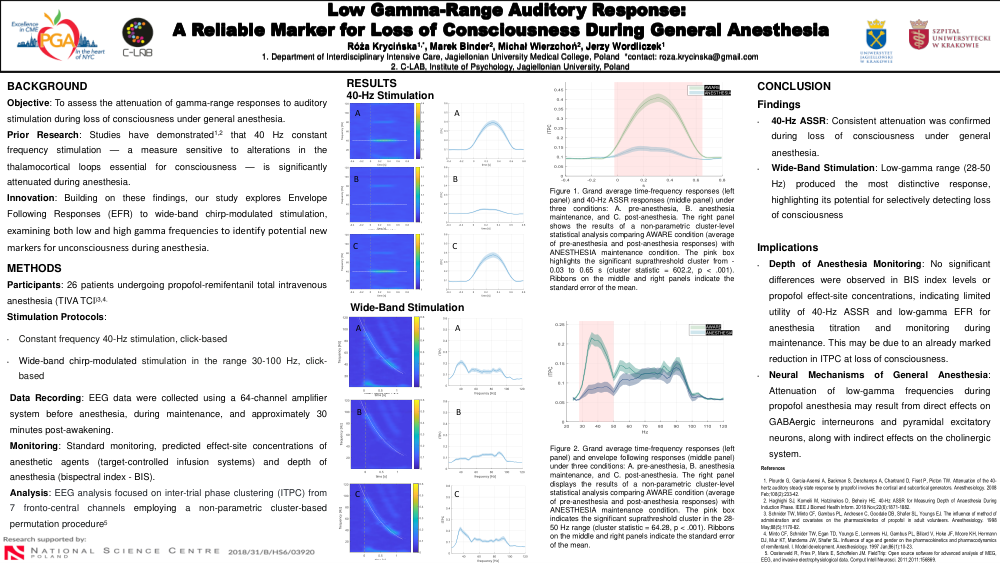
40-Hz Stimulation
Figure 1. Grand average time-frequency responses (left panel) and 40-Hz ASSR responses (middle panel) under three conditions: A. pre-anesthesia, B. anesthesia
maintenance, and C. post-anesthesia. The right panel shows the results of a non-parametric cluster-level statistical analysis comparing AWARE condition (average of pre-anesthesia and post-anesthesia responses) with ANESTHESIA maintenance condition. The pink box highlights the significant suprathreshold cluster from - 0.03 to 0.65 s (cluster statistic = 602.2, p <.001). Ribbons on the middle and right panels indicate the standard error of the mean.
Wide-Band Stimulation
Figure 2. Grand average time-frequency responses (left panel) and envelope following responses (middle panel) under three conditions: A. pre-anesthesia, B. anesthesia maintenance, and C. post-anesthesia. The right panel displays the results of a non-parametric cluster-level statistical analysis comparing AWARE condition (average of pre-anesthesia and post-anesthesia responses) with ANESTHESIA maintenance condition. The pink box indicates the significant suprathreshold cluster in the 28-50 Hz range (cluster statistic = 64.28, p <.001). Ribbonson the middle and right panels indicate the standard error of the mean.
CONCLUSION
Findings
• 40-Hz ASSR: Consistent attenuation was confirmed during loss of consciousness under general anesthesia.
• Wide-Band Stimulation: Low-gamma range (28-50 Hz) produced the most distinctive response, highlighting its potential for selectively detecting loss of consciousness
Implications
• Depth of Anesthesia Monitoring: No significant differences were observed in BIS index levels or propofol effect-site concentrations, indicating limited utility of 40-Hz ASSR and low-gamma EFR for anesthesia titration and monitoring during maintenance. This may be due to an already marked reduction in ITPC at loss of consciousness.
• Neural Mechanisms of General Anesthesia: Attenuation of low-gamma frequencies during propofol anesthesia may result from direct effects on GABAergic interneurons and pyramidal excitatory neurons, along with indirect effects on the cholinergic system.