334 posters, 125 sessions, 831 authors, 236 institutions
ePostersLive by SciGen Technologies S.A. All rights reserved.
78th Annual PostGraduate Assembly in Anesthesiology (PGA78) 2024
December 6 - 9, 2024 | New York City

5042
Emergency Medicine Difficult Airway Course – Educational Component of the URMC Difficult Airway Response Team (DART) Program
Poster Presenter
Part of Topic
Emergency Medicine Difficult Airway Course – Educational Component of the URMC Difficult Airway Response Team (DART) Program Courtney McPhee, MD; Tyler Lemay, MD; Chris Galton, MD, FASA; and Zana Borovcanin, MD, MSc, FASA Department of Emergency Medicine and Department of Anesthesiology and Perioperative Medicine; University of Rochester Medical Center, Rochester, NY
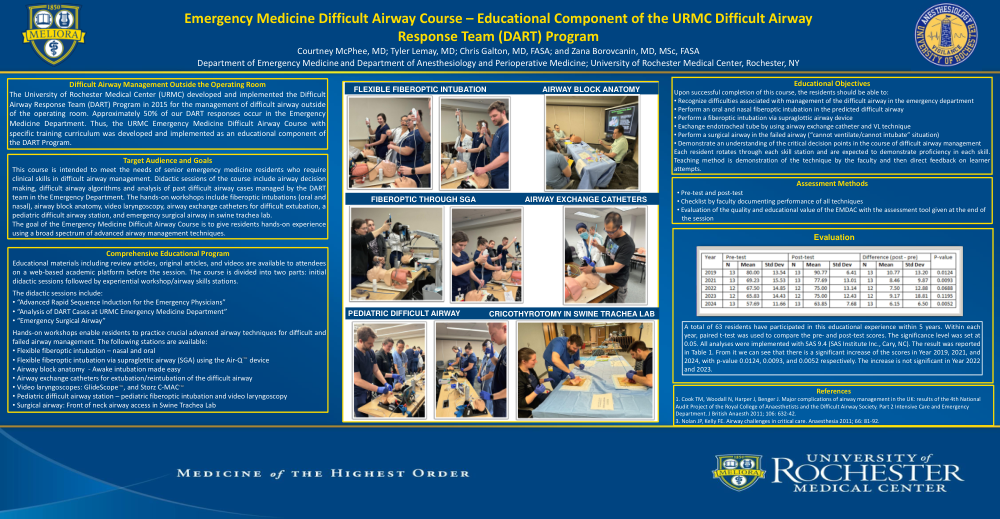
Difficult Airway Management Outside the Operating Room The University of Rochester Medical Center (URMC) developed and implemented the Difficult Airway Response Team (DART) Program in 2015 for the management of difficult airway outside of the operating room. Approximately 50% of our DART responses occur in the Emergency Medicine Department. Thus, the URMC Emergency Medicine Difficult Airway Course with specific training curriculum was developed and implemented as an educational component of the DART Program
Target Audience and Goals This course is intended to meet the needs of senior emergency medicine residents who require clinical skills in difficult airway management. Didactic sessions of the course include airway decision making, difficult airway algorithms and analysis of past difficult airway cases managed by the DART team in the Emergency Department. The hands-on workshops include fiberoptic intubations (oral and nasal), airway block anatomy, video laryngoscopy, airway exchange catheters for difficult extubation, a pediatric difficult airway station, and emergency surgical airway in swine trachea lab. The goal of the Emergency Medicine Difficult Airway Course is to give residents hands-on experience using a broad spectrum of advanced airway management techniques
Comprehensive Educational Program Educational materials including review articles, original articles, and videos are available to attendees on a web-based academic platform before the session. The course is divided into two parts: initial didactic sessions followed by experiential workshop/airway skills stations. The didactic sessions include: • “Advanced Rapid Sequence Induction for the Emergency Physicians” • “Analysis of DART Cases at URMC Emergency Medicine Department” • “Emergency Surgical Airway” Hands-on workshops enable residents to practice crucial advanced airway techniques for difficult and failed airway management. The following stations are available: • Flexible fiberoptic intubation – nasal and oral • Flexible fiberoptic intubation via supraglottic airway (SGA) using the Air-Q device • Airway block anatomy - Awake intubation made easy • Airway exchange catheters for extubation/reintubation of the difficult airway • Video laryngoscopes: GlideScope , and Storz C-MAC • Pediatric difficult airway station – pediatric fiberoptic intubation and video laryngoscopy • Surgical airway: Front of neck airway access in Swine Trachea Lab
Educational Objectives Upon successful completion of this course, the residents should be able to: • Recognize difficulties associated with management of the difficult airway in the emergency department • Perform an oral and nasal fiberoptic intubation in the predicted difficult airway • Perform a fiberoptic intubation via supraglottic airway device • Exchange endotracheal tube by using airway exchange catheter and VL technique • Perform a surgical airway in the failed airway (“cannot ventilate/cannot intubate” situation) • Demonstrate an understanding of the critical decision points in the course of difficult airway management Each resident rotates through each skill station and are expected to demonstrate proficiency in each skill. Teaching method is demonstration of the technique by the faculty and then direct feedback on learner attempts
Assessment Methods • Pre-test and post-test • Checklist by faculty documenting performance of all techniques • Evaluation of the quality and educational value of the EMDAC with the assessment tool given at the end of the session
Evaluation A total of 63 residents have participated in this educational experience within 5 years. Within each year, paired t-test was used to compare the pre- and post-test scores. The significance level was set at 0.05. All analyses were implemented with SAS 9.4 (SAS Institute Inc., Cary, NC). The result was reported in Table 1. From it we can see that there is a significant increase of the scores in Year 2019, 2021, and 2024, with p-value 0.0124, 0.0093, and 0.0052 respectively. The increase is not significant in Year 2022 and 2023
References 1. Cook TM, Woodall N, Harper J, Benger J. Major complications of airway management in the UK: results of the 4th National Audit Project of the Royal College of Anaesthetists and the Difficult Airway Society. Part 2 Intensive Care and Emergency Department. J British Anaesth 2011; 106: 632-42. 3. Nolan JP, Kelly FE. Airway challenges in critical care. Anaesthesia 2011; 66: 81-92.