334 posters, 125 sessions, 831 authors, 236 institutions
ePostersLive by SciGen Technologies S.A. All rights reserved.
78th Annual PostGraduate Assembly in Anesthesiology (PGA78) 2024
December 6 - 9, 2024 | New York City

5039
Optimizing TAVR Supplies for Cost Savings and Carbon Reduction
Poster Presenter
Authors
Affiliations
Part of Topic
Optimizing TAVR Supplies for Cost Savings and Carbon Reduction
Kyle McNeilis1, Muoi Trinh, MD2
1. A.T. Still University – School of Osteopathic Medicine in Arizona
2. Icahn School of Medicine at Mount Sinai
Introduction
• Historically, TAVR procedures have been performed with a back table of emergency sternotomy supplies set up to facilitate a quick response when needed. However, these supplies are now seldom utilized and must be discarded or reprocessed following a case, regardless of if they are used or not.
• Removing this setup from the OR back table, while still having the supplies readily available, reduces the cost and carbon footprint of this procedure while maintaining clinical outcomes.
• The Mount Sinai Hospital completes over 500 TAVR procedures annually. The incidence of emergency sternotomy is very rare; in 2022, no conversions were performed, and in 2023, 4 occurred (0.79%).
Intervention & Methods
• In 2022, emergency sternotomy supplies were removed from the OR case setup for TAVR procedures and were placed in the immediate patient care vicinity with a sterile drape covering them. The supplies were changed out every 2.5 cases, and the sterile drape was changed every case, unless the supplies were changed. In 2023, the emergency supplies were removed from the OR case setup entirely.
• Cost savings from the reduced use of disposable supplies and reprocessed equipment was calculated using procurement data.
• Carbon footprint reduction was estimated using procurement data and USEEIO carbon emissions factors.
Results
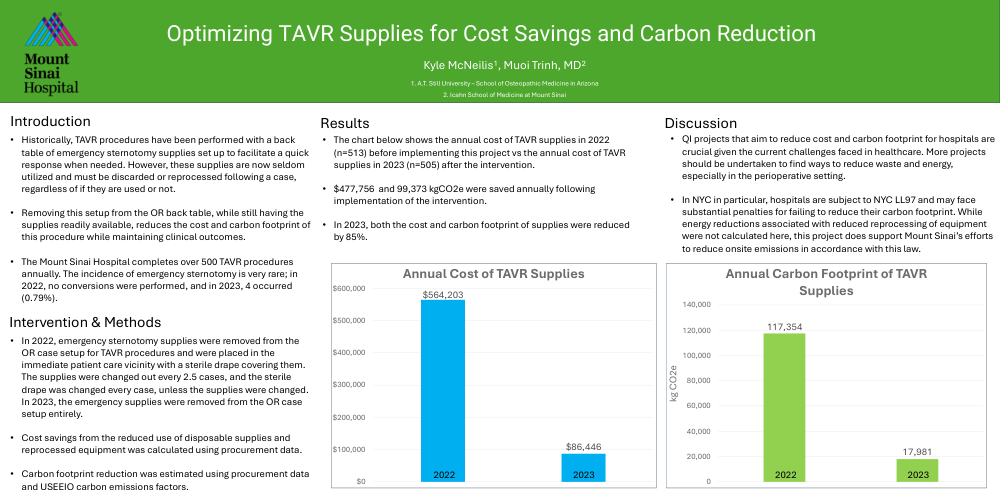
• The chart below shows the annual cost of TAVR supplies in 2022 (n=513) before implementing this project vs the annual cost of TAVR supplies in 2023 (n=505) after the intervention.
• $477,756 and 99,373 kgCO2e were saved annually following implementation of the intervention.
• In 2023, both the cost and carbon footprint of supplies were reduced by 85%.
Discussion
• QI projects that aim to reduce cost and carbon footprint for hospitals are crucial given the current challenges faced in healthcare. More projects should be undertaken to find ways to reduce waste and energy, especially in the perioperative setting.
• In NYC in particular, hospitals are subject to NYC LL97 and may face substantial penalties for failing to reduce their carbon footprint. While energy reductions associated with reduced reprocessing of equipment were not calculated here, this project does support Mount Sinai’s efforts to reduce onsite emissions in accordance with this law.