334 posters, 125 sessions, 831 authors, 236 institutions
ePostersLive by SciGen Technologies S.A. All rights reserved.
78th Annual PostGraduate Assembly in Anesthesiology (PGA78) 2024
December 6 - 9, 2024 | New York City

5032
Neuromuscular monitoring and reversal of blockade. A quality improvement project on current clinical practices
Poster Presenter
Authors
Affiliations
Part of Topic
Introduction
Residual neuromuscular blockade (NMB) poses significant challenges in medical practice due to its prevalence and associated complications. Current clinical tests for NMB recovery demonstrate limited effectiveness, highlighting the need for improved monitoring.
To address this, an evaluation of NMB monitoring practices was conducted at Royal Free Hospital, aiming to compare current practices in NMB monitoring with established standards as outlined in the 2021 AAGBI guidelines.
Aim
In November 2022, an audit assessed TOF monitoring documentation in cases requiring NMB over three days. Out of 73 cases, only qualitative TOF monitoring was documented in 6.8%. Following the presentation of these findings, quantitative TOF monitoring was integrated into clinical practice.
A follow-up audit in October 2023, revealed an increase in compliance to 12.0% across 67 cases, with 87.5% using quantitative TOF. Notably, there were no post-operative airway complications in either audit cycle.
Intervention Description
To improve compliance with AAGBI guidance on neuromuscular monitoring, several interventions were implemented:
1. Introduction of quantitative NMB monitoring at RFH and automatic data integration into the anaesthesia module.
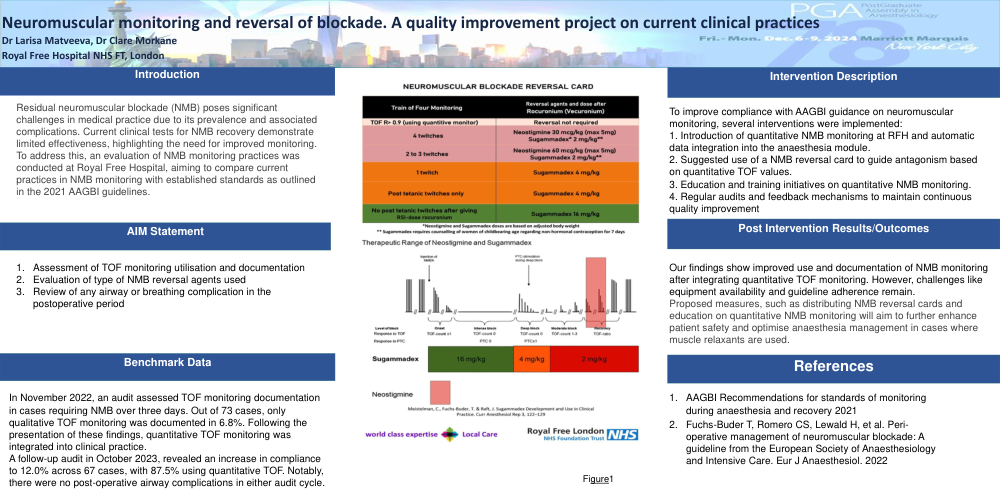
2. Suggested use of a NMB reversal card to guide antagonism based on quantitative TOF values.
3. Education and training initiatives on quantitative NMB monitoring.
4. Regular audits and feedback mechanisms to maintain continuous quality improvement
Post intervention Results/ Outcomes
Our findings show improved use and documentation of NMB monitoring after integrating quantitative TOF monitoring. However, challenges like equipment availability and guideline adherence remain.
Proposed measures, such as distributing NMB reversal cards and education on quantitative NMB monitoring will aim to further enhance patient safety and optimise anaesthesia management in cases where muscle relaxants are used.