334 posters, 125 sessions, 831 authors, 236 institutions
ePostersLive by SciGen Technologies S.A. All rights reserved.
78th Annual PostGraduate Assembly in Anesthesiology (PGA78) 2024
December 6 - 9, 2024 | New York City

5011
Improving Detection of Maternal Hypotension After Epidural on L&D Floor?
Poster Presenter
Part of Topic
Epidural analgesia is the safest form of labor analgesia. Sympathectomy after epidural load can lead to decrease in systemic vascular resistance and peripheral vasodilation. As the placenta lacks autoregulation, placental perfusion is directly dependent on uterine perfusion.
Maternal hypotension after epidural can decrease uterine perfusion and lead to fetal distress and bradycardia. Hypotension is defined as a 20% or greater decrease from baseline systolic BP. Main stay of treatment is a bolus of phenylephrine or ephedrine.
Early detection of hypotension, its communication with OB anesthesia team by nursing and timely treatment can avoid fetal complications.
OBJECTIVE
The aim of this QI initiative was to improve detection of hypotension after epidural on L&D floor
SETTING
Montefiore Medical Center (MMC), an academic Health care network in the Bronx, New York, USA
QI METHODOLOGY
The Plan-Do-Study-Act methodology (PDSA) was used for this project
INTERVENTION
Identify the baseline BP, and patient specific threshold for hypotension, at epidural time out.
Complete charting after epidural placement at bedside to monitor for early hypotension.
Educate L&D nurses regarding threshold for alerting anesthesia provider of maternal hypotension after epidural placement.
Provide nursing with the anesthesia call room extension phone number to alert the resident/fellow.
Hypotension is defined as a fall in systolic BP of 20% or greater from baseline within 45 minutes of placement.
Within a one-week timeframe, 15% of sampled patients who received an epidural experienced hypotension
The anesthesia team was notified during 21.4% of these instances.
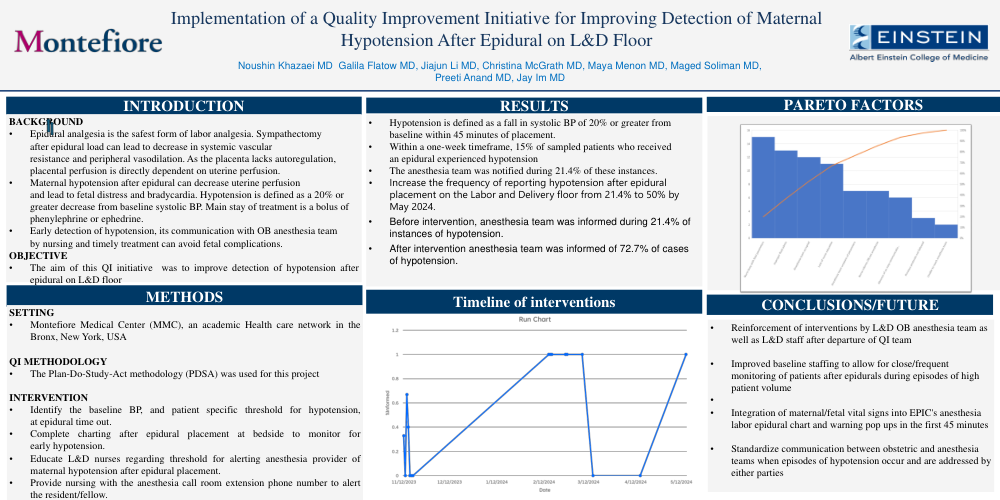
Increase the frequency of reporting hypotension after epidural placement on the Labor and Delivery floor from 21.4% to 50% by May 2024.
Before intervention, anesthesia team was informed during 21.4% of instances of hypotension.
After intervention anesthesia team was informed of 72.7% of cases of hypotension.
Reinforcement of interventions by L&D OB anesthesia team as well as L&D staff after departure of QI team
Improved baseline staffing to allow for close/frequent monitoring of patients after epidurals during episodes of high patient volume
Integration of maternal/fetal vital signs into EPIC's anesthesia labor epidural chart and warning pop ups in the first 45 minutes
Standardize communication between obstetric and anesthesia teams when episodes of hypotension occur and are addressed by either parties