334 posters, 125 sessions, 831 authors, 236 institutions
ePostersLive by SciGen Technologies S.A. All rights reserved.
78th Annual PostGraduate Assembly in Anesthesiology (PGA78) 2024
December 6 - 9, 2024 | New York City

5009
IMPROVING OPERATING ROOM ACCESS FOR ADULT AND PEDIATRIC PATIENTS UNDERGOING DENTAL REHABILITATION
Poster Presenter
Authors
Affiliations
Part of Topic
Improving Operating Room Access for Adult and Pediatric Patients Undergoing Dental Rehabilitation
Background
Efficient utilization of OR block time in adult and pediatric dental rehabilitation is essential for increasing the number of patients treated and minimizing delays that lead to chronic tooth pain, infections, and potentially life-threatening fascial space involvement. Accurate estimation of procedure time is a crucial element for optimizing OR block utilization . However, in our OR, the accuracy for predicting procedure times is less than 35%, largely due to the challenges of obtaining preoperative diagnostic X-rays in this patient population. Inability to determine the exact treatment required and therefore accurately forecasting procedure times significantly hampers the efficient use of allotted OR block time.
Hypothesis
We hypothesize we could use patient factors to improve the accuracy of procedure time prediction in dental rehabilitation, thereby optimizing OR scheduling, and block time utilization. In our OR, procedure time is defined as accurately predicted if it is within 15% of the actual procedure time.
Method
Data Collection: We reviewed the records of 255 cases, documenting patient factors (age, weight, BMI, and ASA), operative treatment, and both estimated and actual procedure times.
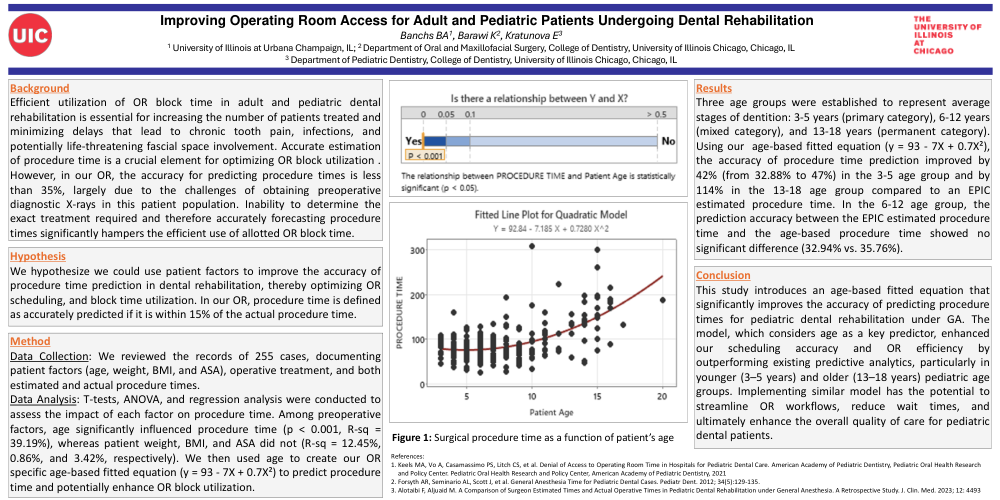
Data Analysis: T-tests, ANOVA, and regression analysis were conducted to assess the impact of each factor on procedure time. Among preoperative factors, age significantly influenced procedure time (p < 0.001, R-sq = 39.19%), whereas patient weight, BMI, and ASA did not (R-sq = 12.45%, 0.86%, and 3.42%, respectively). We then used age to create our OR specific age-based fitted equation (y = 93 - 7X + 0.7X²) to predict procedure time and potentially enhance OR block utilization.
Results
Three age groups were established to represent average stages of dentition: 3-5 years (primary category), 6-12 years (mixed category), and 13-18 years (permanent category). Using our age-based fitted equation (y = 93 - 7X + 0.7X²), the accuracy of procedure time prediction improved by 42% (from 32.88% to 47%) in the 3-5 age group and by 114% in the 13-18 age group compared to an EPIC estimated procedure time. In the 6-12 age group, the prediction accuracy between the EPIC estimated procedure time and the age-based procedure time showed no significant difference (32.94% vs. 35.76%).
Conclusion
This study introduces an age-based fitted equation that significantly improves the accuracy of predicting procedure times for pediatric dental rehabilitation under GA. The model, which considers age as a key predictor, enhanced our scheduling accuracy and OR efficiency by outperforming existing predictive analytics, particularly in younger (3–5 years) and older (13–18 years) pediatric age groups. Implementing similar model has the potential to streamline OR workflows, reduce wait times, and ultimately enhance the overall quality of care for pediatric dental patients.