Loading...

334 posters, 125 sessions, 831 authors, 236 institutions

ePostersLive by SciGen Technologies S.A. All rights reserved.

5008

Anesthesiology Protocols For Environmental Emergencies
Part of Topic

Anesthesiology Protocols for Environmental Emergencies

Jacobs School of Medicine and Biomedical Sciences – Department of Anesthesiology

Joseph R. Current; Peter Natalzia, MD; Stacey A. Watt, MD, MBA, MHPE, FASA


Background

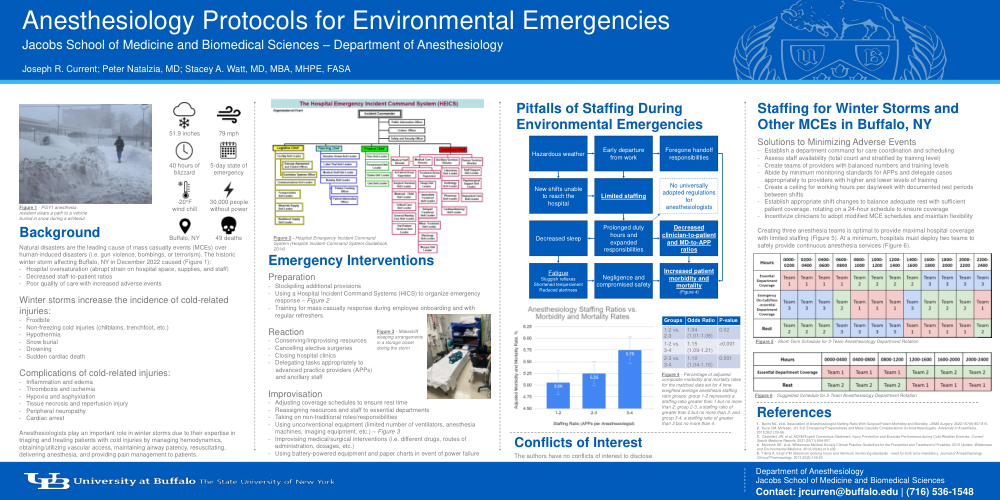
Natural disasters are the leading cause of mass casualty events (MCEs) over human-induced disasters (i.e. gun violence, bombings, or terrorism). The historic winter storm affecting Buffalo, NY in December 2022 caused (Figure 1):

-Hospital oversaturation (abrupt strain on hospital space, supplies, and staff)
-Decreased staff-to-patient ratios
-Poor quality of care with increased adverse events


Winter storms increase the incidence of cold-related injuries:

-Frostbite
-Non-freezing cold injuries (chilblains, trenchfoot, etc.)
-Hypothermia
-Snow burial
-Drowning
-Sudden cardiac death


Complications of cold-related injuries:

-Inflammation and edema
-Thrombosis and ischemia
-Hypoxia and asphyxiation
-Tissue necrosis and reperfusion injury
-Peripheral neuropathy
-Cardiac arrest
 

Anesthesiologists play an important role in winter storms due to their expertise in triaging and treating patients with cold injuries by managing hemodynamics, obtaining/utilizing vascular access, maintaining airway patency, resuscitating, delivering anesthesia, and providing pain management to patients.


Emergency Interventions

Preparation

-Stockpiling additional provisions
-Using a Hospital Incident Command Systems (HICS) to organize emergency response – Figure 2
-Training for mass casualty response during employee onboarding and with regular refreshers


Reaction

-Conserving/Improvising resources
-Cancelling elective surgeries
-Closing hospital clinics
-Delegating tasks appropriately to

advanced practice providers (APPs)

and ancillary staff


Improvisation

-Adjusting coverage schedules to ensure rest time
-Reassigning resources and staff to essential departments
-Taking on non-traditional roles/responsibilities
-Using unconventional equipment (limited number of ventilators, anesthesia machines, imaging equipment, etc.) – Figure 3
-Improvising medical/surgical interventions (i.e. different drugs, routes of administration, dosages, etc.)

Using battery-powered equipment and paper charts in event of power failure


Staffing for Winter Storms and Other MCEs in Buffalo, NY

Solutions to Minimizing Adverse Events

-Establish a department command for care coordination and scheduling
-Assess staff availability (total count and stratified by training level)
-Create teams of providers with balanced numbers and training levels
-Abide by minimum monitoring standards for APPs and delegate cases appropriately to providers with higher and lower levels of training
-Create a ceiling for working hours per day/week with documented rest periods between shifts
-Establish appropriate shift changes to balance adequate rest with sufficient patient coverage, rotating on a 24-hour schedule to ensure coverage
-Incentivize clinicians to adopt modified MCE schedules and maintain flexibility
 

Creating three anesthesia teams is optimal to provide maximal hospital coverage with limited staffing (Figure 5). At a minimum, hospitals must deploy two teams to safely provide continuous anesthesia services (Figure 6).


References

1.  Burns ML, et al. Association of Anesthesiologist Staffing Ratio With Surgical Patient Morbidity and Mortality. JAMA Surgery. 2022;157(9):807-815.
2.  Kuza CM, McIsaac, JH, 3rd. Emergency Preparedness and Mass Casualty Considerations for Anesthesiologists. Advances in Anesthesia. 2018;36(1):39-66.
3.  Castellani JW, et al. ACSM Expert Consensus Statement: Injury Prevention and Exercise Performance during Cold-Weather Exercise. Current Sports Medicine Reports. 2021;20(11):594-607.
4.  McIntosh SE, et al. Wilderness Medical Society Clinical Practice Guidelines for the Prevention and Treatment of Frostbite: 2019 Update. Wilderness and Environmental Medicine. 2019;30(4s):s19-s32.
5.  Trikha A, Singh PM. Maximum working hours and minimum monitoring standards - need for both to be mandatory. Journal of Anaesthesiology Clinical Pharmacology. 2013;29(2):149-50.


Conflicts of Interest

The authors have no conflicts of interest to disclose.


51.9 inches

79 mph

40 hours of blizzard

5-day state of emergency

-20°F wind chill

30,000 people without power

Buffalo, NY

49 deaths


Figure 1 - PGY1 anesthesia resident clears a path to a vehicle buried in snow during a whiteout

Figure 2 - Hospital Emergency Incident Command System (Hospital Incident Command System Guidebook, 2014)

Figure 3 - Makeshift sleeping arrangements in a storage closet during the storm

Figure 4 - Percentage of adjusted composite morbidity and mortality rates for the matched data set for 4 time-weighted average anesthesia staffing ratio groups: group 1-2 represents a staffing ratio greater than 1 but no more than 2; group 2-3, a staffing ratio of greater than 2 but no more than 3; and group 3-4, a staffing ratio of greater than 3 but no more than 4.

Figure 5 - Short-Term Schedule for 3-Team Anesthesiology Department Rotation

Figure 6 - Suggested Schedule for 2-Team Anesthesiology Department Rotation


Department of Anesthesiology
Jacobs School of Medicine and Biomedical Sciences

Contact: jrcurren@buffalo.edu | (716) 536-1548

78th Annual PostGraduate Assembly in Anesthesiology (PGA78) 2024 » banner
Copyright © 2015-2026, ePostersLive® SciGen is a registered trademark of SciGen Technologies S.A. Patent pending.

This website and third-party tools we use rely on cookies for the best user experience. By selecting "I agree", you agree to cookie usage as described in our Privacy Policy.
