334 posters, 125 sessions, 831 authors, 236 institutions
ePostersLive by SciGen Technologies S.A. All rights reserved.
78th Annual PostGraduate Assembly in Anesthesiology (PGA78) 2024
December 6 - 9, 2024 | New York City

4156
Evaluating Empathy in Pre-anesthesia Discussions
Poster Presenter
Part of Topic
Evaluating Empathy in Anesthesia Trainees During Pre-Anesthesia Patient Interactions
Authors: Oluwakemi Tomobi1, Catherine Gouge2, David Scalzo1, Alyssa Brashear3, Julie Huffmyer1, Edward Nemergut1, Rebekah Guillow1
- Department of Anesthesiology, West Virginia University
- Department of English, West Virginia University
- West Virginia University School of Medicine
Introduction:
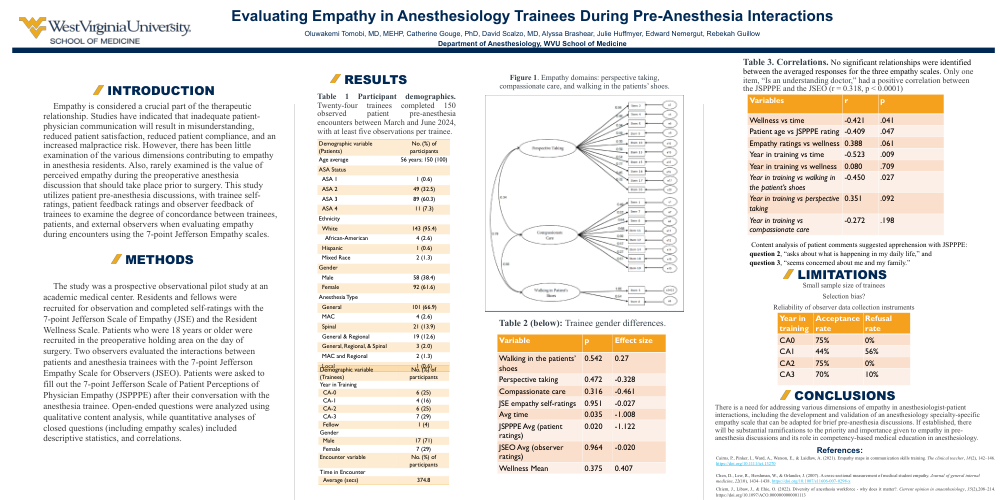
Empathy is considered a crucial part of the therapeutic relationship. Studies have indicated that inadequate patient-physician communication will result in misunderstanding, reduced patient satisfaction, reduced patient compliance, and an increased malpractice risk. However, there has been little examination of the various dimensions contributing to empathy in anesthesia residents. Also, rarely examined is the value of perceived empathy during the preoperative anesthesia discussion that should take place prior to surgery. This study utilizes patient pre-anesthesia discussions, with trainee self-ratings, patient feedback ratings and observer feedback of trainees to examine the degree of concordance between trainees, patients, and external observers when evaluating empathy during encounters using the 7-point Jefferson Empathy scales.
Methods:
The study was a prospective observational pilot study at an academic medical center. Residents and fellows were recruited for observation and completed self-ratings with the 7-point Jefferson Scale of Empathy (JSE) and the Resident Wellness Scale. Patients who were 18 years or older were recruited in the preoperative holding area on the day of surgery. Two observers evaluated the interactions between patients and anesthesia trainees with the 7-point Jefferson Empathy Scale for Observers (JSEO). Patients were asked to fill out the 7-point Jefferson Scale of Patient Perceptions of Physician Empathy (JSPPPE) after their conversation with the anesthesia trainee. Open-ended questions were analyzed using qualitative content analysis, while quantitative analyses of closed questions (including empathy scales) included descriptive statistics, and correlations.
Results:
Twenty-four trainees completed 150 observed patient pre-anesthesia encounters between March and June 2024, with at least five observations per trainee. There was a moderate, negative correlation between average seconds in patient interaction and wellness (r = -0.421, p=0.041), and a moderate, weakly positive correlation between the resident empathy scale and wellness (r=0.388, p=0.061). No significant relationships were identified between the averaged responses for the three empathy scales. Only one item, “Is an understanding doctor,” had a positive correlation between the JSPPPE and the JSEO (r = 0.318, p < 0.0001). In terms of gender differences, males spent significantly more time during the consultation than females (p = 0.042), and male trainees had significantly higher average ratings from patients (JSPPPE) than females (p = 0.045). There was no trainee gender difference from observer ratings. Content analysis of patient comments suggested apprehension with JSPPPE question 2, “asks about what is happening in my daily life,” and question 3, “seems concerned about me and my family.”
Conclusion:
There is a need for addressing various dimensions of empathy in anesthesiologist-patient interactions, including the development and validation of an anesthesiology specialty-specific empathy scale that can be adapted for brief pre-anesthesia discussions. If established, there will be substantial ramifications to the priority and importance given to empathy in pre-anesthesia discussions and its role in competency-based medical education in anesthesiology.