334 posters, 125 sessions, 831 authors, 236 institutions
ePostersLive by SciGen Technologies S.A. All rights reserved.
78th Annual PostGraduate Assembly in Anesthesiology (PGA78) 2024
December 6 - 9, 2024 | New York City

4147
Safety and Pharmacogenetics of Oxycodone for Post-Cesarean Section Pain and in Breastfed Neonates
Poster Presenter
Part of Topic
Safety and Pharmacogenetics of Oxycodone for Post-Cesarean Section Pain and in Breastfed Neonates
Snehi Shah, Sauren Baheti, Sylvia Lin, Dani Lavage, Alexandra Anderson, Rose Barlow, Taylor Troyan, Senthilkumar Sadhasivam
Department of Anesthesiology, University of Pittsburgh Magee Womens Hospital, University of Pittsburgh Medical Center, Pittsburgh, PA
Introduction:
•Opioids are prescribed to >80% of women post-cesarean delivery (CD)
•Codeine and tramadol are contraindicated in breastfeeding women due to sleepiness and breathing problems in breastfed infants
•Oxycodone and hydrocodone are metabolized by CYP2D6, as are codeine and tramadol, carrying the same risk for life-threatening respiratory depression (RD) in an infant breastfeeding from a UM mother
Objectives:
•To assess safety of oxycodone in nursing mothers after CD and in breastfed infants
•To evaluate the role of genetics in maternal and infant clinical outcomes with opioids after CD
Methods:
•Setting: Prospective collection of clinical and laboratory data assessing opioid-adverse effects (PONV and RD) in nursing mothers and sedation and breathing difficulty in infants
•Intervention: 5 mg Oxycodone administered every 4-6 hours as needed post-CD
•Maternal Primary Outcomes: opioid-adverse effects (PONV, RD & sedation) and dependence, and Numerical Rating Scale (NRS) Pain scores and total opioid use, length of hospital stay, chronic post-surgical pain, and persistent opioid use at 3 months
•Neonatal Outcomes: Increased sleepiness, difficulty breastfeeding/latching, breathing difficulties/cyanosis, limpness, and hypothermia
Results:
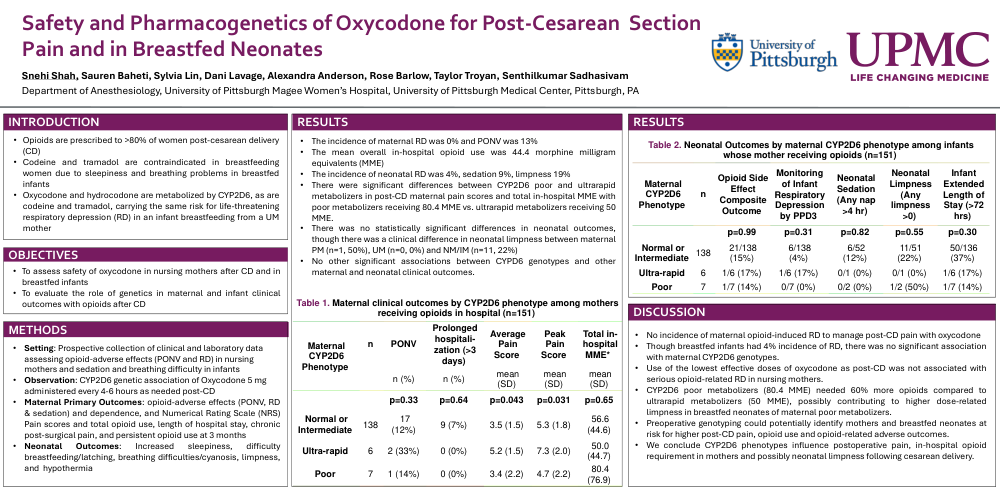
•The incidence of maternal RD was 0% and PONV was 13%
•The mean overall in-hospital opioid use was 44.4 morphine milligram equivalents (MME)
•The incidence of neonatal RD was 4%, sedation 9%, limpness 19%
•There were significant differences between CYP2D6 poor and ultrarapid metabolizers in post-CD pain scores, total in-hospital MME and neonatal limpness
•No other significant associations between CYPD6 genotypes and clinical outcomes
Discussion:
•No incidence of opioid-induced RD to manage post-CD pain with oxycodone
•Though breastfed infants had 4% incidence of RD, there was no significant association with maternal CYP2D6 genotypes
•Use of the lowest effective doses of oxycodone as post-CD was not associated with serious opioid-related RD in nursing mothers
•Preoperative genotyping could potentially identify mothers and breastfed neonates at risk for post-CD opioid use and some opioid-related adverse outcomes
•We conclude CYP2D6 polymorphisms influence oxycodone PK, postoperative pain and LOS in mothers and neonates following cesarean delivery