334 posters, 125 sessions, 831 authors, 236 institutions
ePostersLive by SciGen Technologies S.A. All rights reserved.
78th Annual PostGraduate Assembly in Anesthesiology (PGA78) 2024
December 6 - 9, 2024 | New York City

4144
Intraoperative Methadone in Adult Cardiac Surgical Patients and Risks for Postoperative QTc Prolongation
Poster Presenter
Part of Topic
Intraoperative Methadone in Adult Cardiac Surgical Patients and Risks for
Postoperative QTc Prolongation
Authors: Inesh Sivam, Sahana Sivam, Kathirvel Subramaniam, MD, MPH, Megan Rose McClain, MD, Roshni Cheema, MD, Danielle R. Lavage, MA, Luca La Colla, MD, FASE, Eli Hay, BS, Ibrahim Sultan, MD, Kimberly Howard-Quijano, MD, MS, Senthilkumar Sadhasivam, MD, MPH, MBA.
Introduction: Methadone, a long-acting opioid agonist, is widely utilized in early recovery after surgery pathways has surged in use due to documented benefits including reduced postoperative pain scores, diminished opioid need, and fewer adverse effects like nausea and vomiting compared to other opioids. In this large retrospective study, we investigated whether a single perioperative methadone dose significantly prolonged QTc interval of patients undergoing cardiac surgery and whether it correlated with adverse post-operative arrhythmias. We hypothesized that a single perioperative dose of methadone in cardiac surgical patients was not inferior in causing postoperative QTc prolongation and arrhythmias compared to the non-methadone control group. The aim was to evaluate the effect of intraoperative intravenous methadone within a standardized enhanced recovery after cardiac surgery (ERACS) pathway on perioperative QTc.
Methods: A large retrospective cohort study was conducted utilizing validated institutional electronic medical record data and Society of Thoracic Surgeons (STS) Adult Cardiac Surgery Database (ACSD) outcomes of 1040 patients undergoing cardiac surgery between July 2020 to July 2023 at University of Pittsburgh Medical Center affiliated hospitals utilizing validated institutional electronic medical record data and Society of Thoracic Surgeons (STS) Adult Cardiac Surgery Database (ACSD) outcomes. Exclusion criteria include emergency surgeries, transplants, ventricular assist device (VAD) placements, and patients with history of recent opioid abuse. Patients were administered intrathecal morphine ITM (0.25mg) or methadone (0.1mg/kg) if ITM was contraindicated, as part of an ERACS pathway utilizing current ERAS society guidelines. The primary outcomes for this study were change in corrected QT interval (DQTc) and the percent QTc change (D%QTc) when comparing preoperative baseline QTc to postoperative QTc upon ICU admission. The secondary outcomes include postoperative ventricular arrhythmias, postoperative atrial fibrillation, ICU LOS, 30-day mortality, 1-year mortality, and mortality days from surgery.
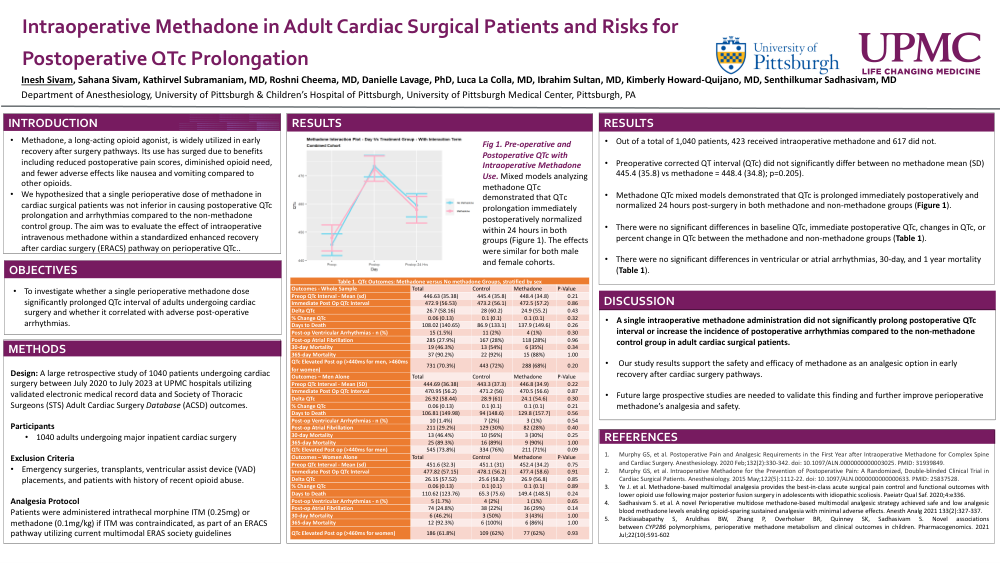
Results: Out of a total of 1,040 patients, 423 received intraoperative methadone and 617 did not. Preoperative corrected QT interval (QTc) did not significantly differ between no methadone mean (SD) 445.4 (35.8) vs methadone = 448.4 (34.8); p=0.205). Methadone QTc mixed models demonstrated that QTc is prolonged immediately postoperatively and normalized 24 hours post-surgery in both methadone and non-methadone groups. There were no significant differences in baseline QTc, immediate postoperative QTc, changes in QTc, or percent change in QTc between the methadone and non-methadone groups. There were no significant differences in ventricular or atrial arrhythmias, 30-day, and 1 year mortality.
Conclusions: In conclusion, the study findings support that a single intraoperative methadone administration did not significantly prolong postoperative QTc interval or increase the incidence of postoperative arrhythmias compared to the non-methadone control group in cardiac surgery patients. Our study results support the safety and efficacy of methadone as an analgesic option in early recovery after cardiac surgery pathways. Future large prospective studies are needed to validate this finding and further improve perioperative methadone’s analgesia and safety.