334 posters, 125 sessions, 831 authors, 236 institutions
ePostersLive by SciGen Technologies S.A. All rights reserved.
78th Annual PostGraduate Assembly in Anesthesiology (PGA78) 2024
December 6 - 9, 2024 | New York City

4139
A parametrization of the dying brain: Revelations from bed side ICU EEG monitoring
Part of Topic
A parametrization of the dying brain: Revelations from bedside ICU EEG monitoring
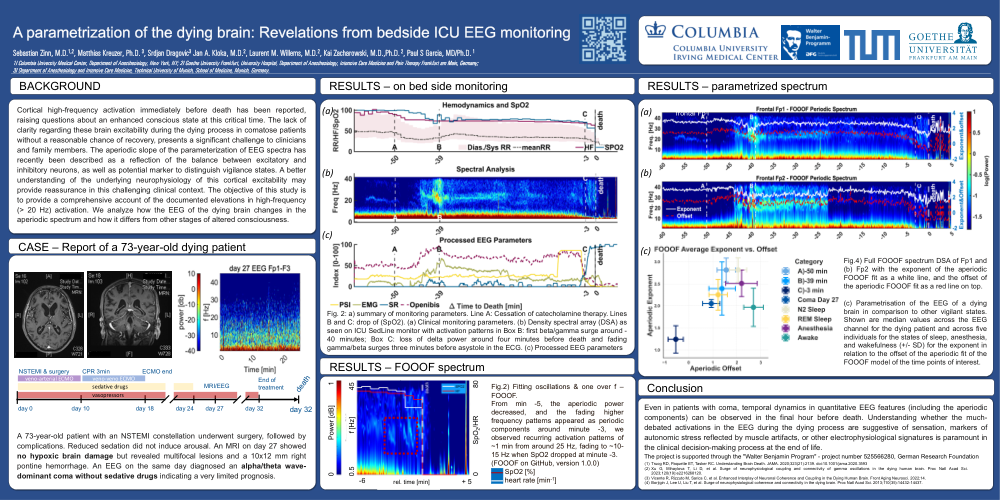
Cortical high-frequency activation immediately before death has been reported, raising questions about an enhanced conscious state at this critical time. The lack of clarity regarding these brain excitability during the dying process in comatose patients without a reasonable chance of recovery, presents a significant challenge to clinicians and family members. The aperiodic slope of the parameterization of EEG spectra has recently been described as a reflection of the balance between excitatory and inhibitory neurons, as well as potential marker to distinguish vigilance states. A better understanding of the underlying neurophysiology of this cortical excitability may provide reassurance in this challenging clinical context. The objective of this study is to provide a comprehensive account of the documented elevations in high-frequency (> 20 Hz) activation. We analyze how the EEG of the dying brain changes in the aperiodic spectrum and how it differs from other stages of altered consciousness.
A 73-year-old patient with an NSTEMI constellation underwent surgery, followed by complications. Reduced sedation did not induce arousal. An MRI on day 27 showedno hypoxic brain damage but revealed multifocal lesions and a 10x12 mm right pontine hemorrhage. An EEG on the same day diagnosed an alpha/theta wave-dominant coma without sedative drugsindicating a very limited prognosis.
Even in patients with coma, temporal dynamics in quantitative EEG features (including the aperiodic components) can be observed in the final hour before death.Understanding whether the much-debated activations in the EEG during the dying process are suggestive of sensation, markers of autonomic stress reflected by muscle artifacts, or other electrophysiological signatures is paramount in the clinical decision-making process at the end of life.
The project is supported through the "Walter Benjamin Program" - project number 525566280, German Research Foundation