334 posters, 125 sessions, 831 authors, 236 institutions
ePostersLive by SciGen Technologies S.A. All rights reserved.
78th Annual PostGraduate Assembly in Anesthesiology (PGA78) 2024
December 6 - 9, 2024 | New York City

4138
Relationship between aortic calcification and postoperative delirium in elderly patients undergoing spine surgery.
Part of Topic
Title: Relationship between aortic calcification and postoperative delirium in elderly patients undergoing spine surgery.
Introduction/Hypothesis: Postoperative delirium (POD) is a serious complication following anesthesia and surgery in elderly patients. The presence of aortic calcification has been reported to be associated with neurocognitive impairment in elderly patients, and it has also been reported to contribute to postoperative neurocognitive dysfunction in patients undergoing cardiac surgery. However, its effect on POD following non-cardiac surgery is unclear. In this study, we evaluated the effect of aortic calcification on POD in elderly patients undergoing spine surgery.
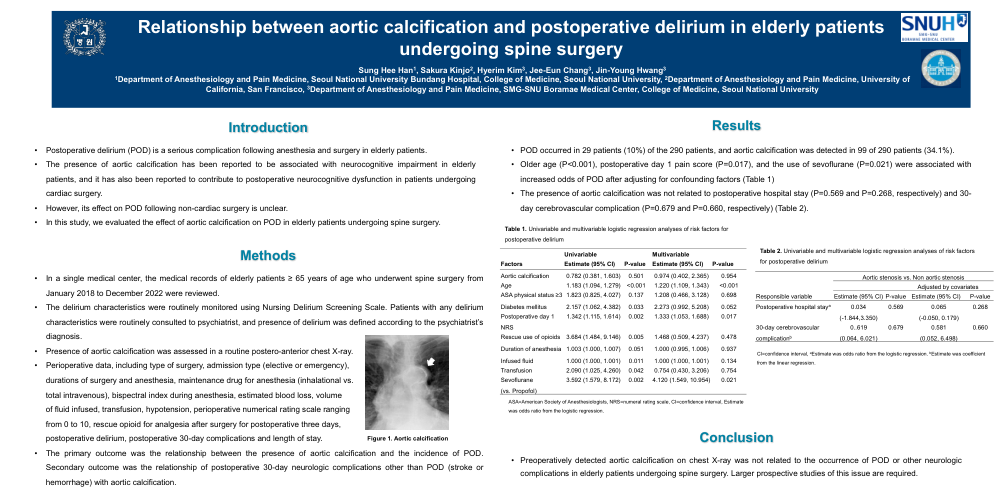
Study Design/Methods: In a single medical center, the medical records of elderly patients = 65 years of age who underwent spine surgery from January 2018 to December 2022 were reviewed. The delirium characteristics were routinely monitored using Nursing Delirium Screening Scale. Patients with any delirium characteristics were routinely consulted to psychiatrist, and presence of delirium was defined according to the psychiatrist’s diagnosis. The extent of aortic calcification was assessed in a routine postero-anterior chest X-ray, and divided into four grades: grade 0, no visible calcification; grade 1, small spots of calcification or a single thin area of calcification of the aortic knob; grade 2, one or more areas of thick calcification; grade 3, circular calcification of the aortic knob. Grade 0 was defined as 'no presence of calcification', while grades 1 to 3 were defined as 'presence of aortic calcification'. The primary outcome was the relationship between the presence of aortic calcification and the incidence of POD. Secondary outcome was the relationship of postoperative 30-day neurologic complications other than POD (stroke or hemorrhage) with aortic calcification.
Results: POD occurred in 29 patients (10%) of the 290 patients included in this study. Aortic calcification was detected in 99 of 290 patients (34.1%). The presence of aortic calcification was not related to the occurrence of POD (P=0.248) and postoperative other neurologic complications (P=0.320).
Discussions/Conclusions: Preoperatively detected aortic calcification on chest X-ray was not related to the occurrence of POD or other neurologic complications in elderly patients undergoing spine surgery. Larger prospective studies of this issue are required.