334 posters, 125 sessions, 831 authors, 236 institutions
ePostersLive by SciGen Technologies S.A. All rights reserved.
78th Annual PostGraduate Assembly in Anesthesiology (PGA78) 2024
December 6 - 9, 2024 | New York City

4132
Real-World Outcomes and Healthcare Burden: Claims Analysis of IV Ibuprofen vs Ketorolac
Poster Presenter
Authors
Emily Durr, Mosadouwa Afolabi, Ishveen Chopra, Theresa Human, Ines Macias-Perez, jason Makii, Jensy Rodriguez-Silva
Affiliations
Part of Topic
Real-World Outcomes and Healthcare Burden:
Claims Analysis of IV Ibuprofen vs Ketorolac
INTRODUCTION
Adverse drug reactions (ADRs) have considerable clinical
and economic costs.
o 2.2 million hospitalizations and 106,000 deaths
annually1
o Up to $136 billion spent on ADRs annually in the US2
• IV ibuprofen (IVIB) and ketorolac are both non-selective
cyclooxygenase (COX) inhibitors; however, they differ in
their degree of COX-1/COX-2 inhibition and subsequent
risk of gastrointestinal toxicity, nephrotoxicity, and
bleeding2,3
Objective:
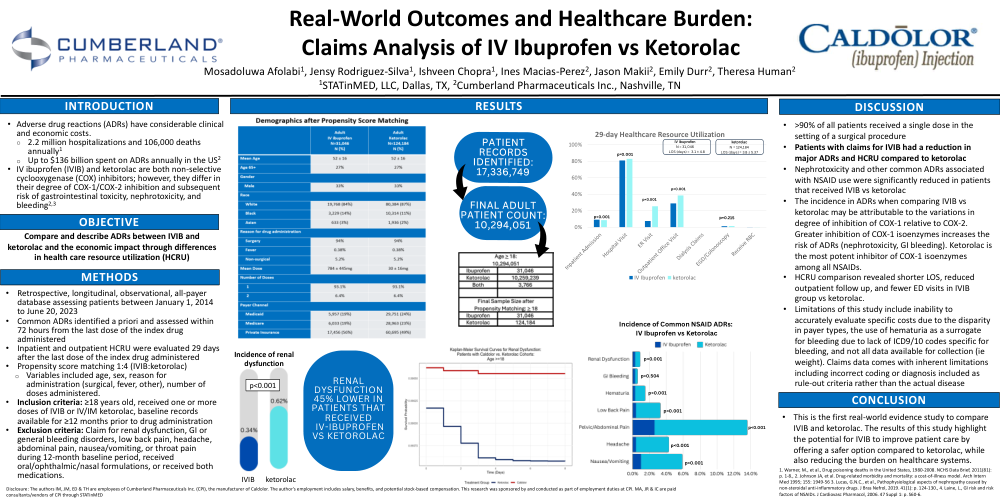
Compare and describe ADRs between IVIB and
ketorolac and the economic impact through differences
in health care resource utilization (HCRU)
Methods:
• Retrospective, longitudinal, observational, all-payer
database assessing patients between January 1, 2014
to June 20, 2023
• Common ADRs identified a priori and assessed within
72 hours from the last dose of the index drug
administered
• Inpatient and outpatient HCRU were evaluated 29 days
after the last dose of the index drug administered
• Propensity score matching 1:4 (IVIB:ketorolac)
o Variables included age, sex, reason for
administration (surgical, fever, other), number of
doses administered.
• Inclusion criteria: ≥18 years old, received one or more
doses of IVIB or IV/IM ketorolac, baseline records
available for ≥12 months prior to drug administration
• Exclusion criteria: Claim for renal dysfunction, GI or
general bleeding disorders, low back pain, headache,
abdominal pain, nausea/vomiting, or throat pain
during 12-month baseline period, received
oral/ophthalmic/nasal formulations, or received both
medications.
Discussion
• >90% of all patients received a single dose in the
setting of a surgical procedure
• Patients with claims for IVIB had a reduction in
major ADRs and HCRU compared to ketorolac
• Nephrotoxicity and other common ADRs associated
with NSAID use were significantly reduced in patients
that received IVIB vs ketorolac
• The incidence in ADRs when comparing IVIB vs
ketorolac may be attributable to the variations in
degree of inhibition of COX-1 relative to COX-2.
Greater inhibition of COX-1 isoenzymes increases the
risk of ADRs (nephrotoxicity, GI bleeding). Ketorolac is
the most potent inhibitor of COX-1 isoenzymes
among all NSAIDs.
• HCRU comparison revealed shorter LOS, reduced
outpatient follow up, and fewer ED visits in IVIB
group vs ketorolac.
• Limitations of this study include inability to
accurately evaluate specific costs due to the disparity
in payer types, the use of hematuria as a surrogate
for bleeding due to lack of ICD9/10 codes specific for
bleeding, and not all data available for collection (ie
weight). Claims data comes with inherent limitations
including incorrect coding or diagnosis included as
rule-out criteria rather than the actual disease
CONCLUSION
• This is the first real-world evidence study to compare
IVIB and ketorolac. The results of this study highlight
the potential for IVIB to improve patient care by
offering a safer option compared to ketorolac, while
also reducing the burden on healthcare systems.