334 posters, 125 sessions, 831 authors, 236 institutions
ePostersLive by SciGen Technologies S.A. All rights reserved.
78th Annual PostGraduate Assembly in Anesthesiology (PGA78) 2024
December 6 - 9, 2024 | New York City

4129
Real-World Outcomes and Healthcare Burden: Claims Analysis of IV Ibuprofen vs Ketorolac in Pediatrics
Poster Presenter
Authors
jason Makii, Mosadouwa Afolabi, Ishveen Chopra, Emily Durr, Theresa Human, Ines Macias-Perez, Jensy Rodriguez-Silva
Affiliations
Part of Topic
Real-World Outcomes and Healthcare Burden:
Claims Analysis of IV Ibuprofen vs Ketorolac in Pediatrics
Introduction:
Adverse drug reactions (ADRs) have considerable clinical
and economic costs, particularly in the pediatric
population:
o The incidence of ADRs in hospitalized children ranges
from 0.4-17.7%1
o Up to $136 billion spent on ADRs annually in the US2
• While both IV ibuprofen (IVIB) and ketorolac are nonselective
cyclooxygenase (COX) inhibitors, they vary in
their selectivity levels for COX-1 and COX-2 enzymes.
This difference affects their relative risks of GI toxicity,
nephrotoxicity, and bleeding3,4
Objective:
Compare ADR profiles of IVIB and ketorolac in
pediatric patients, while evaluating their
economic impact using real-world claims data
Methods:
Retrospective, longitudinal, observational, all-payer
database assessing patients between January 1, 2014
to June 20, 2023
• Common ADRs identified a priori and assessed within
72 hours from the last dose of the index drug
administered
• Inpatient and outpatient HCRU were evaluated 29 days
after the last dose of the index drug administered
• Propensity score matching 1:1 (IVIB:ketorolac)
o Variables included age, sex, reason for
administration (surgical, fever, other), number of
doses administered.
• Inclusion criteria: <18 years old, received one or more
doses of IVIB or IV/IM ketorolac, baseline records
available for ≥12 months prior to drug administration
• Exclusion criteria: Claim for renal dysfunction, GI or
general bleeding disorders, low back pain, headache,
abdominal pain, nausea/vomiting, or throat pain
during 12-month baseline period, received
oral/ophthalmic/nasal formulations, or received both
medications.
Discussion:
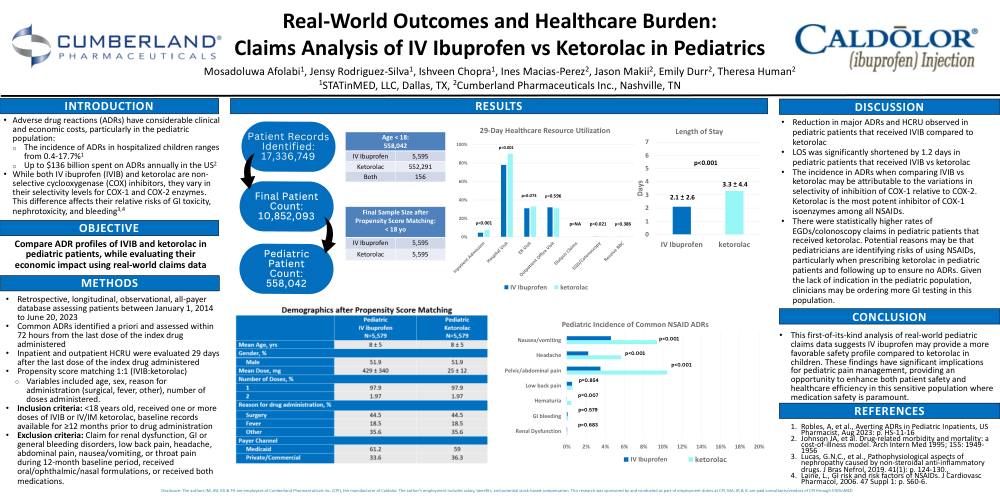
• Reduction in major ADRs and HCRU observed in
pediatric patients that received IVIB compared to
ketorolac
• LOS was significantly shortened by 1.2 days in
pediatric patients that received IVIB vs ketorolac
• The incidence in ADRs when comparing IVIB vs
ketorolac may be attributable to the variations in
selectivity of inhibition of COX-1 relative to COX-2.
Ketorolac is the most potent inhibitor of COX-1
isoenzymes among all NSAIDs.
• There were statistically higher rates of
EGDs/colonoscopy claims in pediatric patients that
received ketorolac. Potential reasons may be that
pediatricians are identifying risks of using NSAIDs,
particularly when prescribing ketorolac in pediatric
patients and following up to ensure no ADRs. Given
the lack of indication in the pediatric population,
clinicians may be ordering more GI testing in this
population.
Conclusion:
• This first-of-its-kind analysis of real-world pediatric
claims data suggests IV ibuprofen may provide a more
favorable safety profile compared to ketorolac in
children. These findings have significant implications
for pediatric pain management, providing an
opportunity to enhance both patient safety and
healthcare efficiency in this sensitive population where
medication safety is paramount.