334 posters, 125 sessions, 831 authors, 236 institutions
ePostersLive by SciGen Technologies S.A. All rights reserved.
78th Annual PostGraduate Assembly in Anesthesiology (PGA78) 2024
December 6 - 9, 2024 | New York City

4128
Dose-Dependent Effects of General Anesthetics on Mandible Movement Rate in Larval Zebrafish
Poster Presenter
Authors
Affiliations
Part of Topic
Introduction
•Zebrafish (Danio rerio) are widely used in research due to their complex nervous system, genetic similarity to humans, and suitability for studying drug responses.
•Although fish and mammals absorb oxygen and eliminate carbon dioxide differently, mandibular movement is necessary for fish to move water through their gills and thus is a corollary to inhalation via diaphragmatic excursion.
•Montandon et al. (2021) proposes that respiratory mandible movement rate can serve as an indicator of respiratory network activity, similar to the respiratory activity of the trigeminal muscle in mammals.
•This model has been previously employed to study opioid-induced respiratory depression, but its potential as a model for studying anesthetic-induced respiratory depression remains unexplored.
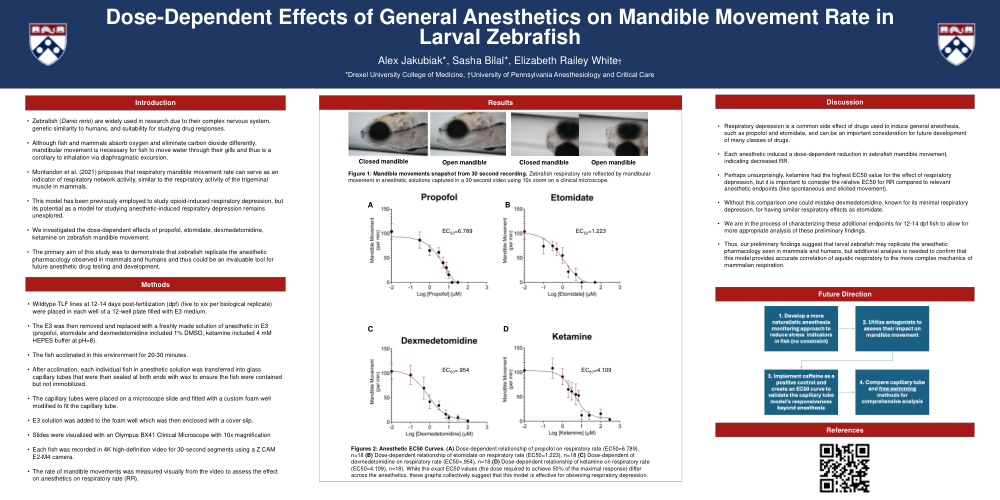
•We investigated the dose-dependent effects of propofol, etomidate, dexmedetomidine, ketamine on zebrafish mandible movement.
•The primary aim of this study was to demonstrate that zebrafish replicate the anesthetic pharmacology observed in mammals and humans and thus could be an invaluable tool for future anesthetic drug testing and development.
Methods
•Wildtype TLF lines at 12-14 days post-fertilization (dpf) (five to six per biological replicate) were placed in each well of a 12-well plate filled with E3 medium.
•The E3 was then removed and replaced with a freshly made solution of anesthetic in E3 (propofol, etomidate and dexmedetomidine included 1% DMSO, ketamine included 4 mM HEPES buffer at pH=8).
•The fish acclimated in this environment for 20-30 minutes.
•After acclimation, each individual fish in anesthetic solution was transferred into glass capillary tubes that were then sealed at both ends with wax to ensure the fish were contained but not immobilized.
•The capillary tubes were placed on a microscope slide and fitted with a custom foam well modified to fit the capillary tube.
•E3 solution was added to the foam well which was then enclosed with a cover slip.
•Slides were visualized with an Olympus BX41 Clinical Microscope with 10x magnification
•Each fish was recorded in 4K high-definition video for 30-second segments using a Z CAM E2-M4 camera.
•The rate of mandible movements was measured visually from the video to assess the effect on anesthetics on respiratory rate (RR).
Discussion
•Respiratory depression is a common side effect of drugs used to induce general anesthesia, such as propofol and etomidate, and can be an important consideration for future development of many classes of drugs.
•Each anesthetic induced a dose-dependent reduction in zebrafish mandible movement, indicating decreased RR.
•Perhaps unsurprisingly, ketamine had the highest EC50 value for the effect of respiratory depression, but it is important to consider the relative EC50 for RR compared to relevant anesthetic endpoints (like spontaneous and elicited movement).
•Without this comparison one could mistake dexmedetomidine, known for its minimal respiratory depression, for having similar respiratory effects as etomidate.
•We are in the process of characterizing these additional endpoints for 12-14 dpf fish to allow for more appropriate analysis of these preliminary findings.
•Thus, our preliminary findings suggest that larval zebrafish may replicate the anesthetic pharmacology seen in mammals and humans, but additional analysis is needed to confirm that this model provides accurate correlation of aquatic respiratory to the more complex mechanics of mammalian respiration.