334 posters, 125 sessions, 831 authors, 236 institutions
ePostersLive by SciGen Technologies S.A. All rights reserved.
78th Annual PostGraduate Assembly in Anesthesiology (PGA78) 2024
December 6 - 9, 2024 | New York City

4123
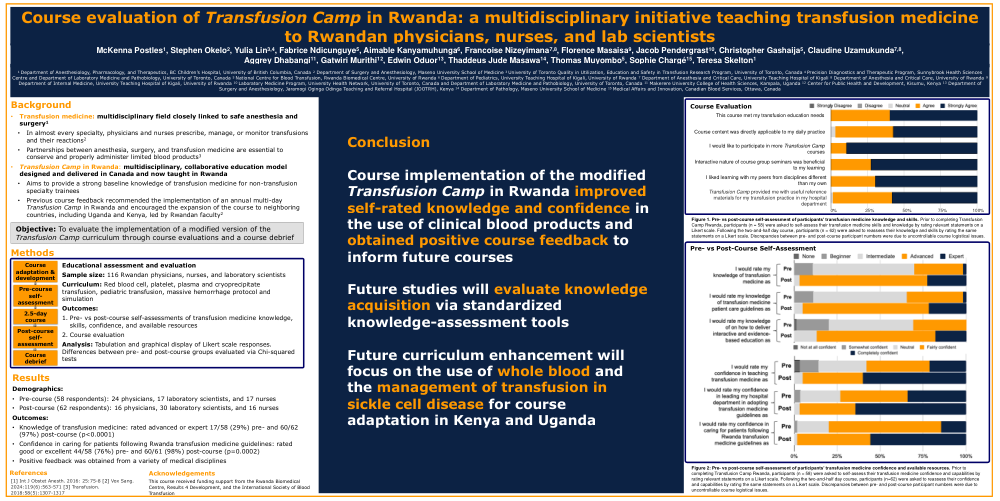
Course evaluation of Transfusion Camp in Rwanda: a multidisciplinary initiative teaching Rwandan physicians, nurses, and lab scientists how to utilize blood products and derivatives safely in district hospitals
Poster Presenter
Authors
McKenna Postles, Sophie Chargé, Aggrey Dhabangi, Theophile Dusengumuremyi, Christopher Gashaija, Aimable Kanyamuhunga, Swaibu Katare, Yulia Lin, Florence Masaisa, Thaddeus Masawa, Gatwiri Murithi, Thomas Muyombo, Fabrice Ndicunguye, Francoise Nizeyimana, Edwin Oduor, Stephen Okelo, Jacob Pendergrast, Teresa Skelton, Claudine Uzamukunda
Affiliations
University of Toronto, Research Institute, BC Children's Hospital, BC Children’s Hospital, Medical Affairs and Innovation, Canadian Blood Services, Ottawa, Makere University College of Health Sciences, Kampala, Uganda, RD4 consultant in East and Central Africa, Rwanda Biomedical Centre, University of Rwanda, University Teaching Hospital of Kigali, University of Rwanda, Sunnybrook Health Sciences & Department of Lab Medicine and Pathobiology, University of Toronto, Maseno University School of Medicine, Center for Public Health and Development, Kisumu, Kenya, Jaramogi Oginga Odinga Teaching and Referral Hospital (JOOTRH)
Part of Topic
Title: Course evaluation of Transfusion Camp in Rwanda: a multidisciplinary initiative teaching transfusion medicine to Rwandan physicians, nurses, and lab scientists
Authors: McKenna Postles1, Stephen Okelo2, Yulia Lin3,4, Fabrice Ndicunguye5, Aimable Kanyamuhunga6, Francoise Nizeyimana7,8, Florence Masaisa9, Jacob Pendergrast10, Christopher Gashaija5, Claudine Uzamukunda7,8, Aggrey Dhabangi11, Gatwiri Murithi12, Edwin Oduor13, Thaddeus Jude Masawa14, Thomas Muyombo5, Sophie Chargé15, Teresa Skelton1
Background:
Educational assessment and evaluation
Sample size: 116 Rwandan physicians, nurses, and laboratory scientists
Curriculum: Red blood cell, platelet, plasma and cryoprecipitate transfusion, pediatric transfusion, massive hemorrhage protocol and simulation
Outcomes:
Analysis: Tabulation and graphical display of Likert scale responses. Differences between pre- and post-course groups evaluated via Chi-squared tests
Results:
Demographics:
Outcomes:
Conclusion:
Course implementation of the modified Transfusion Camp in Rwanda improved self-rated knowledge and confidence in the use of clinical blood products and obtained positive course feedback to inform future courses. Future studies will evaluate knowledge acquisition via standardized knowledge-assessment tools. Future curriculum enhancement will focus on the use of whole blood and the management of transfusion in sickle cell disease for course adaptation in Kenya and Uganda.