Loading...

334 posters, 125 sessions, 831 authors, 236 institutions

ePostersLive by SciGen Technologies S.A. All rights reserved.

4121

Is bubble-blowing a more effective distraction method than video watching for intravenous cannula insertion in young children? - a randomized controlled trial
Part of Topic

Title: Is bubble-blowing a more effective distraction method than video-watching for intravenous cannula insertion in young children? - a randomized controlled trial

Authors: McKenna Postles1, Nicholas West1, Jade Palm3, Lindy Moxham1,4, Miku Wake1, Matthias Görges1,2, James Chen1,2,5

Affiliations: 1 Research Institute, BC Children’s Hospital, Vancouver, BC, Canada 2 Department of Anesthesiology, Pharmacology & Therapeutics, University of British Columbia Vancouver, BC, Canada 3 Child & Youth Therapeutic Services, BC Children’s Hospital, Vancouver, BC, Canada 4 MD Undergraduate Program, University of British Columbia Vancouver, BC, Canada 5 Department of Anesthesia, BC Children’s Hospital, Vancouver, BC, Canada

Background: 

• Preoperative stress is linked with negative outcomes and increases a child’s sympathetic response to pain1-3
• Distraction methods reduce a child’s pain perception and anxiety by shifting their attention away from the perceived pain4
• Bubble-blowing = active distraction technique combining breathing exercises and play therapy to alleviate pain and anxiety5
 
Objective: To compare the effectiveness of two distraction techniques, bubble-blowing vs video-watching, in reducing (1) pain and (2) anxiety associated with intravenous (IV) cannula insertions in young children
 
Methods: 

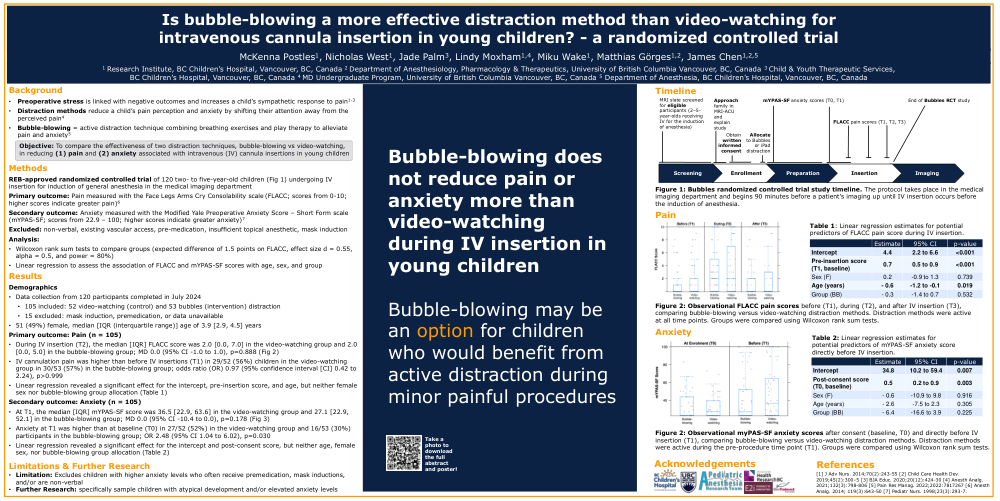
REB-approved randomized controlled trial of 120 two- to five-year-old children (Fig 1) undergoing IV insertion for induction of general anesthesia in the medical imaging department

Primary outcome: Pain measured with the Face Legs Arms Cry Consolability scale (FLACC; scores from 0-10; higher scores indicate greater pain)6

Secondary outcome: Anxiety measured with the Modified Yale Preoperative Anxiety Score – Short Form scale (mYPAS-SF; scores from 22.9 – 100; higher scores indicate greater anxiety)7

Excluded: non-verbal, existing vascular access, pre-medication, insufficient topical anesthetic, mask induction

Analysis:

•Wilcoxon rank sum tests to compare groups (expected difference of 1.5 points on FLACC, effect size d = 0.55, alpha = 0.5, and power = 80%)
•Linear regression to assess the association of FLACC and mYPAS-SF scores with age, sex, and group
 
Results:

Demographics

•Data collection from 120 participants completed in July 2024
•105 included: 52 video-watching (control) and 53 bubbles (intervention) distraction
•15 excluded: mask induction, premedication, or data unavailable
•51 (49%) female, median [IQR (interquartile range)] age of 3.9 [2.9, 4.5] years

Primary outcome: Pain (n = 105)

•During IV insertion (T2), the median [IQR] FLACC score was 2.0 [0.0, 7.0] in the video-watching group and 2.0 [0.0, 5.0] in the bubble-blowing group; MD 0.0 (95% CI -1.0 to 1.0), p=0.888 (Fig 2)
•IV cannulation pain was higher than before IV insertions (T1) in 29/52 (56%) children in the video-watching group in 30/53 (57%) in the bubble-blowing group; odds ratio (OR) 0.97 (95% confidence interval [CI] 0.42 to 2.24), p>0.999
•Linear regression revealed a significant effect for the intercept, pre-insertion score, and age, but neither female sex nor bubble-blowing group allocation (Table 1)

Secondary outcome: Anxiety (n = 105)

•At T1, the median [IQR] mYPAS-SF score was 36.5 [22.9, 63.6] in the video-watching group and 27.1 [22.9, 52.1] in the bubble-blowing group; MD 0.0 (95% CI -10.4 to 0.0), p=0.178 (Fig 3)
•Anxiety at T1 was higher than at baseline (T0) in 27/52 (52%) in the video-watching group and 16/53 (30%) participants in the bubble-blowing group; OR 2.48 (95% CI 1.04 to 6.02), p=0.030
•Linear regression revealed a significant effect for the intercept and post-consent score, but neither age, female sex, nor bubble-blowing group allocation (Table 2)
 
Limitations and Further Research:
•Limitation: Excludes children with higher anxiety levels who often receive premedication, mask inductions, and/or are non-verbal
•Further Research: specifically sample children with atypical development and/or elevated anxiety levels
 
Conclusion: Bubble-blowing does not reduce pain or anxiety more than video-watching during IV insertion in young children. Bubble-blowing may be an option for children who would benefit from active distraction during minor painful procedures.


78th Annual PostGraduate Assembly in Anesthesiology (PGA78) 2024 » banner
Copyright © 2015-2026, ePostersLive® SciGen is a registered trademark of SciGen Technologies S.A. Patent pending.

This website and third-party tools we use rely on cookies for the best user experience. By selecting "I agree", you agree to cookie usage as described in our Privacy Policy.
