334 posters, 125 sessions, 831 authors, 236 institutions
ePostersLive by SciGen Technologies S.A. All rights reserved.
78th Annual PostGraduate Assembly in Anesthesiology (PGA78) 2024
December 6 - 9, 2024 | New York City

4119
Evaluation of a Novel Autoinjector for Rapid Intramuscular Delivery of Sulfanegen as a Cyanide Antidote in a Porcine Model
Poster Presenter
Authors
DEEPALI SHRIVASTAVA, Kumar Belani, John Carney, Steven Patterson, Walt Tollison
Affiliations
Part of Topic
Evaluation of a Novel Autoinjector for Rapid Intramuscular Delivery of Sulfanegen as a Cyanide Antidote in a Porcine Model
Deepali Shrivastava1, Arreh Jain1, Steven E. Patterson2, Walt Tollison3, David S. Beebe1, John Carney3, Jill Schappa Faustich4, Dan Yasevac5, Kumar G. Belani1
1Department of Anesthesiology, 2Center for Drug Design Inc., 3ESS, 4Department of Laboratory Medicine and Pathology, University of Minnesota, Minneapolis MN; 5Windgap Medical Inc, Watertown, MA
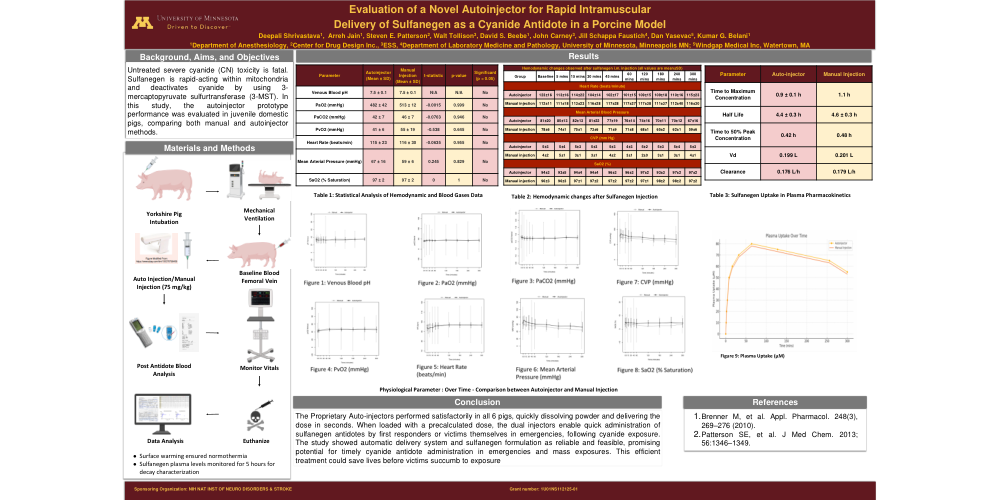
Introduction: Severe cyanide (CN) toxicity when untreated is fatal. Sulfanegen is a rapid acting antidote that captures cyanide (CN) within mitochondria, preventing cellular hypoxia. Sulfanegen works by using 3 mercaptopyruvate sulfurtransferase (3 MST) to neutralize cyanide and can be swiftly administered through injection into the muscle and has shown effectiveness in different animal models.1, 2 The Windgap Medical's autoinjector is especially designed to meet specific dosing requirements for sulfanegen. The dual-chamber design keeps the powdered drug dry and shelf-stable, allowing solvent interaction for rapid sulfanegen powder dissolution. In this study we evaluated the performance of an autoinjector in juvenile domestic pigs, using both manual and autoinjector methods.
Methods: After IACUC approval, 8 healthy juvenile Yorkshire pigs weighing 16-20 kg were anesthetized with a mixture of Telazol and Xylazine, and then received propofol. They were endotracheally intubated and mechanically ventilated. Monitoring included continuous EKG, pulse oximetry, respiratory rate, BP and temperature. Surface warming ensured normothermia. Blood samples were collected before sulfanegen injection with the novel automatic injection system in 6 pigs and manual injection in 2 pigs. The dose of sulfanegen was divided between two injectors and after activation and dissolution it was injected simultaneously into each of the thigh muscles. The same was done with the manual injections. Femoral venous blood samples were collected to evaluate sulfanegen's pharmacokinetics, with serial blood samples collected at various intervals. Plasma concentrations were measured for 5 hours to characterize the antidote concentration-time profiles for each route.
Results: The changes observed in the metabolic and hemodynamic parameters over time after sulfanegen i.m. injection were compared with the respective baseline values. The study found no significant differences in metabolic or hemodynamic parameters, arterial oxygen partial pressure, pH, indicating stable animals throughout the experiment. There was no measurable difference in the average sulfanegen concentration between the two treatment groups after sulfanegen injection. In this study, the pH of venous blood (pBi), PaO2, PaCO2, PvO2 and hemodynamic variables (heart rate, MAP, CVP, SaO2) between repeated measurements in autoinjector and manual injection groups showed no significant difference (all p >0.05). Blood samples were drawn at different times after injection to determine pharmacokinetic parameters. The research determined that Sulfanegen enters the bloodstream rapidly and peak plasma concentrations are achieved within 0.48 hour in autoinjector group vs 0.42 hour in manual group post injection. The pharmacokinetic profile of Sulfanegen after a single injection using an autoinjector was similar to that obtained using manual injections confirming that the autoinjector is suitable for rapid delivery, even in emergency situations.
Discussion and Conclusion: The auto injectors worked well in all the 6 pigs; once activated, the powder easily dissolved in the solvent and the delivery took only a few seconds. The same was noted with the manual injections. When loaded with a precalculated single dose distributed into 2 injectors it should allow timely administration by either first responders or even the victims themselves (for example in biologic warfare). This study demonstrated the reliability and feasibility of the novel automatic delivery system and sulfanegen formulation, promising potential for timely administration of the cyanide antidote during emergency and mass-exposure incidents. This quick-acting, simple treatment could potentially save lives before victims succumb to exposure.