334 posters, 125 sessions, 831 authors, 236 institutions
ePostersLive by SciGen Technologies S.A. All rights reserved.
78th Annual PostGraduate Assembly in Anesthesiology (PGA78) 2024
December 6 - 9, 2024 | New York City

4118
Preliminary Outcomes of Prospective, Single-Center, Randomized, Double-Blind Clinical Trial Evaluating Pain Associated with Epidural Tuohy Needle Insertion after Administration of Intradermal or Subcutaneous Lidocaine in Parturient Women Requesting Epidur
Part of Topic
Title: Preliminary Outcomes of Prospective, Single-Center, Randomized, Double-Blind Clinical Trial Evaluating Pain Associated with Epidural Tuohy Needle Insertion after Administration of Intradermal or SubcutaneousLidocaine in Parturient Women RequestingEpidural Analgesia
By: Lukas Croner, Haosheng Li, Andrew Devine, Srija Konduru, Yun Xia, Ling-Qun Hu
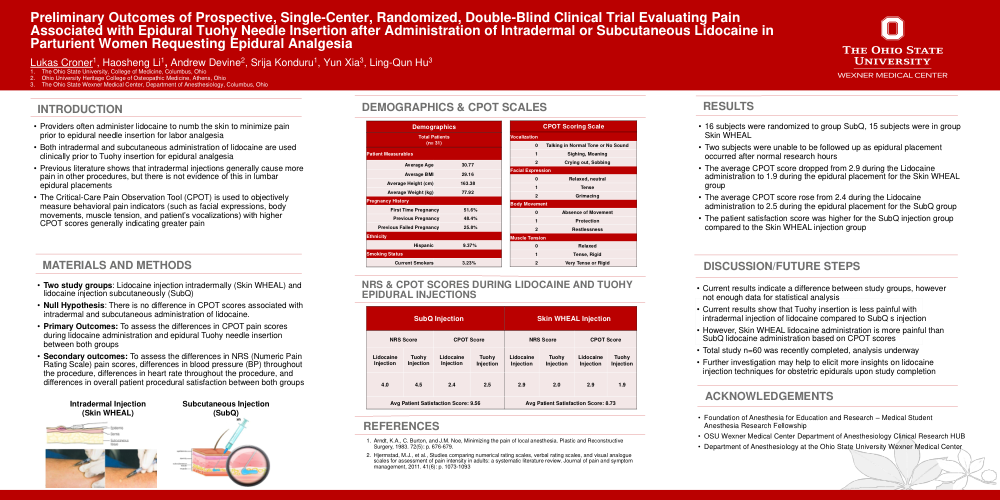
Intro: To minimize pain prior to epidural needle insertion for labor analgesia, providers often administer lidocaine to numb the skin. This lidocaine injection can cause discomfort for parturients, decreasing satisfaction with the epidural procedure. Both intradermal and subcutaneous administration of lidocaine are used clinically prior to Tuohy insertion. Previous literature shows that intradermal injections generally cause more pain in other procedures but lacks study for lumbar epidural placements [1]. This current study investigates the associated pain and analgesia effectiveness of intradermal and subcutaneous lidocaine injections for parturients’ epidural procedures. The Critical-Care Pain Observation Tool (CPOT)is used to objectively measure behavioral pain indicators (facial expressions, body movements, muscle tension and patient’s vocalizations), with higher CPOT scores generally indicating greater pain. Our null hypothesis is that there is no difference in CPOT scores between intradermal and subcutaneous lidocaine administration in parturients undergoing epidural procedures.
Methods: This is a prospective double-blinded randomized trial with the primary outcome of measuring CPOT scores during epidural procedure, following IRB approval and registration at https://clinicaltrials.gov. After the patient’s consent is obtained for the study, they will be randomized via REDCapin a 1:1 ratio to one of the two groups:
Intradermal Group (IG): lidocaine administration with the needle positioned at a 60-degree angle to the skinusing skin wheal technique,followed by local infiltration.
SubcutaneousGroup (SG, study group): lidocaine administration with the needle positioned at a 90-degree angle to the skin with local infiltration subcutaneously, followed by skin wheal.
Prior to insertion of the 18 G Tuohy epidural needle, each patient will receive an injection of 3 mL 1% lidocaine either intradermally or subcutaneously by an unblinded anesthesia care provider using a 27 G needle over 3 seconds between uterine contractions. The investigation ends after the Tuohy needle insertion and documentation of pain scores.
Observer-recordedCPOT scores from 0-8, patients’ self-reported Numeric Pain Rating Scale (NRS)scores from 0-10, HR, and BP will be recorded by a blinded observer at three different time points (prior to lidocaine injection, during lidocaine injection, and during Tuohy insertion).
Results: Currently 31 patients are enrolled, with 15 patients in IG and 16 patientsin SG. The average CPOT and NRS during lidocaine injection and Tuohy insertion was 2.9 and 1.9 for IG, respectively, and 2.4 and 2.5 for SG, respectively. The average NRS during lidocaine injection and Tuohy insertion was 2.9 and 2.0 for IG, respectively, and 4.0 and 4.5 for SG, respectively.
Discussion: Preliminary data shows that within IG, Tuohy insertion seems less painful than lidocaine injection, as shown through both CPOT and NRS scores. Conversely, within SG, Tuohy insertion appears more painful than lidocaine injection. When comparing between groups, CPOT of lidocaine injection seems more painful inIG than SG, corroborating the literature [1]. Yet, the CPOT of Tuohy insertion seems less painful for IG than SG. This data demonstrates that although the initial lidocaine injection for IG may be more painful, IG may provide an overall better analgesia distribution for Tuohyinsertion. Nevertheless, these results could be confounded by the novelty of utilizing both objective CPOT and subjective NRS for measuring pain levels in our study population [2]. Further investigation may help to elicit more insights on lidocaine injection techniques for obstetric epidurals upon study completion.
References (3 max):
-
Arndt, K.A., C. Burton, and J.M. Noe, Minimizing the pain of local anesthesia. Plastic and Reconstructive Surgery, 1983. 72(5): p. 676-679.
-
Hjermstad, M.J., et al., Studies comparing numerical rating scales, verbal rating scales, and visual analogue scales for assessment of pain intensity in adults: a systematic literature review. Journal of pain and symptom management, 2011. 41(6): p. 1073-1093