334 posters, 125 sessions, 831 authors, 236 institutions
ePostersLive by SciGen Technologies S.A. All rights reserved.
78th Annual PostGraduate Assembly in Anesthesiology (PGA78) 2024
December 6 - 9, 2024 | New York City

4106
Depth of Neuromuscular Blockade (NMB) Affects Surgical Conditions in Obese Patients
Poster Presenter
Part of Topic
Depth of Neuromuscular Blockade (NMB) Affects Surgical Conditions in Obese Patients
Allison Woosley, MD, Rainer Lenhardt, MD, Daniel Metzinger, MD, Maria Lenhardt MD, Sarah Todd, MD
Background: Robotically assisted surgeries have been shown to improve outcomes in obese patients. Pneumoperitoneum is of utmost importance to give surgeons an optimal view to maneuver the robotic instruments for the surgical procedure. Pneumoperitoneum is facilitated by neuromuscular blockade. There are two levels of neuromuscular blockade: deep and moderate neuromuscular block (NMB). There is evidence that a deep NMB may improve surgical conditions and may reduce sudden abdominal contractions during surgery. However, it remains unclear if the described advantages are comparable in obese and non-obese patients.
Objectives: We set out to determine whether deep neuromuscular blockade improves surgical conditions in obese and non-obese patients compared to moderate NMB.
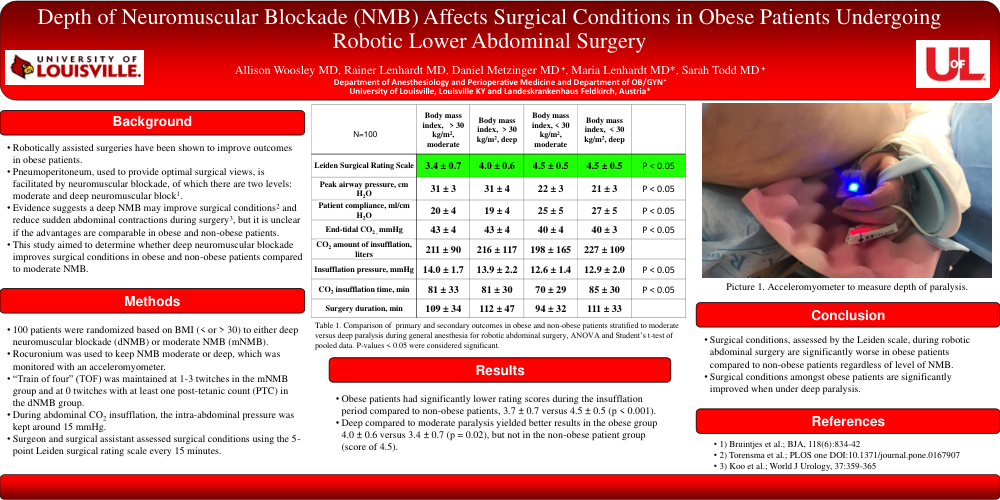
Methods: After IRB approval, 100 subjects were randomized to either deep neuromuscular blockade (dNMB) or moderate NMB (mNMB) as described below. The randomization was stratified based on the patient’s BMI (< or > 30). After induction of anesthesia rocuronium was administered to keep NMB deep or moderate. Patients' paralytic levels were monitored with an acceleromyometer through the anesthesia period. “Train of four” (TOF) was maintained at 1-3 twitches in the mNMB group and at 0 twitches with at least one post-tetanic count (PTC) in the dNMB group. During abdominal CO2 insufflation, the intra-abdominal pressure was kept at 15 mmHg. The 5-point Leiden surgical rating scale was used to assess surgical conditions every 15 minutes. Surgeon and surgical assistant were asked simultaneously.
Results: Obese patients had significantly lower rating scores during the insufflation period compared to non-obese patients, 3.7 ± 0.7 versus 4.5 ± 0.5 (p < 0.001). Deep compared to moderate paralysis yielded better results in the obese group 4.0 ± 0.6 versus 3.4 ± 0.7 (p = 0.02), but not in the non-obese patient group (score of 4.5).
Conclusion: While surgical conditions, as assessed by the Leiden surgical rating scale, during robotic abdominal surgery are significantly worse in obese patients compared to non-obese patients regardless of level of neuromuscular blockade, surgical conditions amongst obese patients are significantly improved when under deep paralysis.