334 posters, 125 sessions, 831 authors, 236 institutions
ePostersLive by SciGen Technologies S.A. All rights reserved.
78th Annual PostGraduate Assembly in Anesthesiology (PGA78) 2024
December 6 - 9, 2024 | New York City

3044
Unilateral Horner Syndrome Following Cervical Interlaminar Epidural Steroid Injection (ESI).
Poster Presenter
Authors
Affiliations
Part of Topic
Background:
•Horner’s Syndrome occurs due to damage to the sympathetic chain ganglia.
•Sympathetic fibers have an extensive course and can be interrupted during extracranial, intracranial, or intra-orbital traversal.
•The most common lesions involve preganglionic fibers coursing the upper thorax.
•The C8-T2 ganglia reside in close proximity to the epidural space.
•Overall incidence is1 in 6,000.
•After neuraxial anesthesia, the incidence is estimated at 0.5%.
•Common symptoms include ptosis, miosis and anhidrosis.
•Symptomology depends on the location of the specific lesion.
•Severity depends on the degree of denervation.
•Most cases are diagnosed clinically (idiopathic causes are particularly rare).
•Treatment is centered around diagnosis and management of underlying cause.
Case Presentation:
•44-year-old female with right arm radiculopathy in the dermatomal distribution of C5-C7.
oMRI showed severe foraminal narrowing at C4-5 & moderate narrowing at C5-6 and C6-7.
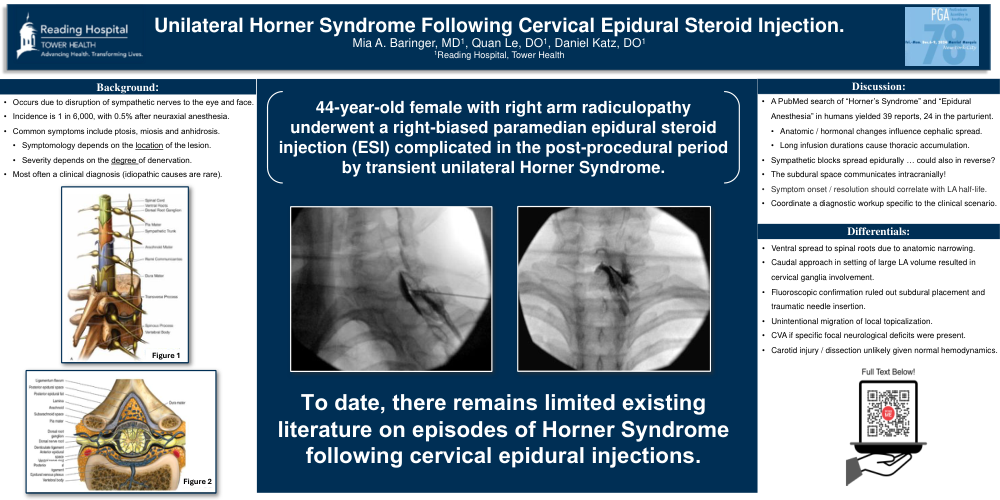
•She was brought to the procedure suite for right-biased C6-7 interlaminar epidural steroid injection (ESI), however, we were unable to access the space due to anatomical constraints.
oDecision was made to proceed with a more caudad approach at C7-T1.
oThe epidural space was identified via continuous loss of resistance technique.
oNeedle placement further verified via fluoroscopy in the lateral and AP views (Figure 3).
o1 cc of Depomedrol 40 milligrams/mL and 2cc of 1% Lidocaine was injected.
•In the post-procedural area, approximately 20 minutes later, she developed new-onset right-sided partial ptosis, miosis and mild right upper extremity weakness.
oA full neurological examination was performed with no focal deficits appreciated.
•The patient was closely monitored and eventually discharged home several hours later.
•She reported complete resolution of symptoms upon awakening the following morning.
Discussion:
•A PubMed search using “Horner’s Syndrome” and “Epidural Anesthesia” in humans yielded only 39 reports, of which 24 were linked to lumbar epidural placement in the parturient.
oAnatomical and hormonal changes influence inadvertent cephalad spread of infusing epidural anesthetic resulting in a subsequently high sympathetic blockage.
oLong anesthetic infusion durations also result in inadvertently high thoracic accumulation.
•The subdural space communicates with the intracranial space directly allowing for life-threatening complications such as cardiorespiratory and neurological compromise.
•Sympathetic blocks can spread epidurally so this could occur in the reverse fashion with LA distributed within the epidural space spreads anteriorly to involve the sympathetic chain.
•We would expect the onset and resolution of symptoms to correlate with specific drug half-life.
•The extent of diagnostic workup should be specific to each clinical scenario.
•There remains limited documentation of Horner syndrome occurring after cervical ESI.
Clinical Pearl:
•Highly probable differentials included ventral spread of local anesthetic to the spinal roots due to anatomic narrowing versus involvement of cervical ganglia due to our more caudal approach in the setting of a larger-than-normal distributed volume.
•Unlikely differentials include subdural injection, traumatic needle insertion, migration of local topicalization, CVA or carotid injury / dissection.
•Providers must maintain a high vigilance with prompt identification and management.
•Ongoing research efforts and cooperation amongst medical professionals is essential to enhance knowledge of Horner Syndrome in the setting of epidural placement.
References:
1.Clayton, K. C. "The incidence of Homer's syndrome during lumbar extradural for elective Caesarean section and provision of analgesia during labour." Anaesthesia 38.6 (1983): 583-585.
2.Biousse, Valérie, Raul A. Guevara, and Nancy J. Newman. "Transient Horner's syndrome after lumbar epidural anesthesia." Neurology 51.5 (1998): 1473-1475.
3.Morris, J. G. L., J. Lee, and C. L. Lim. "Facial sweating in Horner's syndrome." Brain 107.3 (1984): 751-758
4.Turbelin, Caroline, and Jihad Mallat. "Recurrent Horner's syndrome following epidural analgesia for labor: a case report." Medicine 99.5 (2020): e18862..
5.Hassold, Nolan, et al. "Horner syndrome after cervical spine corticosteroid injection." International Journal of Rheumatic Diseases 25.4 (2022): 501-503.
6.Kaplowitz, Kevin, and Andrew G. Lee. "Horner syndrome following a selective cervical nerve root block." Journal of Neuro-Ophthalmology 31.1 (2011): 54-55.
7.Figure 1 & 2: NYSORA