334 posters, 125 sessions, 831 authors, 236 institutions
ePostersLive by SciGen Technologies S.A. All rights reserved.
78th Annual PostGraduate Assembly in Anesthesiology (PGA78) 2024
December 6 - 9, 2024 | New York City

4103
Analysis of TAP Block Effectiveness Following Cesarean Section Under Spinal Anesthesia
Poster Presenter
Authors
Colette B. Gazonas, George A. Popa, Damanveer Singh, Nivetha Srinivasan
Affiliations
Part of Topic
Analysis of TAP Block Effectiveness Following Cesarean Section Under Spinal Anesthesia
Colette B. Gazonas, George A. Popa, Damanveer Singh, Nivetha Srinivasan, Ming Xiong, Dongchen Li, Jean D. Eloy
Rutgers New Jersey Medical School
Introduction
Transversus abdominis plane (TAP) blocks are an analgesic modality traditionally performed following abdominal surgery. Cesarean section delivery remains one of the most common indications for this type of block. The main aim of this study is to determine whether post-cesarean section TAP blocks result in a significant decrease in patient-reported postoperative pain and the amount of pain medication required and administered in the postoperative period in patients who underwent preoperative spinal anesthesia. Through this study, we wished to analyze the impact of TAP blocks on all cesarean section patients receiving spinal anesthesia during a one-month period at our tertiary care hospital.
Methods
Data was retrospectively collected for all obstetric patients who underwent cesarean section with spinal anesthesia in August 2022 at a tertiary medical center (N = 21). The data included patient-reported pain scores over the immediate 24-hour postoperative period, in addition to oxycodone, ibuprofen, and acetaminophen administration for both the 24- and 48-hour postoperative intervals. The number of pain scores reported by each patient was documented, along with their average and peak pain scores. For each pain medication, the total dose administered over the aforementioned intervals was calculated. Patients were grouped based on their TAP block status, forming TAP block recipient (N = 11) and TAP block non-recipient (N = 10) groups. Pain score data and 24-hour and 48-hour medication administration were then compared using unpaired two-tailed t-test analysis with a significance level of alpha 0.05. TAP blocks were performed with bupivacaine 0.25% or 0.3%, with 20 to 30 mL injected bilaterally via ultrasound guidance.
Results
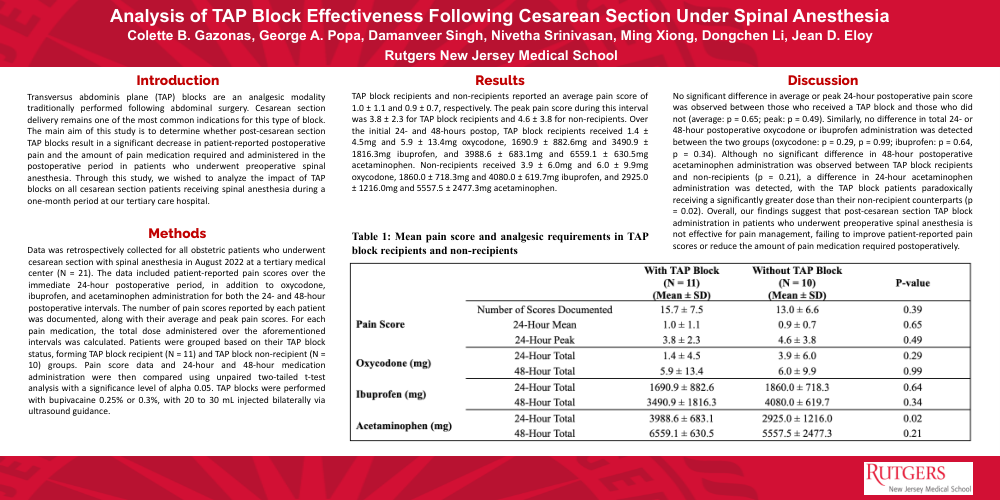
TAP block recipients and non-recipients reported an average pain score of 1.0 ± 1.1 and 0.9 ± 0.7, respectively. The peak pain score during this interval was 3.8 ± 2.3 for TAP block recipients and 4.6 ± 3.8 for non-recipients. Over the initial 24- and 48-hours postop, TAP block recipients received 1.4 ± 4.5mg and 5.9 ± 13.4mg oxycodone, 1690.9 ± 882.6mg and 3490.9 ± 1816.3mg ibuprofen, and 3988.6 ± 683.1mg and 6559.1 ± 630.5mg acetaminophen. Non-recipients received 3.9 ± 6.0mg and 6.0 ± 9.9mg oxycodone, 1860.0 ± 718.3mg and 4080.0 ± 619.7mg ibuprofen, and 2925.0 ± 1216.0mg and 5557.5 ± 2477.3mg acetaminophen.
Discussion
No significant difference in average or peak 24-hour postoperative pain score was observed between those who received a TAP block and those who did not (average: p = 0.65; peak: p = 0.49). Similarly, no difference in total 24- or 48-hour postoperative oxycodone or ibuprofen administration was detected between the two groups (oxycodone: p = 0.29, p = 0.99; ibuprofen: p = 0.64, p = 0.34). Although no significant difference in 48-hour postoperative acetaminophen administration was observed between TAP block recipients and non-recipients (p = 0.21), a difference in 24-hour acetaminophen administration was detected, with the TAP block patients paradoxically receiving a significantly greater dose than their non-recipient counterparts (p = 0.02). Overall, our findings suggest that post-cesarean section TAP block administration in patients who underwent preoperative spinal anesthesia is not effective for pain management, failing to improve patient-reported pain scores or reduce the amount of pain medication required postoperatively.