334 posters, 125 sessions, 831 authors, 236 institutions
ePostersLive by SciGen Technologies S.A. All rights reserved.
78th Annual PostGraduate Assembly in Anesthesiology (PGA78) 2024
December 6 - 9, 2024 | New York City

4102
Analysis of Gender Composition and Productivity in Top Anesthesiology Residency Programs
Poster Presenter
Authors
Colette B. Gazonas, George A. Popa, Damanveer Singh, Nivetha Srinivasan
Affiliations
Part of Topic
Analysis of Gender Composition and Productivity in Top Anesthesiology Residency Programs
Colette B. Gazonas, Damanveer Singh, George A. Popa, Nivetha Srinivasan MD, Jean D. Eloy MD
Rutgers New Jersey Medical School
Introduction
Although females continue to gain increasing representation in the healthcare profession, historically, medicine has largely been a male-dominated field. This gender imbalance remains prevalent across most medical specialties, including anesthesiology. This study aims to determine whether the difference in female-to-male representation in United States anesthesia residency programs remains statistically significant. Furthermore, it seeks to explore whether research output up until the time of residency application submission differs between female and male applicants who were accepted into the class of 2027 at the top 20 anesthesiology residency programs in the United States.
Methods
The Doximity Residency Navigator was utilized to rank the top 20 anesthesiology residency programs in the U.S. based on reputation. All residents from the class of 2027 at each of these programs, as well as their gender, were identified through each program’s website. The total number of female and male residents was calculated, and chi-squared statistical analysis was used to look for a significant disparity in gender breakdown when compared to an even 50-50 female-to-male split (α = 0.05).
To quantify research output before residency applications were submitted, a search of each resident’s name was run on PubMed and cross-referenced with a search on Google Scholar. Only articles published by the end of September 2022 were considered. Authorship was verified by comparing listed affiliations to each resident's undergraduate and medical institutions. Total number of publications, number of publications in anesthesiology journals, number of first-author publications, and number of second-author publications were recorded. The mean of each metric was calculated separately for female and male residents, and the averages were compared using t-test analysis (α = 0.05). Under 10% of residents of interest were excluded due to the inability to verify their publication history using this method.
Results
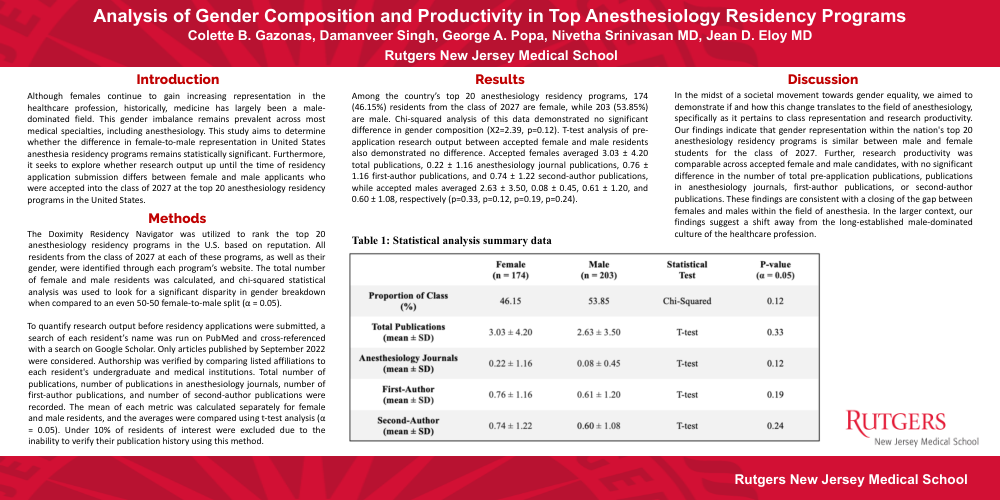
Among the country’s top 20 anesthesiology residency programs, 174 (46.15%) residents from the class of 2027 are female, while 203 (53.85%) are male. Chi-squared analysis of this data demonstrated no significant difference in gender composition (X2=2.39, p=0.12). T-test analysis of pre-application research output between accepted female and male residents also demonstrated no difference. Accepted females averaged 3.03 ± 4.20 total publications, 0.22 ± 1.16 anesthesiology journal publications, 0.76 ± 1.16 first-author publications, and 0.74 ± 1.22 second-author publications, while accepted males averaged 2.63 ± 3.50, 0.08 ± 0.45, 0.61 ± 1.20, and 0.60 ± 1.08, respectively (p=0.33, p=0.12, p=0.19, p=0.24).
Discussion
In the midst of a societal movement towards gender equality, we aimed to demonstrate if and how this change translates to the field of anesthesiology, specifically as it pertains to class representation and research productivity. Our findings indicate that gender representation within the nation's top 20 anesthesiology residency programs is similar between male and female students for the class of 2027. Further, research productivity was comparable across accepted female and male candidates, with no significant difference in the number of total pre-application publications, publications in anesthesiology journals, first-author publications, or second-author publications. These findings are consistent with a closing of the gap between females and males within the field of anesthesia. In the larger context, our findings suggest a shift away from the long-established male-dominated culture of the healthcare profession.