334 posters, 125 sessions, 831 authors, 236 institutions
ePostersLive by SciGen Technologies S.A. All rights reserved.
78th Annual PostGraduate Assembly in Anesthesiology (PGA78) 2024
December 6 - 9, 2024 | New York City

4099
Intraoperative Awareness Under Anesthesia: A Comprehensive Retrospective Analysis Using An Expanded Database
Poster Presenter
Authors
Alex Jakubiak, Sasha Bilal, James Cross, Jake Fanizza, Brendan Mackey, Simran Shamith
Affiliations
Part of Topic
Title - Intraoperative Awareness Under Anesthesia: A Comprehensive Retrospective Analysis Using An Expanded Database
Introduction
Intraoperative awareness is characterized by partial or complete consciousness during surgery despite the administration of anesthesia. It represents a rare but poorly understood complication in anesthetic practice. This gap in knowledge has prompted investigation into when intraoperative awareness occurs, and we aim to provide insight into specific cases and approaches to anesthesia that require more vigilance and understanding of this complex topic.
The largest review of intraoperative awareness was conducted in 2014 with a cohort of 2,766,600 patients [1]. This study serves as an update to this research with an expanded cohort of 25,181,403 patients.
By incorporating detailed stratification of awareness rates based on both induction and maintenance anesthetics as well as surgical procedure types, this investigation offers more comprehensive insights into the pharmacological and surgical factors that may influence the incidence of intraoperative awareness.
Methods
We used a federated cloud-based network TriNetX which provides access to deidentified data of EMRs from over 220 HCOs across the globe. Our search investigated all surgeries that included any case of general anesthesia given in the last 20 years.
Our cohorts were organized in two categories. The first included those who had a surgical event under general anesthesia, or received a particular anesthetic agent within the last 20 years, and had no reported history of awareness in the 3 months following.
The second cohort included patients with their first instance of reported awareness under general anesthesia reported within 3 months of administration of a particular anesthetic agent or a surgical event that took place in the last 20 years.
Cohorts without reported awareness under anesthesia were balanced using propensity score matching to those with reported awareness with respect to age, gender, and race. We compared differences in incidence of awareness under anesthesia after usage of propofol, dexmedetomidine, ketamine, and benzodiazepine, as well as between various types of surgeries including cardiovascular, musculoskeletal, gastrointestinal, reproductive/genital and neurological surgeries.
Results
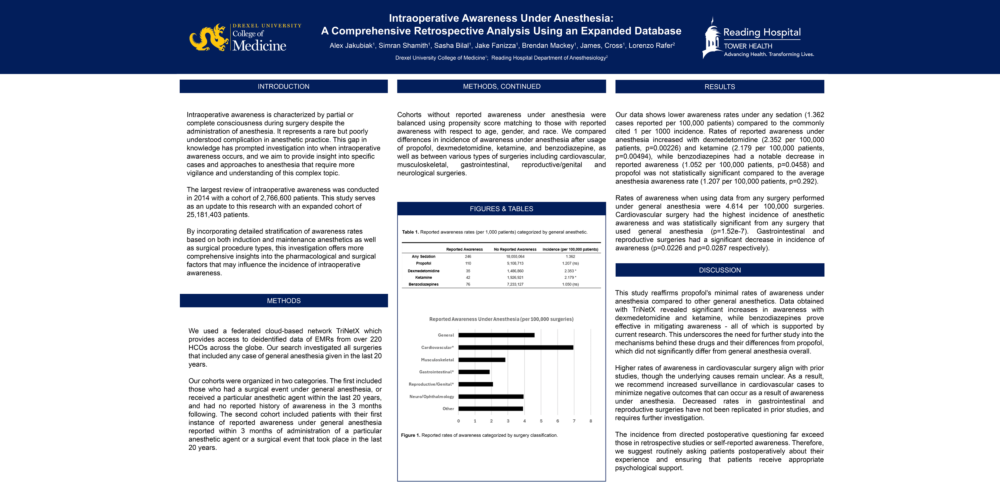
Our data shows lower awareness rates under any sedation (1.362 cases reported per 100,000 patients) compared to the commonly cited 1 per 1000 incidence. Rates of reported awareness under anesthesia increased with dexmedetomidine (2.352 per 100,000 patients, p=0.00226) and ketamine (2.179 per 100,000 patients, p=0.00494), while benzodiazepines had a notable decrease in reported awareness (1.052 per 100,000 patients, p=0.0458) and propofol was not statistically significant compared to the average anesthesia awareness rate (1.207 per 100,000 patients, p=0.292).
Rates of awareness when using data from any surgery performed under general anesthesia were 4.614 per 100,000 surgeries. Cardiovascular surgery had the highest incidence of anesthetic awareness and was statistically significant from any surgery that used general anesthesia (p=1.52e-7). Gastrointestinal and reproductive surgeries had a significant decrease in incidence of awareness (p=0.0226 and p=0.0287 respectively).
Discussion
This study reaffirms propofol's minimal rates of awareness under anesthesia compared to other general anesthetics. Data obtained with TriNetX revealed significant increases in awareness with dexmedetomidine and ketamine, while benzodiazepines prove effective in mitigating awareness - all of which is supported by current research. This underscores the need for further study into the mechanisms behind these drugs and their differences from propofol, which did not significantly differ from general anesthesia overall.
Higher rates of awareness in cardiovascular surgery align with prior studies, though the underlying causes remain unclear. As a result, we recommend increased surveillance in cardiovascular cases to minimize negative outcomes that can occur as a result of awareness under anesthesia. Decreased rates in gastrointestinal and reproductive surgeries have not been replicated in prior studies, and requires further investigation.
The incidence from directed postoperative questioning far exceed those in retrospective studies or self-reported awareness. Therefore, we suggest routinely asking patients postoperatively about their experience and ensuring that patients receive appropriate psychological support.