334 posters, 125 sessions, 831 authors, 236 institutions
ePostersLive by SciGen Technologies S.A. All rights reserved.
78th Annual PostGraduate Assembly in Anesthesiology (PGA78) 2024
December 6 - 9, 2024 | New York City

4098
Orotracheal vs Nasotracheal Pediatric Intubation: To Bleed or Not to Bleed. A Retrospective Chart Review
Poster Presenter
Part of Topic
Introduction:
Nasotracheal intubation is a common technique to provide a definitive airway during anesthesia for oral and maxillofacial surgery. Nasotracheal intubation provides unrestricted surgical access and stands as the standard alternative to orotracheal intubation in oral and maxilla facial procedures. There are many techniques utilized to intubate by nasal route, each with specific complications. Epistaxis from damage in the anterior portion of the nasal septum is the most common reported complication of nasotracheal intubation1. Literature has suggested the utilization of video laryngoscopy in nasotracheal intubation for oral and maxilla facial procedures, especially in children2. We hypothesize that there is no significant difference in the risk of oral or nasal pharyngeal bleeding following intubation in pediatric surgical dental procedures. Secondarily, we hypothesize that there is no significant difference between the use of video assistance and the risk of oral or nasal pharyngeal bleeding following intubation in this same population.
Methods:
Following IRB approval, a retrospective chart review was performed for pediatric patients undergoing dental procedures at a tertiary care pediatric center. The inclusion criteria were all children (age <18years) receiving dental procedures with a planned nasal intubation. The exclusion criteria were patients with congenital or acquired coagulopathies with increased propensity for bleed risk. Electronic medical records from May 2016 to March of 2024 were queried for multiple variables associated with intubation outcomes. The primary outcome variable was hemorrhage vs no hemorrhage following nasal or oral intubation. Hemorrhage is defined as the presence of any blood in the nasal or oral pharynx, or peri-glottic structures noted in the extracted anesthesia records following either intubation type. The secondary outcome variables were risk of hemorrhage with or without the use of video assistance. The data were analyzed using the chi-square test for proportions.
Results:
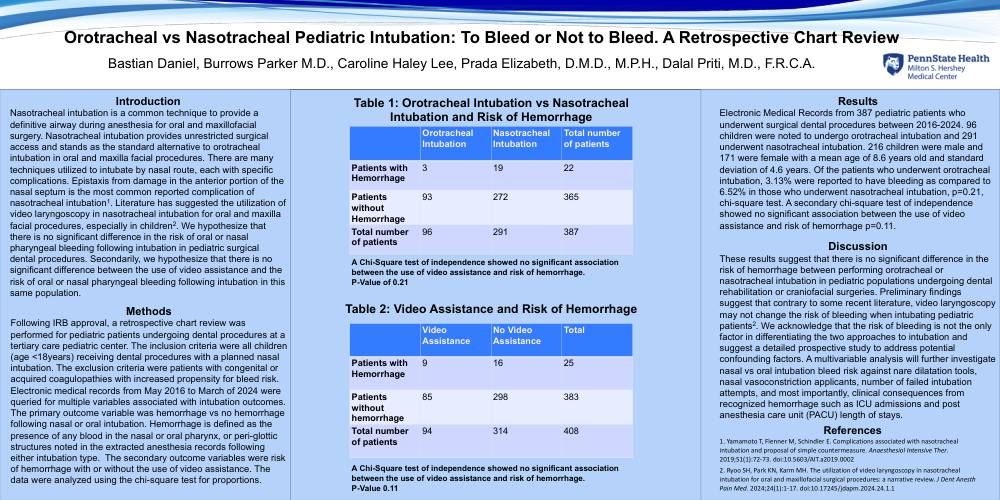
Electronic Medical Records from 387 pediatric patients who underwent surgical dental procedures between 2016-2024. 96 children were noted to undergo orotracheal intubation and 291 underwent nasotracheal intubation. 216 children were male and 171 were female with a mean age of 8.6 years old and standard deviation of 4.6 years. Of the patients who underwent orotracheal intubation, 3.13% were reported to have bleeding as compared to 6.52% in those who underwent nasotracheal intubation, p=0.21, chi-square test. A secondary chi-square test of independence showed no significant association between the use of video assistance and risk of hemorrhage p=0.11.
Discussion:
These results suggest that there is no significant difference in the risk of hemorrhage between performing orotracheal or nasotracheal intubation in pediatric populations undergoing dental rehabilitation or craniofacial surgeries. Preliminary findings suggest that contrary to some recent literature, video laryngoscopy may not change the risk of bleeding when intubating pediatric patients2. We acknowledge that the risk of bleeding is not the only factor in differentiating the two approaches to intubation and suggest a detailed prospective study to address potential confounding factors. A multivariable analysis will further investigate nasal vs oral intubation bleed risk against nare dilatation tools, nasal vasoconstriction applicants, number of failed intubation attempts, and most importantly, clinical consequences from recognized hemorrhage such as ICU admissions and post anesthesia care unit (PACU) length of stays.
References:
1. Yamamoto T, Flenner M, Schindler E. Complications associated with nasotracheal intubation and proposal of simple countermeasure. Anaesthesiol Intensive Ther. 2019;51(1):72-73. doi:10.5603/AIT.a2019.0002
2. Ryoo SH, Park KN, Karm MH. The utilization of video laryngoscopy in nasotracheal intubation for oral and maxillofacial surgical procedures: a narrative review. J Dent Anesth Pain Med. 2024;24(1):1-17. doi:10.17245/jdapm.2024.24.1.1