334 posters, 125 sessions, 831 authors, 236 institutions
ePostersLive by SciGen Technologies S.A. All rights reserved.
78th Annual PostGraduate Assembly in Anesthesiology (PGA78) 2024
December 6 - 9, 2024 | New York City

4089
Effect of desflurane versus sevoflurane on postoperative cardiac biomarkers in older adults undergoing minor- to moderate-risk noncardiac surgery
Poster Presenter
Authors
Nicole Hantakova, Nikolas Adamowitsch, Katharina Horvath, Alexander Taschner
Affiliations
Part of Topic
Effect of desflurane versus sevoflurane on postoperative cardiac biomarkers in older adults undergoing minor- to moderate-risk noncardiac surgery
Nicole Hantakova, MD; Katharina Horvath, MD; Nikolas Adamowitsch, MD; Edith Fleischmann, Prof.; Christian Reiterer, Prof., Alexander Taschner, MD
Department of Anesthesia, General Intensive Care Medicine and Pain Medicine, Medical University of Vienna, Austria
Introduction
Cardiac specific biomarkers are commonly elevated after non-cardiac surgery. (1) Studies have shown that volatile anesthetics exert myocardial protective effects. (2) In contrast to sevoflurane, desflurane additionally mitigated cell death after ischemic reperfusion injury (IRI) in animal trials. (3) Although sevoflumitochondria-drivenrane and desflurane are the most frequently used volatile anesthetics, studies comparing their myocardial protective effects are still limited. Therefore, we conducted a secondary analysis of a prospective randomized clinical trial, comparing the effects of sevoflurane versus desflurane on postoperative Troponin T, NT-proBNP and Copeptin concentrations.
Methods
This is a secondary analysis of a prospective randomized, observer-blinded, singlecenter clinical trial evaluating the effect of anesthesia with sevoflurane or desflurane on postoperative neurocognitive recovery times in older adults undergoing minor- to moderate-risk noncardiac surgery. Patients were randomized in a 1:1 ratio to receive either desflurane or sevoflurane for maintenance of anesthesia. We performed goaldirected administration of volatile anesthetics with target BIS values of 50±5. Blood parameters for the myocardial evaluation included Troponin T, NT-proBNP, and surgery, Copeptin, and were obtained shortly before induction of anesthesia, within one hour after and on the second day. Maximum concentrations of cardiac biomarkers were compared between groups using postoperative Wilcoxon tests. Difference between baseline and postoperative maximum concentrations of cardiac biomarkers were compared between groups using MannWhitney-U-tests.
Results
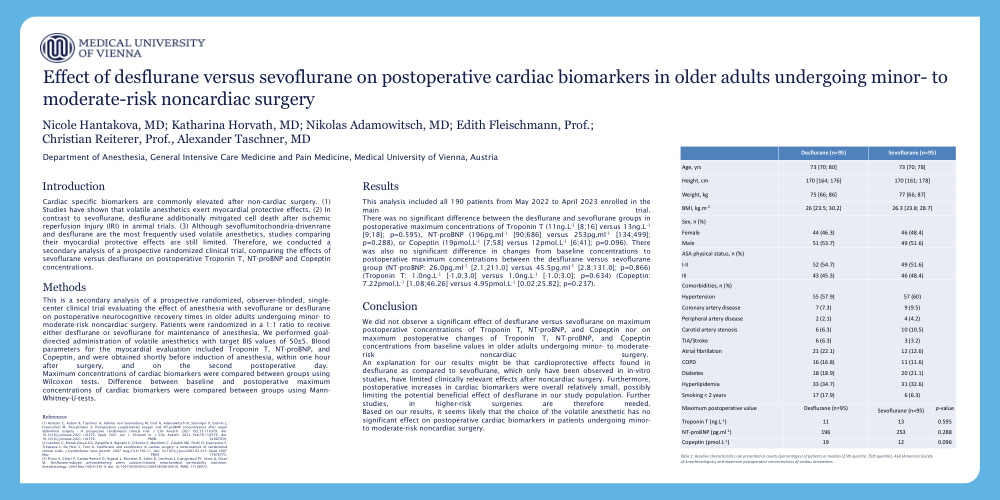
This analysis included all 190 patients from May 2022 to April 2023 enrolled in the main trial. There was no significant difference between the desflurane and sevoflurane groups in postoperative maximum concentrations of Troponin T (11ng.L-1 [8;16] versus 13ng.L-1 [9;18]; p=0.595), NT-proBNP (196pg.ml-1 [90;686] versus 253pg.ml-1 [134;499]; p=0.288), or Copeptin (19pmol.L-1 [7;58] versus 12pmol.L-1 [6;41]; p=0.096). There was also no significant difference in changes from baseline concentrations to postoperative maximum concentrations between the desflurane versus sevoflurane group (NT-proBNP: 26.0pg.ml-1 [2.1;211.0] versus 45.5pg.ml-1 [2.8;131.0]; p=0.866) (Troponin T: 1.0ng.L-1 [-1.0;3.0] versus 1.0ng.L-1 [-1.0;3.0]; p=0.634) (Copeptin: 7.22pmol.L-1 [1.08;46.26] versus 4.95pmol.L-1 [0.02;25.82]; p=0.237).
Conclusion
We did not observe a significant effect of desflurane versus sevoflurane on maximum postoperative concentrations of Troponin T, NT-proBNP, and Copeptin nor on maximum postoperative changes of Troponin T, NT-proBNP, and Copeptin concentrations from baseline values in older adults undergoing minor- to moderaterisk noncardiac surgery. An explanation for our results might be that cardioprotective effects found in desflurane as compared to sevoflurane, which only have been observed in in-vitro studies, have limited clinically relevant effects after noncardiac surgery. Furthermore, postoperative increases in cardiac biomarkers were overall relatively small, possibly in limiting the potential beneficial effect of desflurane in our study population. Further studies, higher-risk surgeries are needed. Based on our results, it seems likely that the choice of the volatile anesthetic has no therefore
References
(1) Reiterer C, Kabon B, Taschner A, Falkner von Sonnenburg M, Graf A, Adamowitsch N, Starlinger P, Goshin J, Fraunschiel M, Fleischmann E. Perioperative supplemental oxygen and NT-proBNP concentrations after major abdominal surgery- A prospective randomized clinical trial. J Clin Anesth. 2021 Oct;73:110379. doi: 10.1016/j.jclinane.2021.110379. Epub 2021 Jun 1. Erratum in: J Clin Anesth. 2022 Feb;76:110579. doi: 10.1016/j.jclinane.2021.110579. PMID: 34087659. (2) Landoni G, Biondi-Zoccai GG, Zangrillo A, Bignami E, D'Avolio S, Marchetti C, Calabrò MG, Fochi O, Guarracino F, Tritapepe L, De Hert S, Torri G. Desflurane and sevoflurane in cardiac surgery: a meta-analysis of randomized clinical trials. J Cardiothorac Vasc Anesth. 2007 Aug;21(4):502-11. doi: 10.1053/j.jvca.2007.02.013. Epub 2007 May 7. PMID: 17678775. (3) Piriou V, Chiari P, Gateau-Roesch O, Argaud L, Muntean D, Salles D, Loufouat J, Gueugniaud PY, Lehot JJ, Ovize M. Desflurane-induced preconditioning alters calcium-induced mitochondrial permeability transition. Anesthesiology. 2004 Mar;100(3):581-8. doi: 10.1097/00000542-200403000-00018. PMID: 15108972. significant effect on postoperative cardiac biomarkers in patients undergoing minorto moderate-risk noncardiac surgery.