334 posters, 125 sessions, 831 authors, 236 institutions
ePostersLive by SciGen Technologies S.A. All rights reserved.
78th Annual PostGraduate Assembly in Anesthesiology (PGA78) 2024
December 6 - 9, 2024 | New York City

4086
Association between Perioperative Copeptin Concentrations and the Incidence of Postoperative Nausea and Vomiting
Poster Presenter
Part of Topic
Association between Perioperative Copeptin Concentrations and the Incidence of Postoperative Nausea and Vomiting
Horvath K., MD; Kabon B., Prof. MD; Fleischmann E., Prof. MD; Taschner A., MD; Hantakova N., MD; Hochreiter B., Bsc., MD; Adamowitsch N., MD; Reiterer C., Prof. MD
Introduction/hypothesis
Postoperative nausea and vomiting (PONV) is a common and distressing complication after general anesthesia and is associated with patient discomfort and a delayed discharge from post anesthesia care unit (PACU).1 Previous studies indicated that preoperatively elevated stress levels are a potential trigger factor for PONV.2 Copeptin is a relatively novel biomarker to assess stress objectively. Specifically, a previous study in 173 patients undergoing non-cardiac surgery has shown that postoperative Copeptin concentrations reflect physiological stress levels caused by surgery.3 However, the association between preoperative Copeptin concentrations and PONV after non-cardiac surgery is still lacking.
Thus, we evaluate in this sub-study the predictive value between pre- and postoperative Copeptin concentrations and PONV in women undergoing minor- to moderate-risk noncardiac surgery.
Study design/methods
In this sub-study of a prospective randomized trial, we included 178 women between 18 and 50 years of age undergoing minor- to moderate-risk noncardiac surgery.
We assessed nausea on a 100mm visual analog scale (VAS) and episodes of vomiting during PACU stay for the first two postoperative hours (= early PONV) as well as on the first three postoperative days (= late PONV). A PONV episode was defined as the occurrence of nausea (VAS ≥ 50mm) and/or vomiting. Copeptin was measured shortly before induction of anesthesia and within one hour after PACU arrival. We compared the median differences of pre- and postoperative Copeptin concentrations using a Wilcoxon signed-rank test.
We performed a receiver-operating characteristics (ROC) curve to evaluate the predictive value of preoperative Copeptin concentrations on the occurrence of overall PONV and postoperative Copeptin concentrations on late PONV. We used the Youden Index to identify the cut of value for optimized sensitivity and specificity.
Results
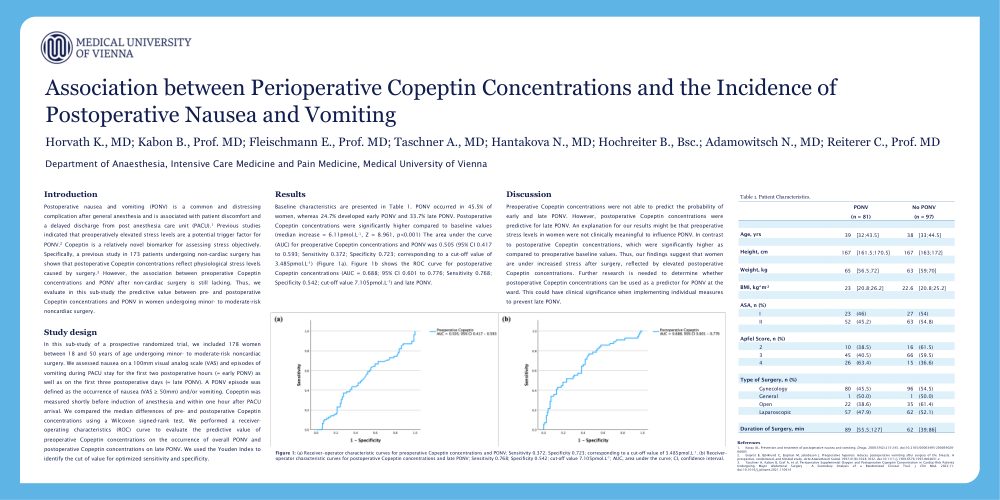
Baseline characteristics are presented in Table 1. PONV occurred in 45.5% of women, whereas 24.7% developed early PONV and 33.7% late PONV. Postoperative Copeptin concentrations were significantly higher compared to baseline values (median increase = 6.11pmol.L-1, Z = 8.961, p<0.001)
The area under the curve (AUC) for preoperative Copeptin concentrations and PONV was 0.505 (95% CI 0.417 to 0.593; Sensitivity 0.372; Specificity 0.723; corresponding to a cut-off value of 3.485pmol.L-1) (Figure 1). Figure 2 shows the ROC curve for postoperative Copeptin concentrations (AUC = 0.688; 95% CI 0.601 to 0.776; Sensitivity 0.768; Specificity 0.542; cut-off value 7.105pmol.L-1) and late PONV.
Discussion
Preoperative Copeptin concentrations were not able to predict the probability of early and late PONV. However, postoperative Copeptin concentrations were predictive for late PONV.
An explanation for our results might be, that preoperative stress levels in women were not clinically meaningful to influence PONV. In contrast to postoperative Copeptin concentrations, which were significantly higher as compared to preoperative baseline values. Thus, our findings suggest that women are under increased stress after surgery, reflected by elevated postoperative Copeptin concentrations. Further research is needed to determine whether postoperative Copeptin concentrations can be used as a predictor for PONV at the ward. This could have clinical significance when implementing individual measures to prevent late PONV.
1. Kovac AL. Prevention and treatment of postoperative nausea and vomiting. Drugs. 2000;59(2):213-243. doi:10.2165/00003495-200059020-00005
2. Enqvist B, Björklund C, Engman M, Jakobsson J. Preoperative hypnosis reduces postoperative vomiting after surgery of the breasts. A prospective, randomized, and blinded study. Acta Anaesthesiol Scand. 1997;41(8):1028-1032. doi:10.1111/j.1399-6576.1997.tb04831.x
3. Taschner A, Kabon B, Graf A, et al. Perioperative Supplemental Oxygen and Postoperative Copeptin Concentration in Cardiac-Risk Patients Undergoing Major Abdominal Surgery - A Secondary Analysis of a Randomized Clinical Trail. J Clin Med. 2022;11. doi:10.1016/j.jclinane.2021.110614