334 posters, 125 sessions, 831 authors, 236 institutions
ePostersLive by SciGen Technologies S.A. All rights reserved.
78th Annual PostGraduate Assembly in Anesthesiology (PGA78) 2024
December 6 - 9, 2024 | New York City

4085
Instruments for Pain Assessment in Autism Spectrum Disorders - a systematic review on validated tools
Poster Presenter
Part of Topic
Instruments for Pain Assessment in Autism Spectrum Disorders - a Systematic Review on Validated Tools
Introduction
Pervasive developmental disorders such as autism spectrum disorder (ASD) begin in early childhood, and although the symptoms of ASD are mainly neurological, they do manifest themselves in a variety of behavioral characteristics that depend on age, language, and cognitive abilities. In the United States alone, the prevalence of ASD among children and adolescents increased from 2.24% in 2014 to 3.49% in 2020 and is three times higher among boys compared to girls. Pain is likely a significant source of suffering for ASD patients, especially when presented with comorbidities. While pain measurement is a prerequisite for analgesic treatment, pain assessment may be challenging in patients with impaired cognitive and/or communicative abilities. Therefore, this systematic review aimed to identify and discuss validated pain assessment tools for ASD, as a lack of validation may itself contribute to inadequate recognition and management of pain in such patients.
Methods
This study followed the Preferred Reporting Items for Systematic Reviews and Meta-Analyses (PRISMA) guidelines. Our search strategy involved a comprehensive electronic search of PubMed and Web of Science databases till June 2022 for articles reporting methods of pain measurement in children, adolescents, or adults diagnosed with ASD and examined them for their internal and external validity. The authors independently reviewed identified articles. After a title and abstract screening, a consensus was reached regarding articles to be included for full-text screening.
Results
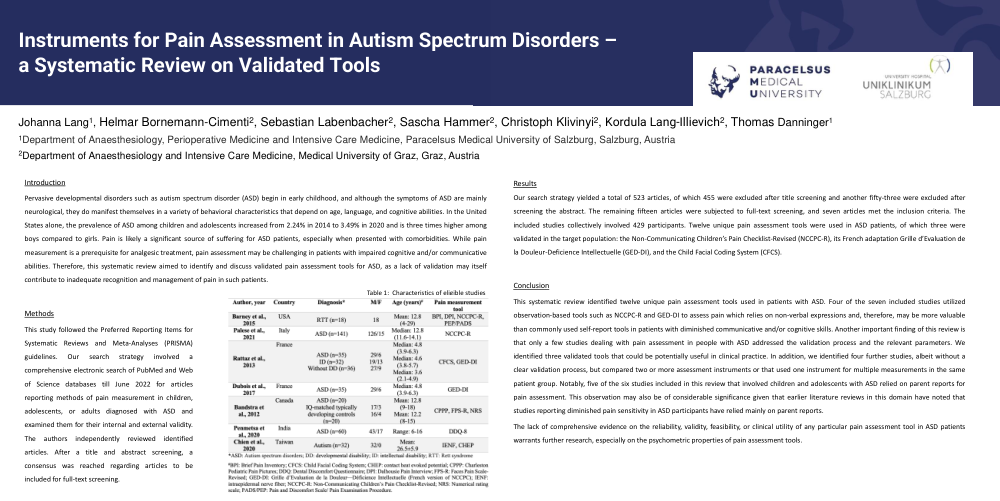
Our search strategy yielded a total of 523 articles, of which 455 were excluded after title screening and another fifty-three were excluded after screening the abstract. The remaining fifteen articles were subjected to full-text screening, and seven articles met the inclusion criteria. The included studies collectively involved 429 participants. Twelve unique pain assessment tools were used in ASD patients, of which three were validated in the target population: the Non-Communicating Children’s Pain Checklist-Revised (NCCPC-R), its French adaptation Grille d’Evaluation de la Douleur-Deficience Intellectuelle (GED-DI), and the Child Facial Coding System (CFCS).
Conclusion
This systematic review identified twelve unique pain assessment tools used in patients with ASD. Four of the seven included studies utilized observation-based tools such as NCCPC-R and GED-DI to assess pain which relies on non-verbal expressions and, therefore, may be more valuable than commonly used self-report tools in patients with diminished communicative and/or cognitive skills. Another important finding of this review is that only a few studies dealing with pain assessment in people with ASD addressed the validation process and the relevant parameters. We identified three validated tools that could be potentially useful in clinical practice. In addition, we identified four further studies, albeit without a clear validation process, but compared two or more assessment instruments or that used one instrument for multiple measurements in the same patient group. Notably, five of the six studies included in this review that involved children and adolescents with ASD relied on parent reports for pain assessment. This observation may also be of considerable significance given that earlier literature reviews in this domain have noted that studies reporting diminished pain sensitivity in ASD participants have relied mainly on parent reports.
The lack of comprehensive evidence on the reliability, validity, feasibility, or clinical utility of any particular pain assessment tool in ASD patients warrants further research, especially on the psychometric properties of pain assessment tools.